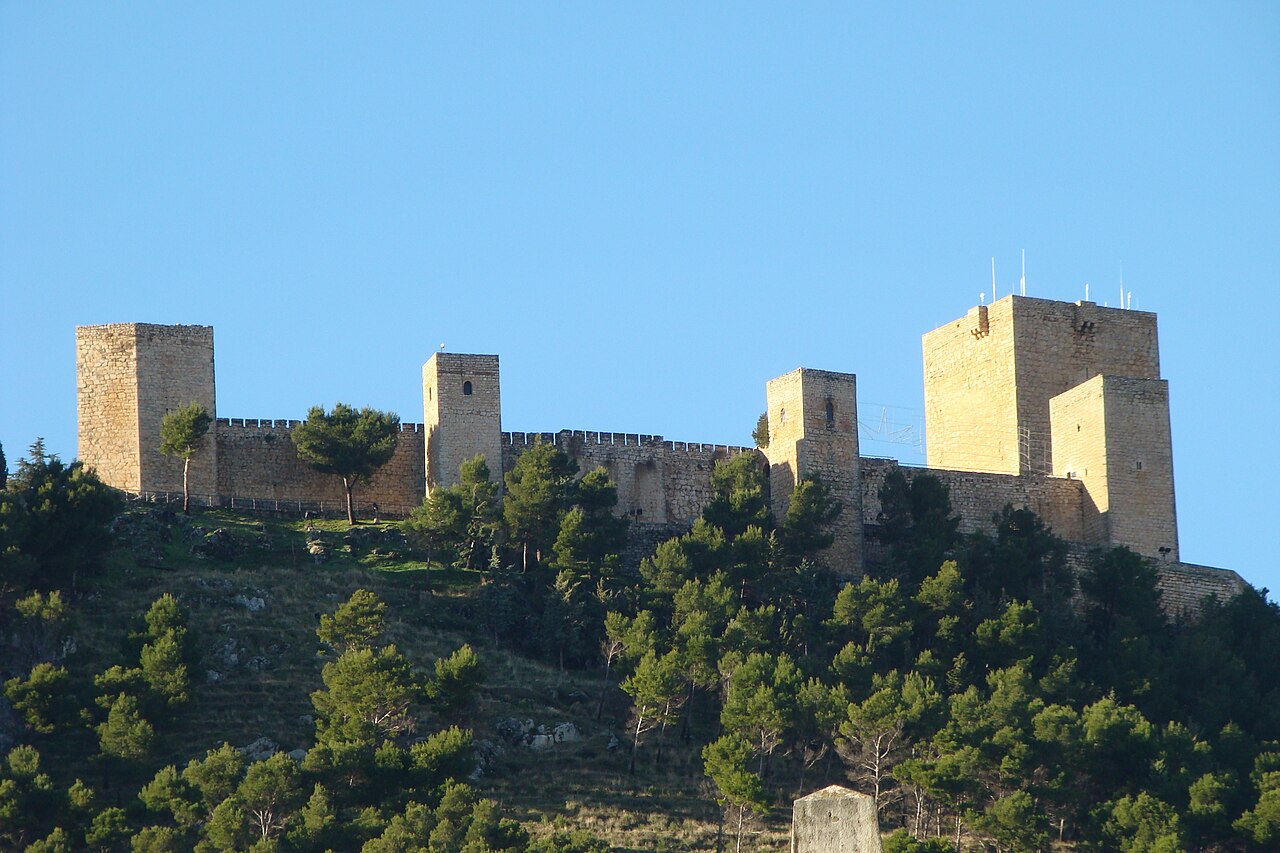
La Guardia de Jaén Castle
La Guardia de Jaén castle is a prominent hill castle located in the town of La Guardia de Jaén, Spain. It dominates the surrounding landscape and the valley of the river Guadalbullón, occupying a strategic position that has shaped its history since the 11th century. Originally built to control an important passageway, the castle evolved through centuries of military and residential use, reflecting the complex history of the region from the High Medieval period onward.
Historical background and strategic importance
The site of La Guardia de Jaén castle has a long history predating the medieval fortress. It corresponds to the ancient city of Mentesa Bastia, a Roman settlement built over an earlier Iberian oppidum. During Roman times, Mentesa Bastia was a key military post along important routes connecting cities such as Acci (modern Guadix), Cástulo, and Aurgi. It also served as a bishopric seat from the early 4th century until the late 7th century, indicating its significance in early Christian history.
In the Islamic period, the settlement was known as Mantisa and became the capital of one of the oldest cities in the Cora of Yayyan. The fortress was adapted and expanded using the remains of Roman and Iberian fortifications, benefiting from abundant water sources and fertile land. This made it a vital stronghold in the region.
Following the Christian reconquest, La Guardia was taken by Ferdinand III in 1244, before the conquest of Jaén itself. The castle then gained renewed strategic importance as a frontier fortress guarding the Christian kingdom against the Nasrid Kingdom of Granada. This role lasted for over two centuries, with La Guardia and nearby Pegalajar serving as key defensive positions along the border.
Architectural features and layout
The castle’s plan is an irregular triangle, divided into two main parts: the Alcázar and the Alcazaba. The Alcázar, located at the northeast corner, was built in the 15th century and refurbished in the 16th century to serve as a palatial residence. It is protected by four towers: one original Muslim rounded tower, two square towers, and the imposing keep (Torre del Homenaje), which rises to 35 meters with a square base.
The Alcazaba is a fortified enclosure built mainly in the 13th century. Its zig-zag walls provided effective defense, making additional towers unnecessary except for one on the eastern wall guarding the main entrance. The main gate is a large late Gothic door constructed in the 16th century, reflecting the castle’s transformation from a military fortress to a noble residence.
The Alcázar’s towers and defenses
The southwest corner features the large original Muslim circular tower, built with masonry and rammed earth, notable for its thick walls and preserved battlement walkway (adarve). The south wall has a small square tower with a barrel vault ceiling, while the northeast corner hosts a two-story rectangular tower with a pointed barrel vault on the upper floor. The keep is divided into three levels: a solid rock foundation, an octagonal middle floor with arrow slits and the main entrance, and a vaulted top floor illuminated by windows.
Water cisterns and internal structures
Inside the Alcázar, two main sectors stand out. The southern sector contains cisterns (aljibes) built in different periods, including an Islamic-era cistern made with lime, gravel, and rammed earth, and a later Castilian masonry cistern. The northern sector includes a small courtyard providing access to the keep and adjacent towers, illustrating the castle’s complex internal circulation.
Historical events and transformations
Throughout its history, La Guardia de Jaén castle witnessed numerous conflicts. In 1425, a battle resulted in the capture of Archbishop Don Gonzalo. In 1460, during a Muslim incursion, Miguel Lucas de Iranzo, the Constable of Jaén, was arrested within the castle. These events underscore the castle’s continued military relevance during the late medieval period.
With the decline of the Nasrid threat by the late 15th century, the castle’s military function diminished. It was extensively remodeled into a palatial residence for the Mexía family, a prominent noble lineage that owned the castle until the 19th century. This transformation included replacing earthen walls with masonry, raising towers, and constructing new residential buildings within the fortress.
During the Napoleonic Wars, the castle was still occupied and functional. However, retreating French troops set fire to the fortress in 1812, causing significant damage. Since then, the castle has fallen into partial ruin, though restoration efforts have preserved key elements such as the Alcázar and the church bell tower.
Religious and ancillary buildings
Within the northeastern external enclosure stands the church of Santa María, built on a rectangular plan with six side chapels. The church incorporates part of the castle’s defensive structure, including a former tower integrated into its apse. The bell tower was constructed atop earlier fortification elements, linking the religious and military architecture.
Additional buildings from the late medieval and early modern periods include two-level residential quarters with cellars, storage rooms, kitchens, and courtyards, reflecting the castle’s role as a noble estate beyond its military origins.
Current condition and preservation
Today, La Guardia de Jaén castle stands as a partially preserved monument showcasing layers of history from Iberian, Roman, Muslim, and Christian periods. The castle’s complex architecture, including its towers, walls, gates, and internal structures, offers valuable insights into medieval military and residential design in southern Spain.
Ongoing restoration and archaeological work continue to reveal new details about the castle’s evolution and significance. Visitors can explore the Alcázar, the church of Santa María, and sections of the Alcazaba, appreciating the site’s strategic importance and architectural diversity.
Frequently asked questions (FAQ)
- How do I get to La Guardia de Jaén castle?
- La Guardia de Jaén castle is located in the town of La Guardia de Jaén, in the province of Jaén, Spain. It is accessible by car via local roads connecting to the main highways. Visitors can reach the castle by walking from the town center, which is a short distance away.
- What is the best time to visit La Guardia de Jaén castle?
- The best time to visit La Guardia de Jaén castle is during the spring and autumn months when the weather is mild and pleasant. Summers can be hot, and winters may be cooler, so planning visits in moderate seasons offers a more comfortable experience.
- Is La Guardia de Jaén castle open to the public?
- Yes, La Guardia de Jaén castle is open to the public. Visitors can explore the Alcázar, the church of Santa María, and parts of the Alcazaba enclosure. Opening hours may vary seasonally, so it is advisable to check local tourist information before planning a visit.
- What architectural styles are represented in La Guardia de Jaén castle?
- La Guardia de Jaén castle features a blend of architectural styles, primarily <strong>Islamic military architecture</strong> from the Muslim period and <strong>late Gothic</strong> elements from the Christian remodeling in the 15th and 16th centuries. The combination reflects the castle’s historical transitions.
- Can I visit the church of Santa María within the castle?
- Yes, the church of Santa María is part of the castle complex and can be visited. It is notable for incorporating former defensive towers into its structure and offers insight into the religious and military functions coexisting within the fortress.
Information
Sources & official resources
Verify the information above using these authoritative references.
Loading map...
Visitor reviews
No reviews yet. Been here? Write the first review and help other travelers!
Write the first reviewVisited this castle? Share your experience
Your review helps other travelers and adds first-hand knowledge to our encyclopedia.