
Sagonne Castle
Sagonne Castle, also known as Château de Sagonne, is a remarkable medieval fortress located in the village of Sagonne within the Cher department of central France. This castle stands on a site rich in history, with archaeological evidence tracing human settlement back to Gallo-Roman times. The earliest written records date to the 9th century, when the domain was part of the dowry of Agane, daughter of Wicfried, Count of Bourges. Strategically positioned on a historic Roman road connecting Lyon to Bourges, the castle was built to control vital routes and defend the region.
The castle's origins are closely linked to the Counts of Sancerre, who held the seigneury from the 10th century. The main fortress was constructed in the first half of the 13th century under Louis I, Count of Sancerre, to protect the road from Bourges to Sancoins. Over time, it evolved into a formidable stronghold, particularly during the Hundred Years' War in the 14th century, when it successfully resisted English attacks. In 1373, a coalition led by the lords of Sagonne and Grossouvre, alongside the renowned French military commander Bertrand du Guesclin, expelled English forces from the region.
Medieval origins and strategic importance
The castle was originally a hilltop fortress featuring a fortified enclosure with eight towers and two gateways, surrounded by water-filled moats fed by the nearby Sagonin stream. Defensive features such as machicolations, arrow slits, cannon embrasures, murder holes, and portcullis grooves highlight its military design. Four towers with sloping bases and vaulted ground floors remain, some partially submerged in the moat, illustrating the castle's original defensive layout.
The courtyard façade primarily dates from the 15th century, showcasing moulded windows and original decorative door moldings. Architectural modifications in the 18th century introduced new openings and altered the castle’s appearance, reflecting changing tastes and functions.
Ownership transitions and architectural evolution
In 1428, the castle passed to the House of Amboise through the marriage of Anne de Bueil, heiress of the Sancerre family, to Pierre d’Amboise, a companion of Joan of Arc. The Amboises maintained ownership until 1542, when Jean Babou, Grand Master of Artillery of France, acquired the estate. The Babou family implemented significant alterations during the 16th century, adapting the fortress to contemporary needs.
The late 17th century marked a pivotal moment when the castle was acquired by the celebrated Baroque architect Jules Hardouin-Mansart in 1699. Mansart, renowned for his work on Versailles and the Grand Trianon, undertook extensive renovations between 1700 and 1703. His modifications included demolishing the eastern curtain walls to create a grand avenue and entrance courtyard, adding a new wing known as the "aile de Monsieur," and constructing a chapel adorned with trompe-l’œil paintings and pink Languedoc marble columns. These changes transformed the medieval fortress into a residence reflecting Baroque tastes and comfort.
Gardens and landscape design
Mansart also designed extensive French formal gardens featuring a long tree-lined avenue crossing the moat via intersecting bridges, an orangery built in 1703, and a large northern building. Although often mistakenly attributed to André Le Nôtre, the gardens were Mansart's own creation, embodying the grandeur and symmetry characteristic of the Baroque era.
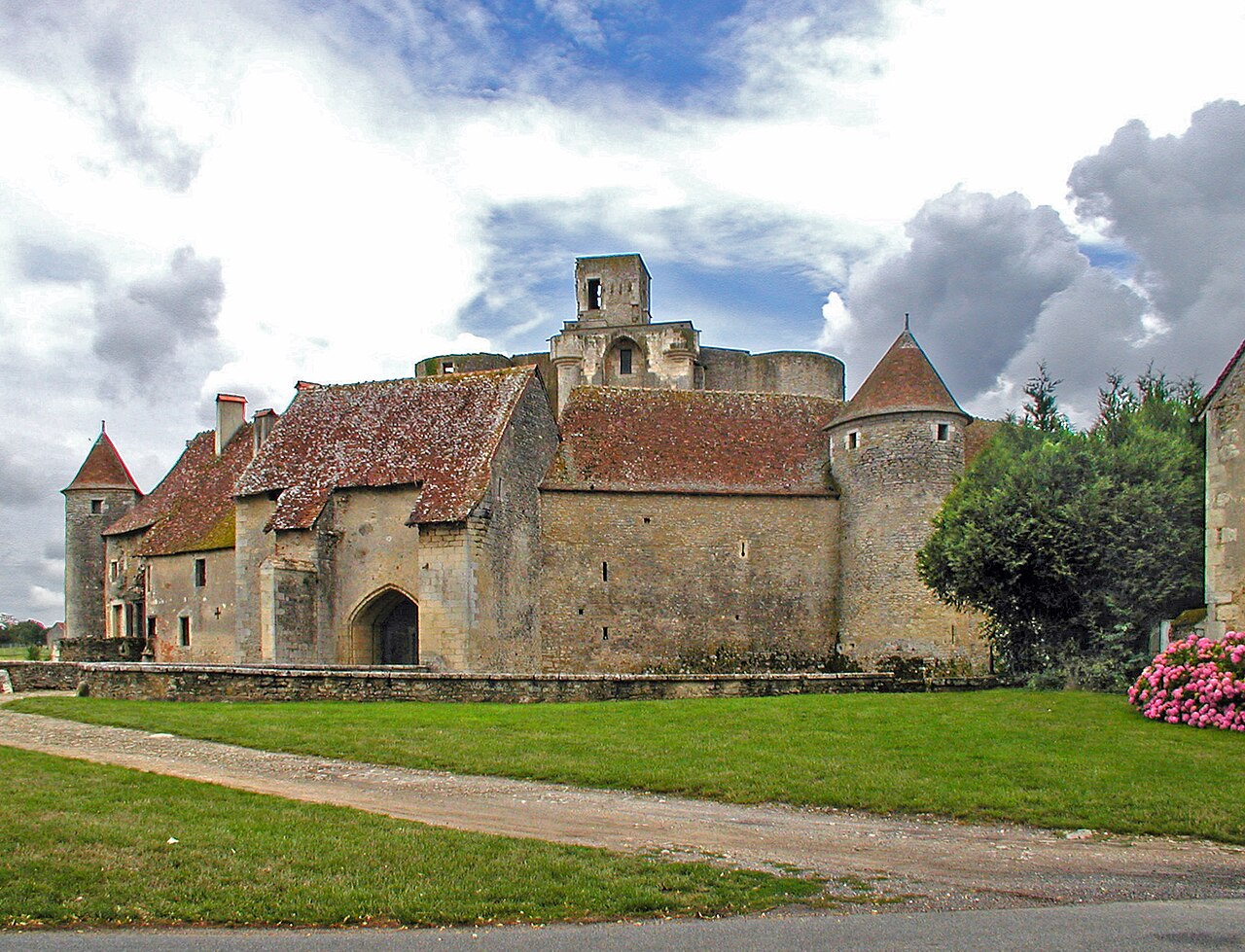
Photo by sybarite48 • CC BY 2.0
Decline and restoration
The castle remained in the Mansart family until the French Revolution, when Anne Claude Louise d’Arpajon, a lady-in-waiting to Queen Marie Antoinette and descendant of the owners, was guillotined in 1794. Subsequently, the castle was looted, its roofs dismantled for lead, and the site fell into ruin. Parts of the castle were repurposed for agricultural use, and the fortress became a quarry for local building materials.
Despite its decline, the castle was classified as a monument historique by the French Ministry of Culture in 1914, recognizing its cultural and architectural significance. Restoration efforts began in 1977 when a private individual purchased the ruins and collaborated with a volunteer organization to rebuild and preserve the medieval sections. Today, the castle is partially restored and open to the public, offering visitors access to the interior of the keep, furnished rooms, 17th-century frescoes, weapons, portraits, and the Mansart Museum.
Architectural features and surviving elements
The castle's medieval core includes a large keep (donjon) and remnants of the fortified enceinte. Defensive elements such as machicolations and arrow slits remain visible, alongside structural features like vaulted ground floors and sloping tower bases. The courtyard façade retains its 15th-century character with original window and door moldings. Mansart's 18th-century additions, including the chapel and the "aile de Monsieur," illustrate the blend of medieval fortification and Baroque residential architecture.
The site also features a three-hectare arboretum and gardens inspired by the designs of Mansart and his followers, open to visitors for a fee. While the classical 18th-century sections have largely disappeared, the medieval parts have been sensitively restored, preserving the castle's historical integrity.
Visiting sagonne castle today
Visitors to Sagonne Castle can explore its rich history through guided tours that showcase the castle's architectural evolution from a medieval fortress to a Baroque residence. The castle is typically open from June to September, with an entrance fee required. The interior includes access to the keep, decorated rooms, and the Mansart Museum, providing a comprehensive insight into the castle's past and the lives of its notable owners.
Nearby, the Jouy Tower complements the historical landscape, offering additional context to the region's medieval defenses. The castle's location in Cher places it within reach of other cultural and historical attractions, making it a valuable destination for those interested in French medieval and Baroque heritage.
Frequently asked questions (FAQ)
- When was Sagonne Castle originally built?
- Sagonne Castle was originally built in the first half of the 13th century under Louis I, Count of Sancerre, to protect the road from Bourges to Sancoins.
- What architectural styles are present at Sagonne Castle?
- The castle features a mix of medieval fortification elements and Baroque residential additions, notably from architect Jules Hardouin-Mansart in the early 18th century.
- Is Sagonne Castle open to the public?
- Yes, Sagonne Castle is open to visitors from June to September, with an entrance fee required to access the castle and its grounds.
- What notable historical events took place at Sagonne Castle?
- During the Hundred Years' War, the castle resisted English attacks and was involved in a 1373 expedition led by Bertrand du Guesclin to drive English forces from the region.
- Who was Jules Hardouin-Mansart and what was his role at Sagonne Castle?
- Jules Hardouin-Mansart was a prominent Baroque architect who acquired Sagonne Castle in 1699 and undertook significant renovations, including adding a chapel and formal gardens.
Photo gallery

Information
Opening hours
June to September, daily
Ticket prices
Entrance fee applies
Current owner
Private owner
Website
Visit websiteAddress
Place du Château, 18600 Sagonne, France
Sources & official resources
Verify the information above using these authoritative references.
Loading map...
Visitor reviews
No reviews yet. Been here? Write the first review and help other travelers!
Write the first reviewVisited this castle? Share your experience
Your review helps other travelers and adds first-hand knowledge to our encyclopedia.