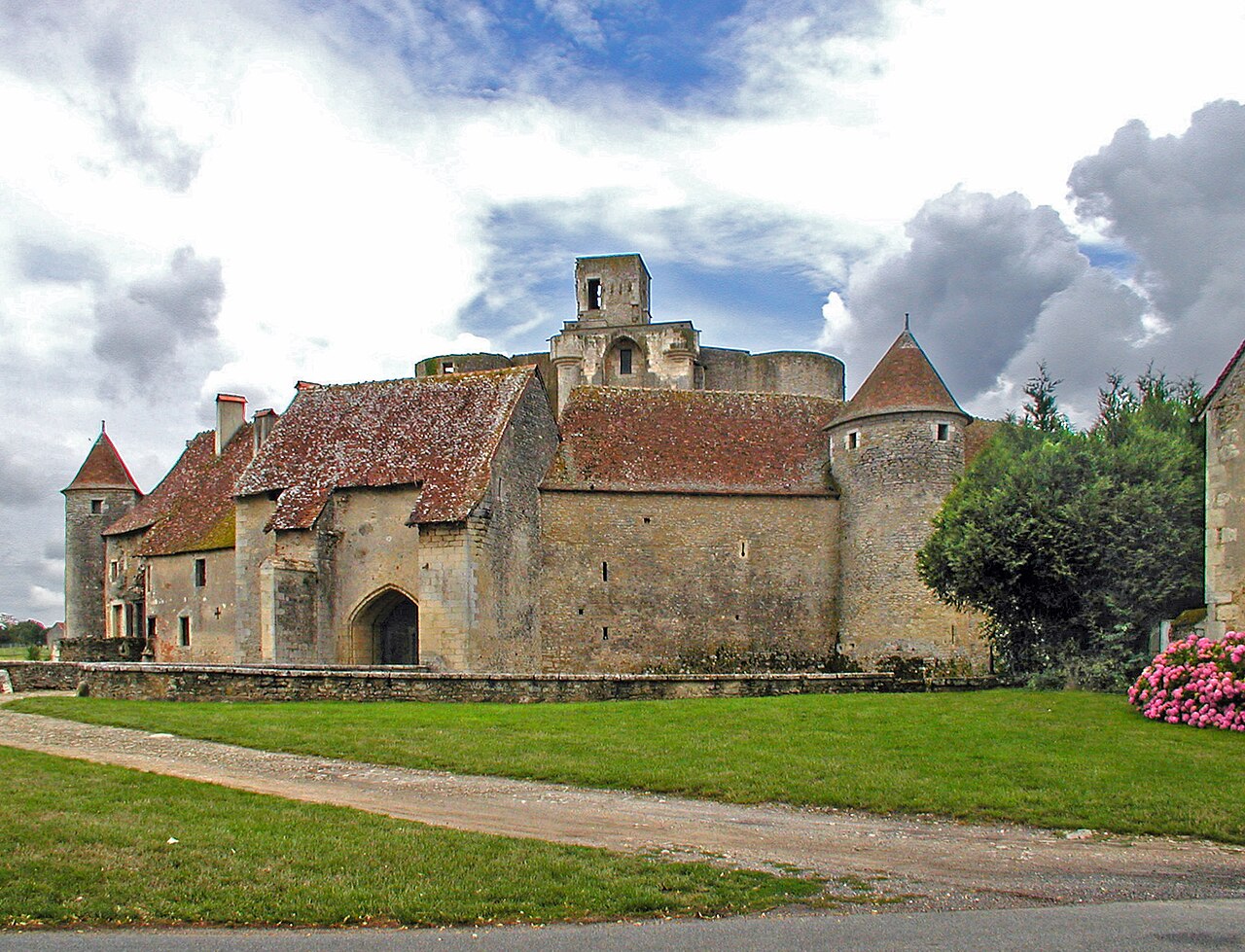
Jouy Tower
Jouy Tower, known locally as Donjon de Jouy, is a significant medieval fortress located in the hamlet of Jouy within the Cher department of France. This imposing structure stands as a witness to centuries of military and noble history, with origins tracing back to Roman times and evolving through the Middle Ages into a stately residence before falling into ruin.
The strategic location of Jouy Tower next to the ancient Roman road D-41 suggests its site was initially used by the Romans as a military camp. This early use underscores the long-standing importance of the site for defense and control of regional routes. On the foundations of this Roman camp, a fortified monastery was established in the 7th century, serving religious and defensive purposes until it was destroyed by invading Hungarian forces during the 8th or 9th century.
Construction and medieval significance
The current structure of Jouy Tower was constructed in 1191 by Peter II of Courtenay, Count of Nevers and cousin by marriage to King Philip II of France. This construction marked the transition of the site from a religious fortification to a military stronghold. The tower was originally a 27-meter-high keep featuring round corner towers, a design typical of the high medieval period that enhanced its defensive capabilities.
Throughout the 12th to 14th centuries, Jouy Tower was under the possession of the Counts of Sancerre, who also controlled the nearby Sagonne Castle. This period was marked by the tower's role as a feudal stronghold, overseeing and protecting the surrounding lands.
Role during the hundred years' war
The Hundred Years' War (1337–1453) brought significant turmoil to the region. Between 1356 and 1373, the area around Jouy Tower was ravaged by the troops of Edward the Black Prince, son of King Edward III of England. Historical accounts indicate that the tower was held by English forces around 1361, demonstrating its strategic value in the conflict.
In 1373, a combined force led by the lords of Sagonne and Grossouvre along with the renowned Breton knight and French commander Bertrand du Guesclin successfully expelled the English from the region. This victory restored French control over the tower and surrounding lands.
Post-war modifications and decline
Following the English departure, the tower came into the possession of the House of Giac, who transformed it from a purely military fortress into a stately residence. These modifications included enhancements to living quarters and possibly the addition of more comfortable domestic spaces, reflecting the changing needs and tastes of noble owners during the late medieval period.
In 1428, the assets of the House of Giac were confiscated and transferred to Louis I de Bourbon, Count of Montpensier. Over the next century and a half, the castle changed hands multiple times through inheritance, reflecting the complex feudal and dynastic politics of the era.
Impact of the french wars of religion
The French Wars of Religion in the second half of the 16th century brought further strife to Jouy Tower. In 1591, the fortress was seized by the troops of the Catholic League. It is believed that during this occupation, the castle was deliberately dismantled and set on fire, leading to its ruinous state.
After this period, Jouy Tower remained in ruins and became part of the County of Sagonne. The counts retained ownership until the French Revolution at the end of the 18th century, when their properties were confiscated, declared Bien Nationaux, and sold off.
Later history and present condition
Following its sale post-Revolution, the remains of Jouy Tower were used as a quarry for building materials, a common fate for many ruined castles. Despite this, the tower's ruins have endured and today it stands as a beautiful ruin that reflects its layered history.
The castle is currently privately owned. During the summer months, the garden surrounding the keep hosts exhibitions of contemporary art, blending the medieval heritage with modern cultural activities. This use highlights the ongoing relevance and adaptive reuse of historic sites.
Architectural features and layout
Jouy Tower's original design included a tall keep with round corner towers, a defensive feature that provided wider angles of surveillance and protection against siege engines. The height of the keep, approximately 27 meters, made it a dominant feature in the landscape, serving both as a lookout and a symbol of feudal power.
The modifications by the House of Giac likely introduced more refined residential elements, though much of the detailed interior layout has been lost due to destruction and decay. The surrounding fortifications, if any, have not survived extensively, but the tower itself remains a testament to medieval military architecture.
Historical significance and cultural heritage
Jouy Tower is a notable example of a high medieval keep that transitioned through various phases of military, residential, and ruinous use. Its connection to prominent historical figures such as Peter II of Courtenay and Bertrand du Guesclin situates it within the broader narrative of French medieval history.
The tower's endurance through the Hundred Years' War, the French Wars of Religion, and the upheavals of the French Revolution illustrates the shifting political and social dynamics of the region over several centuries.
Today, Jouy Tower serves not only as a cultural landmark but also as a venue for artistic expression, linking its medieval past with contemporary creativity. Its preservation as a ruined castle allows visitors to engage with France's layered history and appreciate the architectural legacy of the high medieval period.
Frequently asked questions (FAQ)
- How do I get to Jouy Tower?
- Jouy Tower is conveniently located next to the D-41 road in France, making it easily accessible by car. If you are using public transportation, check local bus services that may connect to nearby towns.
- What is the historical significance of Jouy Tower?
- Jouy Tower dates back to the medieval period and served as a defensive structure during various conflicts in the region. Its architecture reflects the military strategies of the time, offering insight into the historical context of France.
- When was Jouy Tower built?
- Jouy Tower was constructed in the late 12th century, making it a significant example of early medieval architecture. Its age adds to the charm and historical value of the site, drawing visitors interested in France's rich history.
- Can I visit Jouy Tower year-round?
- Yes, Jouy Tower is open to visitors year-round, but it's advisable to check for any seasonal hours or maintenance closures. Planning your visit ahead of time ensures you have the best experience possible.
- Why is Jouy Tower an important architectural site?
- Jouy Tower showcases unique architectural features from the medieval era, including its sturdy stone construction and defensive design. It represents the evolution of military architecture in France, making it a fascinating site for history and architecture enthusiasts.
- Is it possible to take guided tours at Jouy Tower?
- Yes, guided tours are available at Jouy Tower, providing visitors with in-depth knowledge about its history and architecture. These tours enhance the experience and offer a deeper understanding of the site's significance.
- What are the opening hours for Jouy Tower?
- Jouy Tower generally opens to the public from 10 AM to 5 PM, with extended hours during the summer months. It's best to check the official website or local tourist information for any updates on opening times.
- What are the ticket prices for visiting Jouy Tower?
- Admission to Jouy Tower is typically affordable, with adult tickets priced around €5 and reduced rates for children and seniors. Special family packages may also be available, allowing for an economical visit.
- What are some nearby attractions to Jouy Tower?
- In addition to Jouy Tower, visitors can explore nearby historical sites such as the Château de Jouy and beautiful natural parks. These attractions provide a comprehensive experience of the region's history and landscape.
Loading map...
Visitor reviews
No reviews yet. Been here? Write the first review and help other travelers!
Write the first reviewVisited this castle? Share your experience
Your review helps other travelers and adds first-hand knowledge to our encyclopedia.