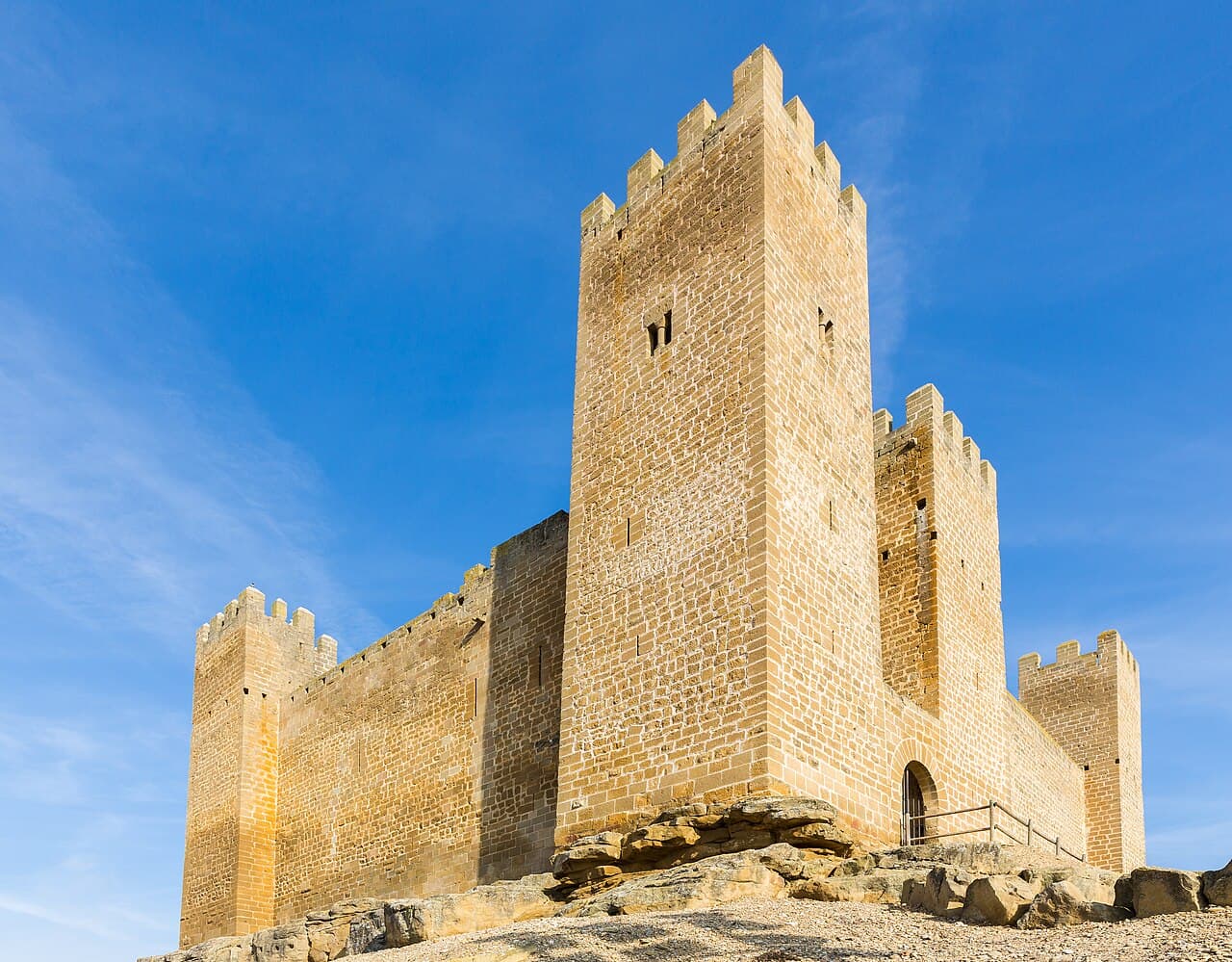
Sadaba Castle
Sadaba Castle stands prominently on a small hill in the village of Sadaba, within the province of Zaragoza in Aragon, Spain. This high medieval fortress is a remarkable example of early 13th-century military architecture, distinguished by its rigorous geometric rectangular plan covering approximately 1000 square meters. Unlike many regional castles characterized by irregular layouts, Sadaba Castle's design reflects a deliberate and advanced architectural approach, emphasizing symmetry and defensive efficiency.
The castle's origins are somewhat enigmatic. While a document from 1125 by King Alfonso I of Aragón references "the new castle built in the land of Sadaba," architectural analysis suggests that the current structure was erected in the first half of the 13th century. This timing aligns with the period when the territory was contested between the Alascún family, loyal to the Crown of Aragón, and Sancho VII of Navarre, known as "el Fuerte" (the Strong), who likely captured the area around 1223 and commissioned the castle's construction.
Historical context and ownership
The region of Sadaba was repopulated during the 11th century following the Christian reconquest of the Iberian Peninsula. Early records from 1099 mention local lords such as García Garcés and Blanquita overseeing the territory. The castle's strategic importance grew in the early 13th century amid conflicts between the kingdoms of Aragón and Navarra. The castle was involved in significant military actions, including the war against Navarra and France in 1283 and the War of the Two Peters in the 14th century, which shaped the political landscape of the region.
Ownership of Sadaba Castle changed hands multiple times. Initially held by the Alascún family, it later passed to Fernando de Leret. The castle also shows evidence of association with the Order of San Juan (Knights Hospitaller), a medieval religious and military order, as indicated by the Maltese cross inscription found in the castle chapel. After the 15th century, the castle returned to the Crown of Aragón and was eventually acquired by the local inhabitants, who liberated the fortress. The castle faced attacks during the Navarrese civil war in the mid-15th century but maintained its defensive role until the 16th century before falling into abandonment.
Architectural features and defensive design
Layout and fortifications
Sadaba Castle is enclosed by a rectangular stone curtain wall measuring approximately 38 by 30 meters. The walls are constructed from finely dressed ashlar masonry laid in horizontal courses, reflecting the skilled craftsmanship of the period. The fortress notably lacks a central keep or moat, relying instead on its strong perimeter defenses.
The castle features seven rectangular towers positioned strategically along the walls. Four towers anchor each corner of the enclosure, providing flanking fire and structural strength. The remaining three towers are placed along the curtain walls, with one guarding the main entrance. This main gate tower, known as the "tower of the king", is the largest and includes a distinctive Arab-influenced bent entrance passage. This design forces attackers to approach at an angle, enhancing the castle's defense by exposing them to defensive fire from multiple directions.
Adjacent to the king's tower is the smaller "tower of the queen", which also contributes to the gate's defense. The towers are equipped with narrow arrow slits and semicircular-arched windows that allow defenders to observe and shoot while minimizing their exposure. The battlements are topped with crenellations, providing protected firing positions. Rows of beam holes on the exterior walls indicate the former presence of wooden hoardings, temporary platforms used to extend the defenders' reach during sieges.
Interior structures and facilities
Within the castle's courtyard lies a large cistern, constructed with a series of three pointed arches that once supported a vaulted roof. This cistern was essential for collecting and storing rainwater, ensuring a reliable water supply during sieges or droughts.
Two substantial residential halls occupy the north and west sides of the courtyard. These halls, likely two stories tall, served as living quarters and administrative spaces, reflecting the castle's role as both a military fortress and a noble residence.
In the southeastern corner, a small chapel bears the Maltese cross, symbolizing the presence of the Order of San Juan. The chapel's architectural decoration exhibits Cistercian influences, including pairs of half-columns with simple capitals, pilasters supporting pointed arches, and geometric capitals from which triple rib vaults emerge. These features illustrate the transitional architectural styles of the period, combining functional military design with religious and aesthetic elements.
Cultural significance and preservation
Sadaba Castle is a valuable cultural heritage site that exemplifies the military architecture of the early 13th century in the Iberian Peninsula. Its "Felipe Augusto" style protogothic design reflects the evolving defensive strategies of the time, moving away from traditional central keeps to fortified perimeter walls with multiple towers.
The castle's abandonment after the 16th century has preserved its original form without significant later modifications or expansions. This makes Sadaba Castle a rare and well-preserved example of its architectural type, offering insights into medieval fortification techniques and regional history.
Currently, the castle is under provincial administration and enjoys legal protection as a cultural heritage monument. Although public access may be limited or subject to specific visiting hours, the castle remains a significant attraction for historians, architects, and visitors interested in medieval military architecture and the history of Aragon.
Architectural details reflecting military innovation
The castle's design incorporates defensive innovations influenced by both Christian and Muslim military architecture. The bent entrance passage is a notable feature derived from Muslim fortification techniques, enhancing the castle's defensibility by complicating direct assaults on the gate.
The absence of a central keep marks a shift in fortress design philosophy, emphasizing the strength of the curtain walls and towers to provide comprehensive defense. The crenellated battlements and arrow slits are carefully arranged to maximize defensive coverage while minimizing vulnerabilities.
The presence of beam holes for wooden hoardings suggests that the defenders could erect temporary platforms to increase their field of fire and better repel attackers. This adaptability was crucial during prolonged sieges.
Visiting sadaba castle
Visitors to Sadaba Castle can appreciate its elegant and austere medieval architecture, the geometric precision of its layout, and the historical ambiance preserved over centuries. Although the castle may not always be open to the public, informational panels provide valuable context for those exploring the exterior. The village of Sadaba itself offers a charming setting, enhancing the experience of visiting this notable Aragonese fortress.
Frequently asked questions (FAQ)
- How do I get to Sadaba Castle?
- Sadaba Castle is located in the village of Sadaba in Aragon, Spain. Visitors can reach the castle by car or local transport to the village, then walk to the castle situated on a small hill at Calle Apóstol Santiago.
- What are the opening hours for Sadaba Castle?
- Opening hours for Sadaba Castle may vary seasonally and are sometimes limited. It is recommended to check with the local tourist office in Sadaba for the most current visiting times before planning your visit.
- Is there an entrance fee to visit Sadaba Castle?
- There may be a small entrance fee or donation requested for access to Sadaba Castle to support its maintenance. Visitors should verify current ticket prices locally or online prior to their visit.
- What architectural style is Sadaba Castle?
- Sadaba Castle exemplifies early 13th-century Gothic military architecture with protogothic features and Cistercian influences evident in its chapel and structural details.
- Can I explore the interior of Sadaba Castle?
- Access to the interior of Sadaba Castle might be restricted depending on preservation efforts and local regulations. Visitors should inquire locally about guided tours or permitted access to the castle's courtyard and halls.
- Why is Sadaba Castle historically significant?
- Sadaba Castle played a strategic role in the conflicts between the kingdoms of Aragón and Navarra during the 13th and 14th centuries, reflecting the military and political history of the region.
Photo gallery

Information
Address
Calle Apóstol Santiago, Sadaba, Zaragoza, Spain
Loading map...
Visitor reviews
No reviews yet. Been here? Write the first review and help other travelers!
Write the first reviewVisited this castle? Share your experience
Your review helps other travelers and adds first-hand knowledge to our encyclopedia.



