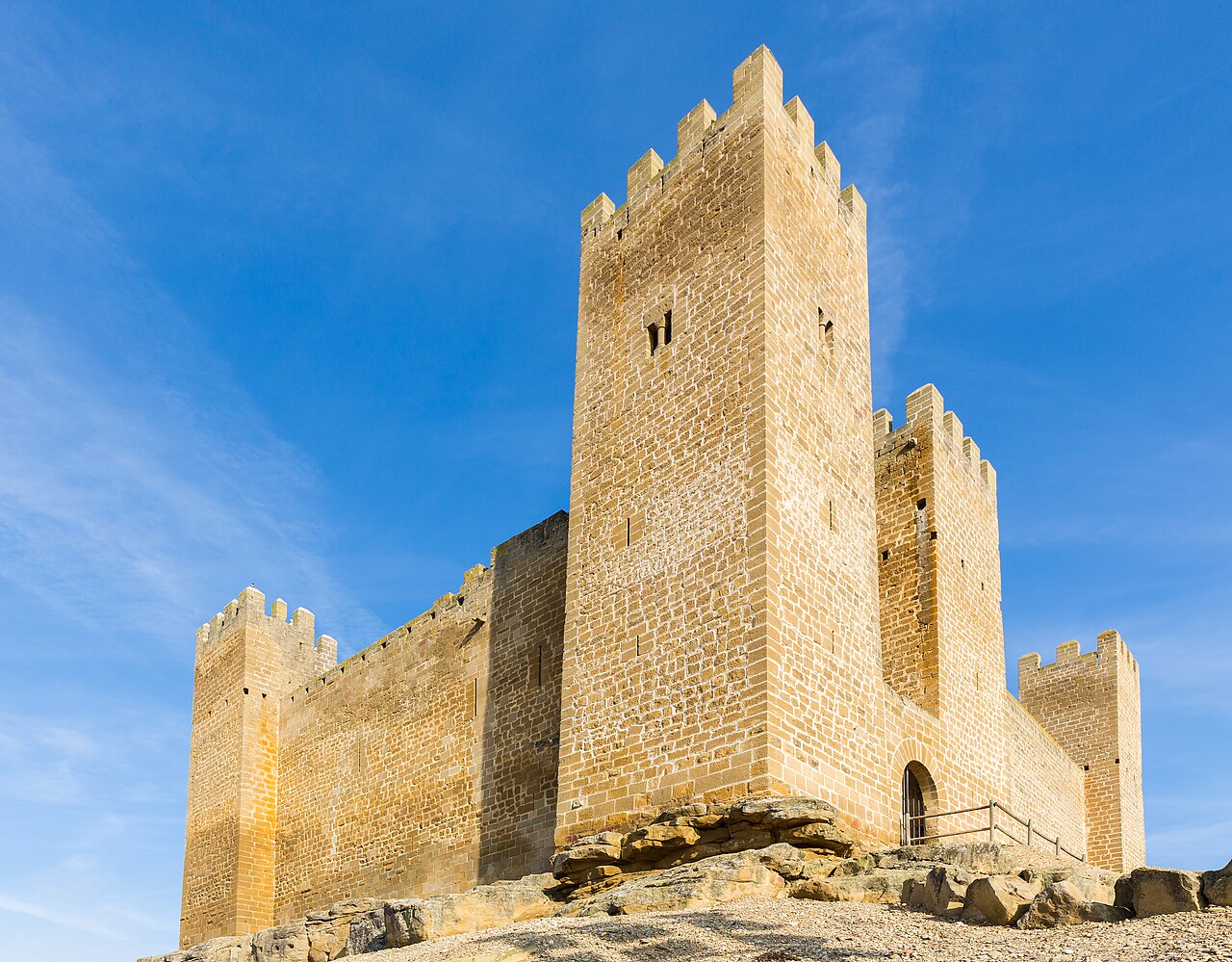
Castillo de Castiliscar
The Castillo de Castiliscar is a significant medieval hill castle located in the municipality of Castiliscar, Spain. This fortress holds a prominent place in the region’s history due to its strategic military role during the turbulent period of the Christian Reconquista. Its origins date back to the medieval period, when it was constructed by Christian forces to fortify and secure territorial gains against Muslim-held lands.
The earliest documented reference to the castle appears in the year 1088, when King Sancho Ramírez granted the area, then known as “castiello Liscare,” to Galindo Sánchez, the tenant of Sos. This royal grant was intended to empower Galindo Sánchez to reinforce and fortify the existing defensive structure, which itself was built atop earlier ruins, indicating a long-standing strategic importance of the site. The castle's location on a hill provided a natural defensive advantage, enabling surveillance and control over the surrounding territory.
Historical significance and ownership transitions
In 1171, the settlement around the castle was formally recognized with the issuance of a carta puebla, a charter that established legal and administrative frameworks for the local population. This development marked the growth of the community under the castle’s protection and its integration into the Christian kingdom’s governance structures.
By 1201, ownership of the castle transferred to the Order of Saint John of Jerusalem, a religious and military order dedicated to defending Christian territories and supporting pilgrims. This transfer underscored the castle’s continued strategic and religious importance during the high medieval period. The Order’s stewardship likely involved maintaining the castle’s fortifications and possibly adapting it for their dual military and hospitaller functions.
The castle’s role in the frontier defense network
The Castillo de Castiliscar was part of a broader defensive network that protected the shifting frontier between Christian and Muslim territories. This network included key fortresses such as those at Loarre and Sos, as well as supporting castles at Royta, Petilla, Uncastillo, and Sibirana, plus the tower at Layana. On the Muslim side, the fortress of Sádaba was a significant stronghold, supported by defenses at Biota and Malpica de Arba.
As the Christian Reconquista advanced southward, the frontier moved away from Castiliscar, reducing the castle’s military significance. This transition reflects the dynamic nature of medieval territorial conflicts and the evolving strategic priorities of the time.
Architectural features and layout
The castle’s remains reveal a structure that was carefully adapted to the natural contours of the hill on which it stands. The oval-shaped enclosure follows the irregular topography, a common medieval defensive strategy to maximize natural protection and minimize construction challenges.
A prominent feature is the castle’s tower, built using ashlar masonry—finely cut stone blocks that indicate skilled craftsmanship. Originally, this tower would have been taller to serve as a lookout and defensive strongpoint. Over time, it was reduced in height and modified with openings that now function as a bell tower, reflecting the castle’s later use as a hermitage.
Despite these changes, some original defensive elements survive, such as arrow slits. These narrow vertical openings allowed defenders to shoot arrows while remaining protected, highlighting the castle’s military design and the tactical considerations of its builders.
Transformation and current status
Today, the Castillo de Castiliscar exists as an archaeological site, preserving the remnants of its medieval past. Its transformation from a military fortress to a religious hermitage illustrates the layered history of the site and its adaptive reuse over centuries. The site offers valuable insights into medieval fortification techniques, the strategic importance of hill castles, and the historical context of the Christian-Muslim frontier in Spain.
Visitors to the site can explore the remains of the enclosure and tower, appreciating the castle’s integration with the natural landscape and its historical significance. The castle stands as a testament to the complex history of territorial conflict, religious orders, and architectural adaptation in medieval Spain.
Castillo de Castiliscar in the context of Spanish medieval fortifications
The castle exemplifies the typical characteristics of hill castles built during the high medieval period in Spain. Its strategic placement on elevated terrain, use of local materials, and incorporation into a network of fortifications reflect broader military and political trends of the Reconquista era.
Its association with the Order of Saint John of Jerusalem places it within the context of religious military orders that played crucial roles in the defense and administration of frontier territories. These orders combined martial prowess with religious missions, influencing castle architecture and regional governance.
While the castle’s military role diminished over time, its enduring presence and adaptation for religious use demonstrate the multifaceted functions such sites held in medieval and post-medieval Spain.
Frequently asked questions (FAQ)
- When was Castillo de Castiliscar built and by whom?
- Castillo de Castiliscar was built during the 11th century by Christian forces, with the earliest record dating to 1088 when King Sancho Ramírez granted the area to Galindo Sánchez to fortify the site.
- What architectural features are notable at Castillo de Castiliscar?
- Notable architectural features include the oval-shaped enclosure adapted to the hill's contours, the ashlar masonry tower originally taller but now serving as a bell tower, and surviving arrow slits used for defense.
- What was the castle's role during the medieval period?
- The castle served as a strategic military fortress within a network of defenses along the Christian-Muslim frontier, later becoming property of the Order of Saint John of Jerusalem, reflecting its military and religious significance.
- Is Castillo de Castiliscar open to visitors?
- Castillo de Castiliscar is preserved as an archaeological site and can be visited, though specific visiting hours and ticket prices may vary; it offers insights into medieval fortifications and regional history.
- How did the castle's function change over time?
- Originally a military fortress, Castillo de Castiliscar's role diminished as the frontier shifted southward, and it was later converted into a hermitage, illustrating its adaptive reuse through history.
Information
Loading map...
Visitor reviews
No reviews yet. Been here? Write the first review and help other travelers!
Write the first reviewVisited this castle? Share your experience
Your review helps other travelers and adds first-hand knowledge to our encyclopedia.