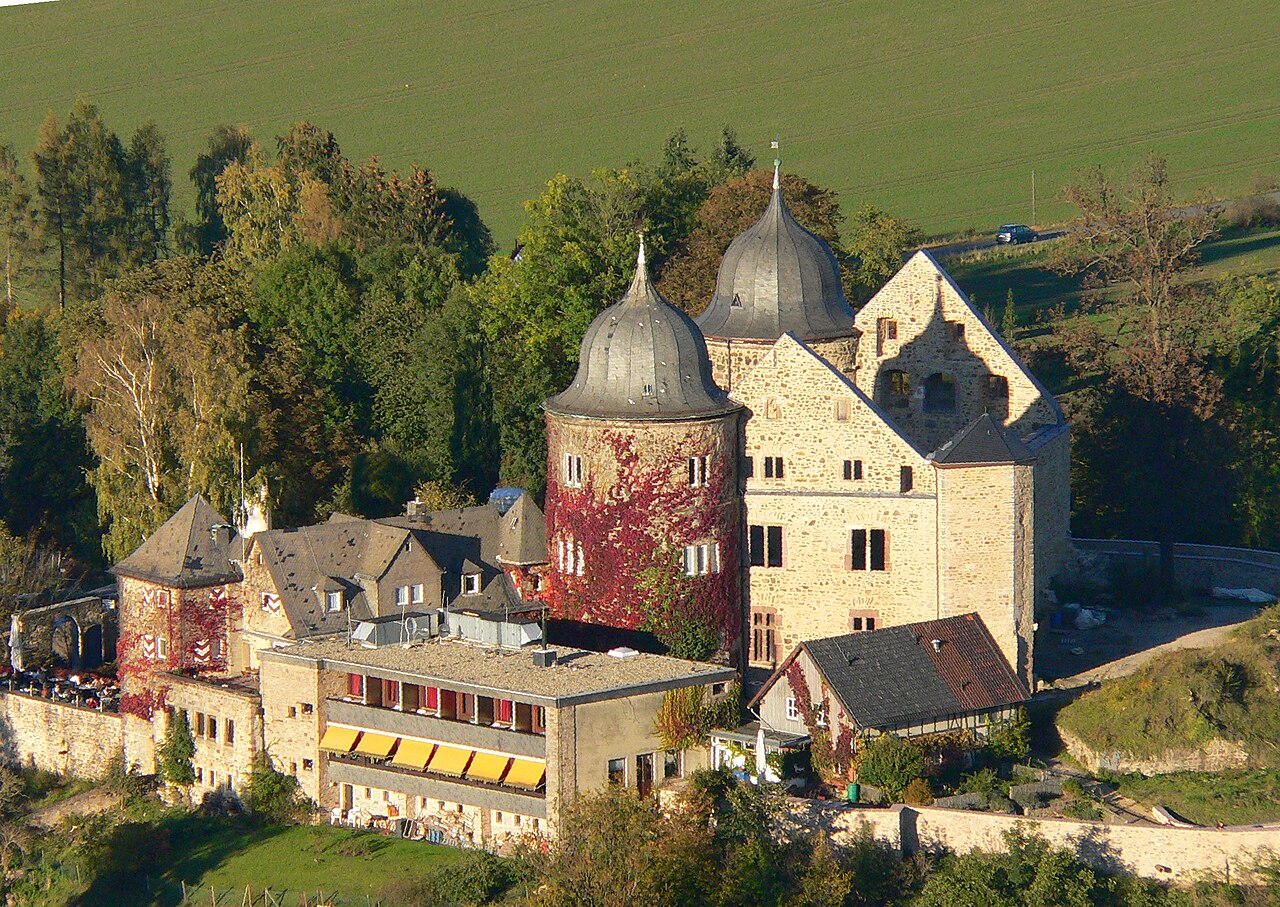
Sababurg Castle
Sababurg Castle stands prominently on a basalt hill in the Reinhardswald forest near Hofgeismar, Hessen, Germany. This historic hill castle is renowned not only for its medieval origins but also for its rich association with German folklore and the Brothers Grimm fairy tales, earning it the nickname "Sleeping Beauty Castle." Originally constructed in the early 14th century, Sababurg has served various roles—from a strategic border fortress to a princely hunting lodge and now a cultural heritage site and hotel complex.
The castle’s history begins with its foundation by the Bishopric of Mainz on 19 April 1334. Initially called Zappenburg or Zapfenburg, it was built to protect pilgrims traveling to Gottsbüren, the site of a reported miraculous discovery of the incorrupt body of Jesus in 1330. Sababurg’s location was strategically significant, situated at a contested frontier among Mainz, the Landgraviate of Hesse, the Bishopric of Paderborn, and the Duchy of Brunswick. This geopolitical tension shaped its early military and administrative importance.
Medieval origins and strategic significance
After its completion in 1336, Sababurg was entrusted to Arnold von Portenhagen as its first castellan. However, the castle’s control shifted following Mainz’s defeat in 1346, resulting in a division of ownership between Hesse and Paderborn. By the mid-15th century, the castle had fallen into disuse and was described as abandoned by 1455. The aftermath of the Mainz Diocesan Feud in 1462 saw Sababurg fully integrated into Hessian territory, marking a new chapter in its history.
Transformation into a princely hunting lodge
In 1490, Landgrave Wilhelm I of Hesse undertook a significant transformation of the site, converting the former fortress into an elaborate hunting lodge. This adaptation reused much of the original medieval foundations but introduced Renaissance architectural elements and amenities suitable for aristocratic leisure. Construction of the main residential building, or palas, commenced in 1508 and was completed in 1519 under the reign of his grandson, Philip I. The castle became a prestigious venue for hunting parties and courtly gatherings for approximately three centuries.
During this period, a stud farm was also established on the castle grounds to support the landgrave’s equestrian interests. The castle’s name evolved to Sababurg by 1582, the same year the chancellery building was constructed, which later served as the administrative center for the Gieselwerder district.
Architectural evolution and wartime impacts
Sababurg’s architecture reflects a blend of medieval and Renaissance styles. Notably, the two large round towers originally featured Gothic helmets, which were replaced in the mid-17th century by distinctive welsche Hauben (barrel-shaped domes) characteristic of Renaissance taste. Defensive features included a ring wall with flanking gates, ditches, and embankments, some of which remain visible today.
Between 1571 and 1591, a remarkable five-kilometer-long thorn hedge, three meters high, was planted around the castle to protect livestock from wild animals, highlighting the castle’s role in regional land management and hunting culture.
The castle suffered significant damage during the Thirty Years’ War when Catholic troops under Field Marshal Tilly occupied it in 1628. Subsequent occupations, including by French forces during the Seven Years’ War in 1760, further contributed to its decline. By the late 18th century, Sababurg had largely fallen into ruin and was repurposed as a forester’s house.
Decline, romanticization, and modern restoration
Following the annexation of Hesse by Prussia in 1866, Sababurg’s decline accelerated. The castle’s wings were gradually demolished between 1824 and 1826, and its precious furnishings were dispersed. Despite its dilapidated state, the castle became a symbol of romantic ruin and inspired numerous legends, including tales of the "Three Giant Daughters Saba, Trendela, and Brama" and the story of "Count Reinhard and the emergence of the Reinhardswald."
In 1957, the Koseck family initiated a restoration project that reimagined Sababurg as the "Sleeping Beauty Castle," drawing on the Brothers Grimm fairy tales to enhance its cultural appeal. Restoration efforts included preserving the remaining ring walls, corner towers with their unique Renaissance domes, and the chancellery building, which was expanded with a modern annex in 1976.
From 1959 onwards, the castle ruins were adapted into a high-class hotel with restaurant and café facilities, opening to the public in 1960. The site also became home to the SabaBurgTheater, fostering cultural events and performances. In 1987, Sababurg made history as the first venue in Germany outside a town hall to offer civil wedding ceremonies, later expanding its facilities in 2002.
Recent developments and future plans
Since 2018, extensive renovations have limited visitor access to the castle’s exterior on weekends and holidays. Hotel and catering operations ceased the same year, and civil weddings were discontinued. In 2020, demolition of the old hotel began to make way for a new four-star hotel with 40 rooms, a restaurant, and conference facilities designed to harmonize with the historic ruins.
The new construction aims to echo the castle’s architectural diversity, incorporating horizontal lines reminiscent of the palas and sloping roof shapes. The planned restaurant and catering areas are situated in the basement, featuring a terrace overlooking the Sababurg Wildlife Park below. Initial construction costs were estimated at €12 million but escalated to €43 million due to a shift toward primarily wooden structures. Work was halted in 2024 due to economic challenges and ground conditions.
Architectural remains and landscape setting
Sababurg is classified as a hill castle ruin, situated approximately 315 meters above sea level on a basalt hill between the villages of Beberbeck and Gottsbüren. The castle’s layout includes remnants of the ring wall, flanking gate, defensive ditches, and embankments, some restored to preserve the site’s historical integrity.
The palas survives primarily as outer walls, with the interior lost to time. Two large corner towers with their distinctive welsche Hauben remain intact and are currently utilized within the hotel complex. A smaller stair tower also survives, adding to the castle’s architectural complexity.
The chancellery building from 1582 remains a prominent feature, expanded in the 20th century with a modern annex. Historically, the castle was uniquely protected by a five-kilometer thorn hedge, underscoring its role in regional land and wildlife management.
Cultural significance and tourism today
Today, Sababurg Castle is celebrated not only for its historical and architectural heritage but also as a cultural landmark tied to the Brothers Grimm fairy tales. The castle and its surrounding wildlife park attract visitors interested in history, nature, and folklore. The SabaBurgTheater continues to offer dramatic and musical performances, enriching the visitor experience.
Despite recent construction halts, plans for the new hotel aim to blend modern hospitality with the castle’s historic ambiance, promising a renewed destination for guests seeking a unique blend of history, culture, and natural beauty in Hessen.
Frequently asked questions (FAQ)
- How do I visit Sababurg Castle and what are the opening hours?
- Sababurg Castle currently has limited visitor access on weekends and holidays due to ongoing renovations. It is advisable to check the latest visitor information before planning your trip.
- What is the historical significance of Sababurg Castle?
- Sababurg Castle was originally built in 1334-1336 as a border fortress and later transformed into a princely hunting lodge. It holds cultural importance as an inspiration for the Brothers Grimm fairy tales, especially the Sleeping Beauty legend.
- Can I attend events or performances at Sababurg Castle?
- The castle hosts the SabaBurgTheater, which offers dramatic and musical performances. Visitors should check the theater's schedule for current events, though some activities may be affected by renovation work.
- Is Sababurg Castle accessible for weddings?
- Sababurg was the first venue outside a town hall in Germany to offer civil wedding ceremonies, with expanded facilities added in 2002. However, civil weddings have been discontinued since 2018 due to renovations.
- What architectural styles are present at Sababurg Castle?
- Sababurg Castle features a mix of medieval and Renaissance architectural styles, including Gothic origins and Renaissance elements such as the welsche Hauben domes on its towers.
Information
Opening hours
Limited access on weekends and holidays due to renovations
Current owner
State of Hesse
Website
Visit websiteSources & official resources
Verify the information above using these authoritative references.
Loading map...
Visitor reviews
No reviews yet. Been here? Write the first review and help other travelers!
Write the first reviewVisited this castle? Share your experience
Your review helps other travelers and adds first-hand knowledge to our encyclopedia.