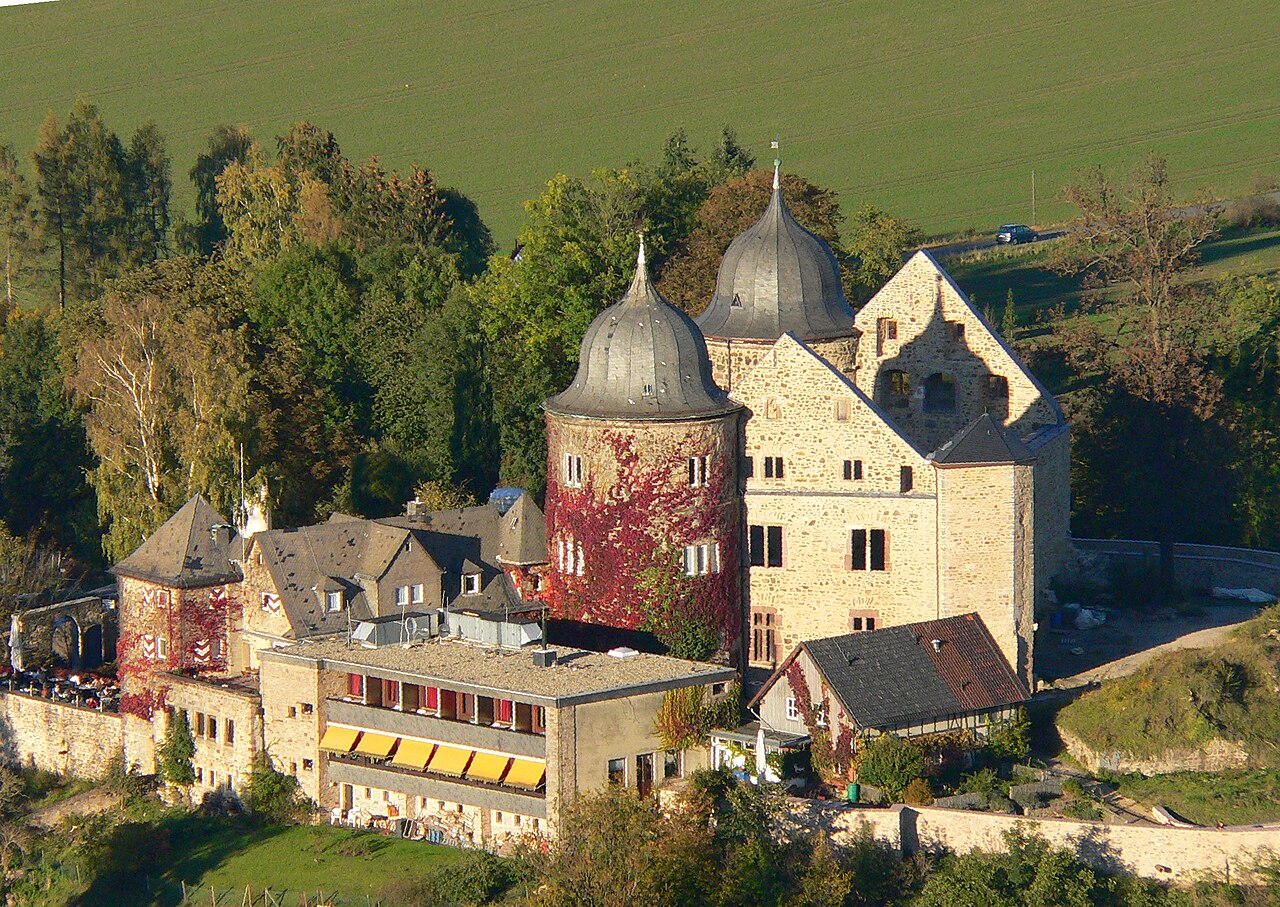
Grebenstein Castle
Grebenstein Castle stands as a remarkable example of a medieval hilltop fortress in Germany, perched strategically above the town of Grebenstein. Its origins trace back to the second half of the 11th century, when it was initially constructed by German builders as a modest defensive stronghold. Over the centuries, the castle evolved in response to the shifting political and military landscape of the region, becoming a significant site of feudal power and territorial control.
Early construction and medieval significance
The castle's earliest phase reflects typical high medieval fortification techniques, with a focus on defense and control of the surrounding territory. The choice of the Burgberg hill—a basalt cone rising approximately 56 meters above the town and situated at 249 meters above sea level—provided a natural vantage point and formidable defensive advantage. The site’s natural defenses were further enhanced by the nearby Esse stream, which partially encircles the hill and feeds into the Diemel River, creating a natural moat-like barrier.
In the mid-13th century, Count Ludolf V of Dassel undertook significant expansions and reinforcements, transforming the castle into a more formidable fortress to protect his estates. This period marked a turning point, as the castle became deeply entwined with the regional power struggles between the Bishopric of Paderborn and the Landgraviate of Hesse. The first documented mention of Grebenstein Castle in 1272 coincides with these territorial disputes, highlighting its strategic importance.
Ownership changes and political role
Through marriage alliances, the castle passed to Otto von Everstein around 1279, who held it as a fief under the Archbishopric of Mainz. Despite agreements to dismantle the fortress, the castle remained intact, partly due to the intervention of Landgrave Heinrich I of Hesse, who gained partial control by 1282. Otto von Everstein’s appointment as a Burgmann in 1293 and subsequent sale of the castle to Heinrich I in 1297 marked the beginning of Hessian dominance.
Grebenstein Castle then functioned primarily as a Hessian administrative center and military stronghold, particularly in opposition to Mainz territories. The fortified town of Grebenstein itself was considered more strategically vital than the castle, but the fortress remained a key component of regional defense. In 1328, the castle was granted as a Paragium to Ludwig the Junker, brother of Landgrave Heinrich II, indicating its continued importance within the Hessian feudal system.
The castle’s historical significance is further underscored by its association with notable figures such as Hermann II, born there in 1341, who later became Landgrave. In 1385, Grebenstein Castle successfully withstood a siege by forces led by Archbishop Adolf I of Mainz, demonstrating its defensive capabilities and strategic resilience.
Decline and later history
Following the Mainz Stiftsfehde conflict (1461–1463), which resulted in the transfer of Mainz possessions in the region to Hesse, Grebenstein Castle's strategic role diminished considerably. By 1471, it appears the castle was occupied only by a scribe, signaling its reduced military importance. By around 1540, the fortress ceased to serve as a noble residence and was repurposed as a granary, reflecting changing functional needs.
The castle suffered significant destruction during the Thirty Years’ War in 1631, when both the fortress and the town were devastated. Subsequent decades saw the castle fall into ruin, as local inhabitants quarried stone from the remains for building materials. This extensive decay continued until the late 20th century, when conservation efforts began to stabilize and preserve the surviving structures.
Architectural features and surviving ruins
The most prominent remains of Grebenstein Castle are dominated by the large palas, the main residential building of the fortress. Measuring approximately 37 meters in length and 12 meters in width, the palas was constructed with thick masonry walls nearly three meters thick on the first floor, designed to withstand sieges and attacks. The exterior walls have survived to heights exceeding 13 meters, allowing visitors to appreciate the scale and defensive strength of the original construction.
The palas originally included a basement and three upper floors. Remnants of oriel windows—small projecting windows that provided additional light and vantage points—and chimneys remain visible, offering insights into the castle’s domestic arrangements. The basement housed the kitchen, while the upper floors contained the Kemenate or women's chamber, reflecting the residential and functional diversity of the castle’s interior spaces.
Surrounding the palas is a partial moat, which formed an integral part of the castle’s defensive system. Although traces of an outer bailey and additional defensive ditches are faint, the moat itself remains, delineating the extent of the fortifications. The castle's position atop the Burgberg hill, combined with these man-made defenses, made it a formidable stronghold in its prime.
Cultural significance and visitor experience
Today, Grebenstein Castle’s ruins offer a tangible connection to the region’s medieval past. Beneath the hill lies a small Jewish cemetery, marking the historical presence of a local Jewish community and adding cultural depth to the site. Visitors can access the ruins via a modern steel staircase leading to a viewing platform atop the upper walls. From this vantage point, panoramic views extend across the historic town of Grebenstein and the surrounding Habichtswald and Reinhardswald forests, emphasizing the castle’s commanding position within the landscape.
The castle’s ruins are a testament to the architectural ingenuity and historical endurance of medieval fortifications in Germany. The site continues to attract historians, architecture enthusiasts, and tourists interested in exploring the layers of feudal history and medieval military architecture preserved in the remaining structures.
Historical officials and administration
Throughout its history, Grebenstein Castle was governed by a series of Hessian Amtmänner (officials), recorded from 1336 to 1529. These included notable figures such as Ludwig von Grebenstein and Dietrich von Schachten, who served multiple terms. Their administration reflects the castle’s role as a center of regional governance and military oversight during the late medieval period.
Frequently asked questions (FAQ)
- What is the best way to reach Grebenstein Castle?
- Grebenstein Castle is accessible via hiking trails from the town of Grebenstein. Visitors can follow marked paths leading up Burgberg hill to the ruins, which are reachable on foot within a short walk from the town center.
- When was Grebenstein Castle built and by whom?
- Grebenstein Castle was originally constructed in the second half of the 11th century by medieval German builders. It was later expanded in the mid-13th century by Count Ludolf V of Dassel to strengthen regional defenses.
- Can visitors explore the interior of the castle ruins?
- Visitors can explore the exterior ruins of Grebenstein Castle, including the impressive palas walls and remnants of defensive structures. However, the interior spaces are largely ruins and may have limited access for safety reasons.
- Why is Grebenstein Castle historically significant?
- Grebenstein Castle played a key role in regional power struggles between the Bishopric of Paderborn, the Landgraviate of Hesse, and the Archbishopric of Mainz during the medieval period. It also withstood a notable siege in 1385 and served as a Hessian administrative center.
- Is there a best time of year to visit Grebenstein Castle?
- The castle ruins are best visited during spring to early autumn when weather conditions are favorable for hiking and outdoor exploration. The panoramic views from the viewing platform are particularly enjoyable on clear days.
Information
Loading map...
Visitor reviews
No reviews yet. Been here? Write the first review and help other travelers!
Write the first reviewVisited this castle? Share your experience
Your review helps other travelers and adds first-hand knowledge to our encyclopedia.