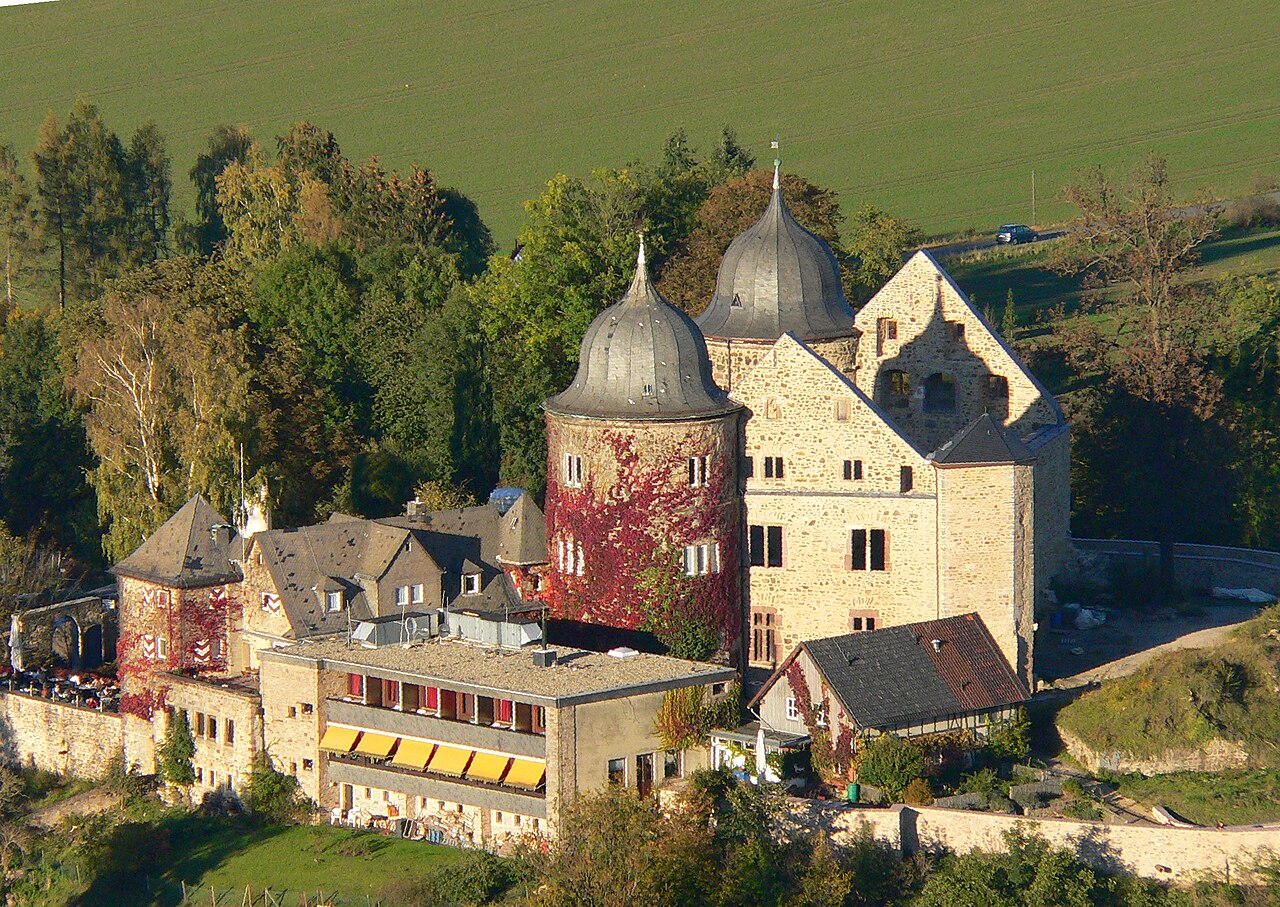
Burg Trendelburg
Burg Trendelburg is a remarkable example of a hill castle situated in the municipality of Trendelburg, Germany. Constructed in the late 13th century by the nobleman Konrad III von Schöneberg, the castle occupies a commanding position atop a sandstone ridge overlooking the Diemel River. This strategic location was chosen to control vital medieval trade routes, underscoring the castle's significance in regional defense and governance during the High Medieval period.
The site’s historical roots extend deeper, with the area originally part of Saxon lands subdued by Charlemagne during his campaigns. Subsequently, the territory came under the jurisdiction of the Bishopric of Paderborn and the County of Warburg. In the early 14th century, after Konrad III lost his ancestral castle to Paderborn, Burg Trendelburg emerged as a joint administrative center. This dual control was formalized through a peace agreement in 1306 between the Bishopric of Paderborn and the Landgrave of Hesse, highlighting the castle’s role in regional power dynamics.
Medieval origins and strategic importance
The castle’s initial construction reflects typical spur castle design, leveraging natural topography for defense. Positioned at an elevation of 172 meters on a sandstone ridge, the site features steep drops on three sides towards the Diemel River, providing formidable natural barriers. Only the western side slopes gently towards the medieval town of Trendelburg, which historically adjoined the castle walls, facilitating access and trade.
The trapezoidal layout of Burg Trendelburg was originally fortified with a moat and an earthen embankment, both now filled in. A distinctive rock-cut neck ditch separates the fortress from the town, with access controlled via a wooden bridge equipped with a drawbridge. This entrance led to a low gate opening into the courtyard, serving as the castle’s first line of defense.
Architectural features and defensive elements
One of the castle’s most iconic features is its bergfried, a tall stone tower commonly known as the "Rapunzel Tower." Rising over 40 meters with walls up to seven meters thick, the bergfried served multiple defensive functions. Inside, a spiral staircase of more than 130 steps ascends its height, leading to vantage points equipped with four machicolations—openings for dropping projectiles on attackers—and three arrow slits facing west.
The bergfried also housed a dungeon and a courtyard-facing escape doorway, illustrating its dual role in defense and imprisonment. In 2012, restoration efforts added a protective roof modeled after historical depictions to preserve this significant structure.
The castle’s curtain walls remain well-preserved and crenellated, allowing for defensive patrols. Opposite the bergfried stands the main gate, flanked by two corner towers. One tower retains a timber-framed superstructure that historically accommodated the gatekeeper and the town prison, reflecting the castle’s judicial functions. The other tower has lost its original spire.
Additional fortifications include two more corner towers, one featuring a garderobe—a medieval latrine projecting beyond the wall. The main residential building, the Festes Haus, rises three stories and is roofed with traditional sandstone slabs. It includes a visible stair tower that once contained a spiral staircase, replaced in later renovations by a robust oak staircase.
Historical developments and transformations
By 1472, the settlement beneath the castle was granted town rights by Landgrave Ludwig II, strengthening the castle’s administrative role. It served as the residence and office for officials appointed by the Landgrave, cementing its importance in late medieval governance.
The Thirty Years’ War (1618–1648) was a turbulent period for Burg Trendelburg. The castle was repeatedly attacked and set ablaze by forces under General Tilly, underscoring its strategic military value. Post-war, Landgrave Karl expanded the castle, transforming it into a fortified hunting lodge, blending residential comfort with defensive features.
During the Seven Years’ War (1756–1763), the castle experienced occupation by French troops and sustained severe damage amid battles with forces led by Duke Ferdinand. This conflict further impacted the castle’s structure and necessitated later repairs.
In the 19th century, as administrative functions moved elsewhere, Burg Trendelburg became a Prussian forestry office. At the dawn of the 20th century, it was acquired by the von Stockhausen family and converted into a private residence. From 1949 onwards, the castle began a new chapter as a hotel, incorporating restaurant services and later additions such as a wedding tower.
Cultural significance and modern restoration
Burg Trendelburg holds a special place in German cultural heritage, notably through its association with the Brothers Grimm fairy tale "Rapunzel". This connection has made the castle a key site along the German Fairy Tale Route, attracting visitors interested in folklore and history alike.
The castle also served as a filming location for a 1958 movie featuring comedian Heinz Erhardt, adding to its cultural footprint. Since 1996, ownership by the Dr. Lohbeck hotel group has focused on careful restoration, preserving the castle’s historic fabric while adapting it for tourism.
Significant restoration efforts culminated in 2012 with the completion of work on the bergfried, including the installation of a protective roof. These efforts have made the tower accessible to visitors, enhancing public engagement with the castle’s medieval architecture and history.
Visitor experience and preserved features
The castle courtyard remains open and accessible, featuring exhibitions such as the dungeon and a former torture chamber. These spaces provide tangible insights into the castle’s medieval defensive and judicial roles, enriching the visitor experience.
The combination of natural defensive advantages, well-preserved medieval architecture, and layered historical narratives makes Burg Trendelburg a significant heritage site. Its enduring presence atop the sandstone ridge continues to dominate the landscape, inviting exploration of its rich past and architectural splendor.
Frequently asked questions (FAQ)
- When was Burg Trendelburg built and by whom?
- Burg Trendelburg was built in the late 13th century by the nobleman Konrad III von Schöneberg, strategically positioned atop a sandstone ridge overlooking the Diemel River.
- What architectural style characterizes Burg Trendelburg?
- The castle exhibits Gothic architectural features typical of the High Medieval period, including a tall bergfried with machicolations and crenellated curtain walls.
- What is the significance of the Rapunzel Tower?
- The Rapunzel Tower is the castle’s bergfried, rising over 40 meters with thick stone walls. It served defensive purposes and contains a dungeon and escape doorway, inspiring its association with the Brothers Grimm fairy tale.
- How did the Thirty Years’ War affect Burg Trendelburg?
- During the Thirty Years’ War, the castle was repeatedly attacked and set on fire by General Tilly’s forces, reflecting its strategic importance and resulting in significant damage.
- Can visitors explore the interior of Burg Trendelburg?
- Yes, visitors can access the castle’s courtyard, dungeon, and other preserved areas. Restoration efforts have made the bergfried accessible, offering insight into medieval defensive architecture.
- What cultural connections does Burg Trendelburg have?
- The castle is linked to the Brothers Grimm fairy tale "Rapunzel" and is part of the German Fairy Tale Route. It was also a filming location for a 1958 Heinz Erhardt movie.
Information
Sources & official resources
Verify the information above using these authoritative references.
Loading map...
Visitor reviews
No reviews yet. Been here? Write the first review and help other travelers!
Write the first reviewVisited this castle? Share your experience
Your review helps other travelers and adds first-hand knowledge to our encyclopedia.