Saalau Castle Ruins
Saalau Castle ruins stand as a testament to the turbulent history of the northern East Prussian region, now part of the Russian Federation near Chernyakhovsk. Founded in the mid-14th century by the Teutonic Order, this hill castle was strategically positioned to defend against frequent Lithuanian raids and to assert control over the surrounding lands along the upper Pregel River. The site reflects the complex interplay of military, religious, and administrative functions typical of Teutonic fortifications during the late medieval period.
The castle's origins trace back to a previous Prussian fortification named Vastopole, destroyed during the Teutonic conquest in 1276. In 1352, the land was divided between the Church and the Monastic Order, with Saalau ceded to the Church, which initially constructed a Chapter House known as the Cathedral Chancery. Repeated Lithuanian attacks led to the destruction of this early building, prompting the decision in 1376 to erect a robust brick fortress called the Kapitelburg. Despite these efforts, the castle suffered significant damage during Lithuanian sieges, particularly in 1390, after which a new and more formidable castle was constructed within five years.
Architectural design and defensive features
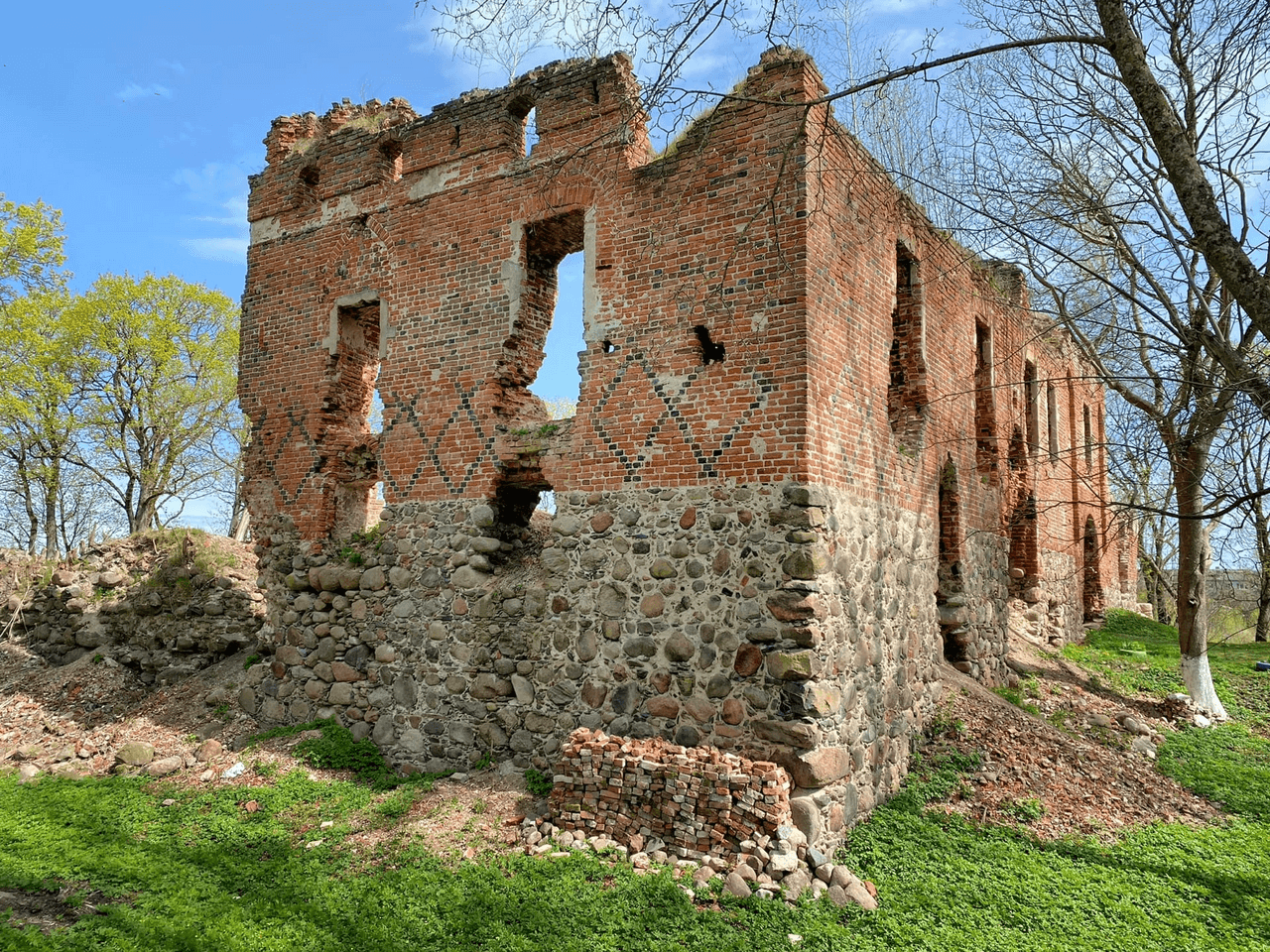
Saalau Castle was built on a roughly rectangular plan measuring approximately 42 by 46 meters atop a hill near a small stream, providing natural defensive advantages. The main structure, a compact single-wing building stretching 42 meters along the southern side, was constructed with burnt bricks laid in a distinctive pattern creating continuous horizontal diamond shapes, a hallmark of Teutonic architectural style. The walls were notably thick, with exterior walls about 2.5 meters and internal walls around 1.5 meters, offering substantial resistance to siege weaponry.
The castle featured a low gate tower on the southern wing with rounded granite-framed gateways and a niche designed for a portcullis, enhancing its defensive capabilities. The eastern wing housed a chapel, underscoring the religious role of the castle's occupants, while the western wing served as living quarters for the castle manager. Beneath the main building were cellars used for storage, which later found industrial uses such as cheese production and brewing.
A gabled roof covered the main building, under which was a defensive gallery equipped with embrasures—narrow openings for archers or crossbowmen to defend the castle. An adjoining courtyard gallery provided access to the upper floors. Surrounding the eastern and northeastern sides was a pond formed by damming a millstream, serving as a natural moat alongside a strong defensive wall topped by a covered walkway with a tiled roof, allowing defenders to patrol safely.
Additional residential and utility rooms were added in the 1370s, including a long utility building along the western defensive wall measuring about 38 by 8 meters, featuring a small tower at its northwest corner and a passage to the forecourt. This forecourt was an outer defensive enclosure with its own moat and wall protecting the western, southern, and parts of the northern sides. The utility building likely contained kitchen facilities and a brewery, integral to daily castle life.
Historical context and significance
The castle's history is deeply intertwined with the military and religious ambitions of the Teutonic Order during their expansion into Prussian and Baltic territories. The initial establishment of Saalau was part of a broader strategy to consolidate control over the region and to protect against persistent Lithuanian incursions. The castle's repeated destruction and rebuilding reflect the volatile nature of the borderlands during the 14th and 15th centuries.
Following the secularization of the Teutonic Order in 1525, Saalau transitioned from a military fortress to an administrative center for the local district, known as Amt Saalau. The castle came under the control of church canons based in Königsberg, who faced financial difficulties maintaining the property, leading to its eventual pawn and decline. A devastating fire in the 16th century further damaged the castle, leading to partial demolition and the loss of some structural elements.
By the 19th century, the castle had become state property and served as the residence of the Amtmann, the local administrative head. The site adapted to various practical uses, including cheese production in its cellars and brewing in converted rooms, illustrating the shift from military to economic functions. After World War II, the castle was abandoned and fell into ruin, overtaken by forest growth, with only its foundations and some walls remaining visible today.
Current condition and preservation
Today, Saalau Castle ruins present an evocative glimpse into medieval fortification architecture, despite their ruined state. The remains include foundation stones, surviving wall sections, and the distinctive brickwork patterns that hint at the castle's former grandeur. The surrounding forest has reclaimed much of the site, but the layout and defensive features remain discernible to visitors and researchers.
Nearby, an 18th-century church on the opposite side of the road has survived in better condition. During the Soviet era, it was repurposed as a club and cinema, which helped preserve the building from demolition. This church stands as a cultural landmark complementing the historical narrative of the Saalau area.
Architectural legacy and cultural importance
Saalau Castle exemplifies the architectural and historical characteristics of Teutonic Order castles in the Baltic region, combining military, religious, and administrative functions within a compact fortified complex. Its distinctive brickwork and defensive design elements reflect the Order's building techniques and strategic priorities during the late medieval period.
The castle's ruins contribute valuable insights into the colonization and cultural assimilation processes in the region, where German settlers mingled with local Prussian populations. Saalau's history also illustrates the shifting political and religious landscapes of East Prussia, from monastic military rule to secular administration and eventual integration into modern state structures.
As a protected historical site under the Russian Federation, Saalau Castle remains an important destination for historians, archaeologists, and visitors interested in medieval military architecture and the complex history of the Baltic frontier. Its evocative ruins and surrounding landscape continue to inspire exploration and study of the region's rich past.
Visitor information and accessibility
While the castle is in ruins, the site is accessible to visitors interested in medieval history and architecture. The location near Chernyakhovsk allows for exploration of the broader historical region of Samland. Visitors should prepare for natural terrain and limited facilities, as the site is primarily an archaeological and historical ruin rather than a restored tourist attraction.
Nearby cultural landmarks, including the preserved 18th-century church, provide additional context and interest for those touring the area. The castle's remote and forested setting offers a unique opportunity to experience the atmosphere of a medieval fortress in a largely natural environment.
Frequently asked questions (FAQ)
- What is the historical significance of Saalau Castle Ruins?
- Saalau Castle Ruins, dating back to the 13th century, played a crucial role in the defense strategies of the region during the medieval period. It served as a stronghold for various rulers and has witnessed significant historical events, making it a vital part of local heritage.
- When was Saalau Castle built?
- The construction of Saalau Castle is believed to have begun in the early 13th century, with various modifications and expansions occurring over the centuries. Its architectural style reflects the medieval fortification techniques of the time, showcasing the evolving military architecture.
- Can I visit Saalau Castle Ruins?
- Yes, Saalau Castle Ruins are open to the public for exploration. Visitors can walk around the ruins, enjoy the scenic views, and learn about the castle's history through informational plaques located throughout the site.
- What are the opening hours for Saalau Castle Ruins?
- Saalau Castle Ruins are generally open to visitors from sunrise to sunset. However, it's advisable to check local resources for any seasonal changes or special events that might affect visiting hours.
- Is it possible to access Saalau Castle by public transport?
- Yes, public transport options are available to reach Chernyakhovsk, and from there, visitors can take a taxi or a short hike to the castle ruins. It's recommended to plan your journey in advance, as public transport schedules may vary.
- What is the best time to visit Saalau Castle Ruins?
- The best time to visit Saalau Castle Ruins is during the late spring and early autumn months when the weather is mild and pleasant. This allows for comfortable exploration of the site and opportunities for photography amidst the beautiful natural surroundings.
- Are there any nearby attractions to Saalau Castle Ruins?
- Yes, several attractions are located near Saalau Castle, including the picturesque landscapes of the surrounding region and other historical sites in Chernyakhovsk. Visitors can also explore local museums and cultural landmarks to enrich their experience.
- What are the ticket prices for visiting Saalau Castle Ruins?
- There is no entry fee to visit Saalau Castle Ruins, making it an accessible option for all visitors. However, donations are appreciated to help with the maintenance and preservation of the site.
Photo gallery

Information
Loading map...
Visitor reviews
No reviews yet. Been here? Write the first review and help other travelers!
Write the first reviewVisited this castle? Share your experience
Your review helps other travelers and adds first-hand knowledge to our encyclopedia.