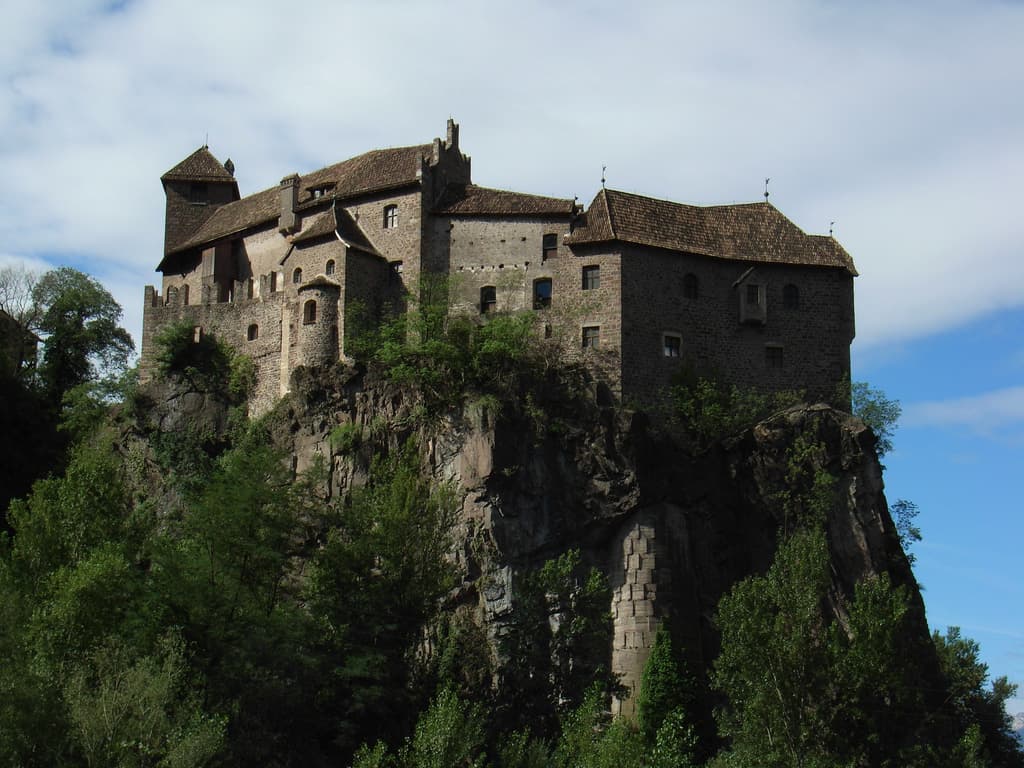
Runkelstein Castle
Runkelstein Castle, also known as Castel Roncolo, is a remarkable medieval fortress perched on a rocky spur overlooking the city of Bolzano in the Trentino-Alto Adige region of Italy. Constructed in 1237 by the brothers Friedrich and Beral von Wangen, the castle stands as a testament to the turbulent history and rich cultural heritage of the region during the High Medieval period. Its strategic location provided both defensive advantages and control over the surrounding territory, making it a significant stronghold in the area.
Throughout its history, Runkelstein Castle underwent multiple phases of construction, expansion, and restoration, reflecting the changing needs and tastes of its various owners. The castle is particularly renowned for its exceptional collection of secular frescoes, which are among the most important and well-preserved examples of medieval mural art in Europe. These frescoes depict a variety of themes, including courtly life, chivalric romance, and legendary tales such as the story of Tristan and Isolde and the Arthurian Round Table.
Early history and original construction
The origins of Runkelstein Castle date back to the early 13th century when Alderich, Prince-Bishop of Trent, granted permission to the von Wangen brothers to build a fortress on the rocky outcrop known as Runchenstayn. The initial structure was designed primarily as a defensive stronghold, featuring typical medieval fortification elements such as thick stone walls, a keep, and battlements. The castle's Romanesque architectural elements from this period are still visible in parts of the surviving structure.
In 1274, the castle suffered damage during a siege led by Meinhard II of Tirol amid his conflict with Heinrich, Prince-Bishop of Trent. After his victory, Meinhard II entrusted the castle to Gottschalk Knoger of Bozen, marking a shift in control that would influence the castle's subsequent development.
The vintler family and the flourishing of fresco art
In the late 14th century, the castle entered a new phase under the ownership of the wealthy Vintler brothers, Niklaus and Franz, prominent merchants from Bolzano. Their acquisition of Runkelstein Castle in 1385 was unusual for merchants at the time, as castles were typically the domain of nobility. This purchase reflected their rising social status and influence, particularly Niklaus, who served as a counselor and financier to Leopold III, Duke of Austria.
The Vintler brothers undertook extensive renovations and expansions, including the construction of a new defensive wall, a moat, and additional chambers. Most notably, in 1390, they commissioned the building of the "Casa d'Estate" (Summer House), which became the centerpiece for the castle's famous frescoes. These murals, painted both inside and on the exterior walls, depict a rich tapestry of secular themes, including the romantic legend of Tristan and Isolde by Gottfried von Straßburg and one of the earliest surviving depictions of the Arthurian Round Table. These frescoes are exceptional for their vivid colors, detailed narrative scenes, and insight into medieval courtly culture.
Architectural features added by the vintlers
- A new defensive wall and moat enhanced the castle's fortifications.
- A cistern was installed to ensure a reliable water supply during sieges.
- The Summer House featured spacious halls adorned with frescoes, serving as a residence and a symbol of the Vintlers' wealth and taste.
- Additional rooms and chambers were constructed to improve the castle's habitability and status.
Conflicts and ownership changes in the 15th and 16th centuries
The early 15th century brought political turmoil to Runkelstein Castle. In 1407, a conflict erupted between Frederick IV, Duke of Austria, and the Tyrolean nobility, including the Vintler family. The castle was besieged during these hostilities. Niklaus Vintler, allied with the noble faction known as the Hawk League, suffered significant losses, including his wealth and possessions. His brother Franz, who sided with the Duke, retained ownership of the castle until it eventually passed to Sigismund, Archduke of Austria.
Under the Habsburgs, the castle saw further renovations ordered by Emperor Maximilian I, who valued the fortress for its strategic and symbolic importance. Maximilian furnished his apartments and commissioned restoration of the frescoes, also prominently displaying his coat of arms throughout the castle. Around 1500, the castle was granted to his vassal Georg von Frundsberg, with a vicar appointed to manage its upkeep.
In 1520, a catastrophic explosion of the powder magazine in the tower caused significant damage to the outer walls, entrance, and the Eastern Palace, destroying the tower itself. This event marked the beginning of the castle's decline, as it was neglected in the following decades.
Later history, decline, and romantic rediscovery
Following the explosion and subsequent neglect, Runkelstein Castle changed hands several times. In 1530, it was bestowed by King Ferdinand I to Sigmund von Brandis, Knight Commander of Bozen. Later, the castle returned to the control of the Prince-Bishops of Trent, who granted it as a fief to the Counts of Lichtenstein-Kastelkorn. A fire in 1672 destroyed the Eastern Palace, which was never rebuilt, further contributing to the castle's ruinous state.
By the 18th century, the castle was in grave decay. However, during the 19th century Romanticism movement, Runkelstein Castle was rediscovered and celebrated as a symbol of medieval chivalry and art. German writer Johann Joseph von Görres was among the first to visit, inspiring a wave of artists and intellectuals, including those connected to King Ludwig I of Bavaria.
The castle's fortunes improved when Johann Salvator Archduke of Austria purchased it in 1880 and gifted it to Emperor Franz Josef in 1882. The emperor commissioned the renowned architect Friedrich von Schmidt to undertake a comprehensive restoration, which included careful preservation of the frescoes. In 1893, the castle was donated to the city of Bolzano, ensuring its protection and public accessibility.
Architectural highlights and frescoes
Runkelstein Castle is distinguished by its blend of Romanesque and Gothic architectural elements. The castle complex includes defensive walls, a moat, a cistern, various residential buildings, and the famous Summer House, which serves as a gallery for the frescoes.
The frescoes are the castle's defining feature. They are unique for their secular themes, which contrast with the predominantly religious art of the period. Scenes depict courtly love, chivalric adventures, and legendary narratives, providing invaluable insight into medieval culture and values. The depiction of the Arthurian Round Table is particularly significant as one of the earliest visual representations of this iconic legend.
Preservation and current status
Today, Runkelstein Castle is well preserved thanks to multiple restoration campaigns, most recently in the late 1990s. It functions as a cultural monument and museum, attracting visitors interested in medieval history, art, and architecture. The castle's frescoes remain a highlight for scholars and tourists alike, celebrated for their artistic quality and historical importance.
Visitors can explore the castle's courtyards, halls, and towers, gaining a vivid sense of medieval life and the artistic achievements of the period. The site also hosts exhibitions and cultural events, further enriching its role as a vibrant heritage landmark in the heart of Bolzano.
Frequently asked questions (FAQ)
- How do I get to Runkelstein Castle?
- Runkelstein Castle is easily accessible from Bolzano by public transport. You can take a bus that runs regularly from the city center, or if you prefer, enjoy a scenic walk that takes approximately 30 minutes from the city.
- What is the historical significance of Runkelstein Castle?
- Runkelstein Castle, built in the 13th century, is known for its beautifully preserved frescoes and its strategic location overlooking the Adige River. It played a vital role in the region's defense and served as a residence for the noble family of the same name.
- When was Runkelstein Castle built?
- Construction of Runkelstein Castle began in the early 13th century, around 1237. Over the years, it underwent several modifications and expansions, reflecting the architectural styles of different periods.
- Can I visit Runkelstein Castle with children?
- Yes, Runkelstein Castle is family-friendly and offers educational opportunities for children. The castle features engaging exhibits and guided tours that cater to visitors of all ages.
- Why is Runkelstein Castle famous for its frescoes?
- The castle is celebrated for its extensive collection of medieval frescoes that depict chivalric themes and daily life in the Middle Ages. These artworks provide a fascinating glimpse into the culture and values of the time.
- Is it possible to have a guided tour of Runkelstein Castle?
- Yes, guided tours are available and highly recommended for a deeper understanding of the castle's history and significance. Tours are typically offered in multiple languages and can be booked in advance.
- What are the opening hours of Runkelstein Castle?
- Runkelstein Castle is open to visitors year-round, with varying hours depending on the season. Generally, it opens from 10 AM to 5 PM, but it's advisable to check the official website for specific seasonal hours.
- What are the ticket prices for visiting Runkelstein Castle?
- Ticket prices for Runkelstein Castle are quite reasonable, with discounts available for students and families. Admission typically costs around €8 for adults, and children under a certain age can enter for free or at a reduced rate.
- What is the best time to visit Runkelstein Castle?
- The best time to visit Runkelstein Castle is during the spring and early autumn when the weather is pleasant for outdoor exploration. Additionally, visiting during weekdays can help you avoid larger crowds.
- Are there any nearby attractions to visit after Runkelstein Castle?
- Yes, after visiting Runkelstein Castle, you can explore other nearby attractions such as the beautiful city of Bolzano, the South Tyrol Museum of Archaeology, and the stunning landscapes of the Dolomites. These sites offer a variety of cultural and natural experiences for visitors.
Photo gallery

Information
Loading map...
Visitor reviews
No reviews yet. Been here? Write the first review and help other travelers!
Write the first reviewVisited this castle? Share your experience
Your review helps other travelers and adds first-hand knowledge to our encyclopedia.



