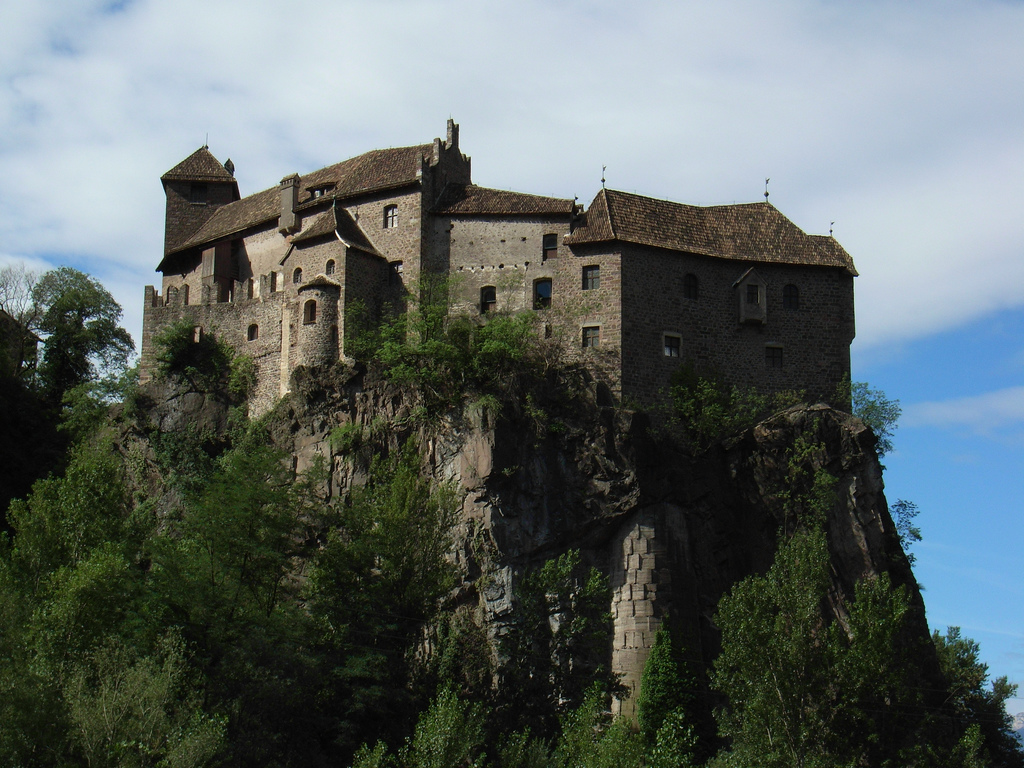
Rafenstein Castle
Rafenstein Castle, known locally as Castel or Burg Rafenstein, is a striking medieval ruin perched on a rocky hill northwest of the city of Bolzano in the South Tyrol province of the Trentino-Alto Adige region in northern Italy. This historic fortress stands at an elevation of 692 meters above sea level, overlooking the Talvera and Sarntal valleys, commanding strategic views that were vital for controlling trade routes between northern and southern Europe during the Middle Ages.
Constructed in the early 13th century by Prince-Bishop Friedrich von Wangen of Trento, the castle was originally built to assert the bishopric's sovereignty over Bolzano and to monitor the important commercial road passing through the area. The initial medieval complex consisted of a great hall, a low donjon, and a circular defensive wall, reflecting typical high medieval fortification principles designed to balance residential comfort with military defense.
Historical development and ownership
The earliest documented mention of Rafenstein dates to 1217, identifying it as a fief under the Bishop of Trento, with a castellan named Albert von Rafenstein overseeing the castle's operations. Throughout the 13th century, ownership shifted among several noble families, including Berthold Schwab von Bozen and Morandin von Bozen, before coming under the control of the brothers Friedrich and Beral von Wangen.
In 1277, the castle was nearly destroyed during a siege by Meinhard II, Count of Tyrol, amid regional power struggles. This event marked a significant turning point, as the castle was subsequently rebuilt and expanded in the 14th century by Konrad Schinlein. Restoration efforts focused on the palas (main residential building) and the ring wall, reinforcing the castle's defensive capabilities.
Ownership continued to change hands through the 14th and 15th centuries, passing to Francisk von Auer (ennobled as von Rafenstain), the Goldecker family, and later the Weineck family. Around 1500, the Gerstel family took possession and undertook extensive renovations and expansions that lasted until 1544, enhancing both the castle's living quarters and fortifications.
In the latter half of the 16th century, the castle saw further ownership transitions, including Daniel von Spaur in 1563, Franz Wettin in 1585, and finally the Wolkenstein family in 1599. Under the Wolkensteins, Rafenstein underwent significant modernization to adapt to evolving military technology, including the addition of a chapel near the main tower and strengthening of bastions.
Marx Sittich von Wolkenstein, a notable owner in the early 17th century, resided at Rafenstein and contributed to its cultural heritage by compiling a detailed regional description and establishing a cabinet of curiosities featuring exotic artifacts such as a Nile crocodile skeleton. Despite these enhancements, the castle was abandoned by 1620, and its importance declined over the following centuries.
Architectural features and renovations
Original medieval structures
The castle's earliest structures featured thick, whitewashed stone walls two to three meters thick, typical of high medieval fortifications. The palas, located in the southeast corner, served as the main residence and administrative center. It was surrounded by a defensive ring wall that enclosed the inner courtyard and was anchored by a tower to the north, providing a strong defensive perimeter.
14th-century additions
During the 14th century, the castle was expanded to include an outer ward known as a zwinger, designed to trap attackers between defensive walls. A gate tower and a southern wing were added, improving both the defensive and domestic capabilities of the complex. These enhancements reflected the castle's ongoing military significance during the late medieval period.
16th-century transformations
The most significant architectural evolution occurred in the 16th century when the castle was transformed into a late Gothic fortress. The ring walls between the palas and the northern tower were converted into two-story buildings, and an additional two-story structure was built along the northern wall between the tower and entrance gate. A new outer ring wall was constructed, featuring four round bastions designed to deflect artillery fire, and a Renaissance-style gate tower was introduced.
The main tower was heightened in the early 1600s, with enlarged windows that shifted the structure's focus from purely military defense to greater residential comfort and light. The southern wing was also enhanced with the addition of a chapel, reflecting the castle's dual role as a fortress and noble residence.
Decline, damage, and archaeological discoveries
Despite its robust construction and strategic location, Rafenstein Castle suffered significant damage during the Napoleonic Wars. In 1797, French artillery bombardment severely damaged the northeast corner, which remains in ruins today, contributing to the castle's romantic silhouette as a partially preserved ruin.
Following this damage, the castle was gradually abandoned throughout the 19th century. It fell into disrepair until the late 19th century when it was donated to the city of Bolzano in 1893. Archaeological excavations conducted between 2008 and 2014 uncovered important structural and decorative elements, including medieval kitchens, whitewashed wall surfaces, and Renaissance marble friezes and columns.
Excavations also revealed the skeleton of a French soldier in the northeast ruins, corroborating historical accounts of the 1797 siege. These findings have enriched understanding of the castle's military history and domestic life.
Current condition and visitor information
Today, Rafenstein Castle stands as a romantic hill castle ruin that has undergone extensive stabilization and partial restoration. While the site is now accessible to the public, visits are supervised due to the delicate condition of the ruins and the steep, narrow access roads.
The castle features a small museum within the gate tower that displays artifacts discovered during archaeological work, including uniform buttons and a detailed model of the castle as it appeared in the late medieval period. Nearby, the "Schloss Rafenstein" restaurant offers visitors traditional South Tyrolean cuisine, enhancing the cultural experience of the site.
Access to the castle is possible via a steep, winding road from Bolzano or a gentler path from the nearby town of Jenesien. The site remains a popular destination for those interested in medieval history, architecture, and stunning panoramic views of the surrounding Alpine landscape.
Frequently asked questions (FAQ)
- How do I get to Rafenstein Castle?
- Rafenstein Castle is located in Bolzano, Italy, easily accessible by car or public transportation. If you're traveling by train, you can take a bus from Bolzano to the castle, which offers stunning views of the surrounding landscape.
- What is the historical significance of Rafenstein Castle?
- Rafenstein Castle dates back to the 13th century and played a crucial role in the region's defense against invasions. It is a remarkable example of medieval architecture and has been preserved to showcase its historical importance.
- When was Rafenstein Castle built?
- Rafenstein Castle was built in the early 1200s, making it one of the oldest castles in the area. It has undergone several renovations over the centuries, maintaining its historical charm while adapting to modern times.
- Can I enter Rafenstein Castle?
- Yes, visitors are welcome to explore Rafenstein Castle. Guided tours are available, allowing you to learn more about its history and architecture, so be sure to check the schedule before your visit.
- Why is Rafenstein Castle a popular tourist attraction?
- Rafenstein Castle is popular due to its stunning views, rich history, and well-preserved architecture. Visitors appreciate the opportunity to step back in time and experience the medieval atmosphere of the castle.
- Is it possible to hold events at Rafenstein Castle?
- Yes, Rafenstein Castle offers facilities for hosting various events, including weddings and corporate gatherings. The picturesque setting adds a unique charm to any event, but it's advisable to contact the castle administration for specific arrangements.
- What are the opening hours of Rafenstein Castle?
- Rafenstein Castle is typically open to visitors from April to October, with varying hours depending on the season. It's best to check the official website for the most current opening times before planning your visit.
- What are the ticket prices for Rafenstein Castle?
- Ticket prices for Rafenstein Castle vary by age group, with discounts available for children, students, and senior citizens. Keep an eye on the castle's official website for any special promotions or family passes that may be offered.
- What are some nearby attractions to Rafenstein Castle?
- Nearby attractions include the picturesque town of Bolzano, the South Tyrol Museum of Archaeology, and the scenic hiking trails in the surrounding mountains. These sites complement your visit to Rafenstein Castle and offer a well-rounded experience of the region.
Information
Address
Rafensteiner Weg, Bolzano, Italy
Loading map...
Visitor reviews
No reviews yet. Been here? Write the first review and help other travelers!
Write the first reviewVisited this castle? Share your experience
Your review helps other travelers and adds first-hand knowledge to our encyclopedia.