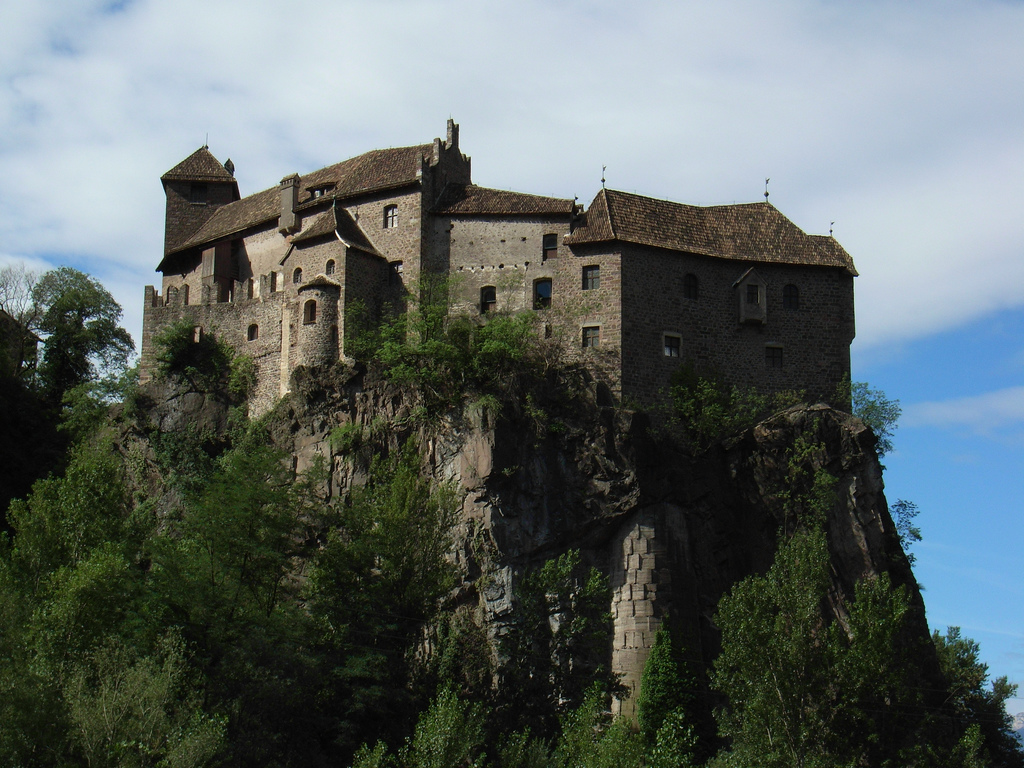
Ried Castle stands as a modest yet historically significant hill castle located near Bolzano in the South Tyrol region of Italy. Constructed around 1200, this high medieval fortress was strategically positioned at the entrance to the Sarntal valley, serving both defensive and administrative roles throughout its long history. Despite its relatively small size, the castle's architectural evolution and historical associations reflect the complex political and social dynamics of the Tyrolean region during the Middle Ages and beyond.
Early history and construction
The origins of Ried Castle trace back to the early 13th century, with the earliest documentary evidence dating to 1225, mentioning a ministerial named Heinrich de Riade. The castle was initially built as a fortified stronghold to control access to the Sarntal valley, a vital route in the region. Around 1250, significant expansions were undertaken, including the addition of residential buildings, a fortified outer enclosure known as a zwinger, and a chapel, which underscored the castle's growing importance as a local seat of power.
Architectural features from the 13th century
The 13th-century expansions introduced key architectural elements that define the castle's layout today. The residential quarters provided living spaces for the noble occupants and their retinue. The zwinger served as an outer ward between the main curtain walls and an additional defensive wall, designed to trap and expose attackers, enhancing the castle's defenses. The chapel within the complex catered to the spiritual needs of the inhabitants, reflecting the integral role of religion in medieval noble life.
Ownership and political significance
By the late 13th century, Ried Castle was owned by the von Wangen family, a noble lineage influential in the region. In 1307, the castle was sold to the wife of Duke Otto of Carinthia-Tyrol, marking its integration into the broader Tyrolean ducal holdings. Subsequently, the fortress functioned as a regional administrative center under the Tyrolean-Habsburg rule, with officials such as Lenhart Ortwegker managing the estate in the 15th century.
The castle as a customs post and noble residence
At the dawn of the 16th century, Emperor Maximilian I repurposed the castle as a customs post along the newly established road through the Sarntal valley. Ownership transferred to the Liechtenstein family by 1509, and later to Christoph Khuepacher in 1549, an imperial secretary to Emperor Maximilian II. Khuepacher was ennobled with the right to append "von und zu Ried" to his name and granted an enhanced coat of arms. His descendants rose to the rank of Freiherren (barons) von Kuepach zu Ried.
Refuge for a displaced ruler
In the late 16th century, the castle provided refuge to Petre Şchiopul, the last voivode (prince) of Wallachia, who fled advancing Ottoman forces. Şchiopul died while in sanctuary at Ried Castle and was buried in the Franciscan church in Bolzano. Remarkably, throughout its history, the castle was never captured by force, highlighting its defensive effectiveness.
19th and 20th-century restoration and cultural context
During the 19th century, the Freiherren von Ingram family acquired the castle and undertook restoration efforts that enhanced its medieval character. These restorations aimed to preserve the structure's historical essence while accentuating its castle-like appearance. In the early 20th century, under the Fascist regime's campaign to Italianize Germanic place names, the castle was renamed Castel Novale by Ettore Tolomei.
Historical events in the 20th century
Ried Castle was designated as the intended endpoint for the 1921 Bolzano fair procession. However, the march was halted due to violent confrontations known as the Bozen Bloody Sunday, a significant event in the region's turbulent history during the post-World War I period.
Architectural layout and current condition
Set within a small basin at the entrance to the Sarntal valley, Ried Castle occupies a strategic position. Historically, the Talfer river flowed along the castle's right bank, effectively surrounding it with water and classifying it as a water castle. Today, the river lies approximately twenty meters away due to natural course changes.
Defensive structures and residential elements
The castle's defensive system includes the curtain walls, the zwinger outer ward, and the original moat area. The residential quarters remain a central feature, illustrating the dual military and domestic functions of the fortress. The chapel within the complex continues to be a notable architectural and historical element.
Restoration impact and preservation
Restoration work by the Freiherren von Ingram in the 19th century contributed significantly to the castle's well-preserved state. These efforts enhanced the medieval character without compromising the authenticity of the structure. The castle retains its original coat of arms motif, featuring a black rooster on a golden background, symbolizing the identity of its early lords.
Access and ownership today
Currently, Ried Castle is privately owned and not open to the public. Its preservation as a largely intact medieval fortress offers valuable insight into the region's history and medieval architecture, even though direct visitation is restricted. The castle remains an important cultural landmark within the South Tyrol area.
Frequently asked questions (FAQ)
- What is the historical significance of Ried Castle?
- Ried Castle, located in Bolzano, Italy, dates back to the 13th century and is an excellent example of medieval architecture in the region. It served as a noble residence and has witnessed significant historical events, reflecting the power dynamics of the time between local rulers and the Church.
- When was Ried Castle built?
- Ried Castle was constructed in the early 13th century, with its first documented mention occurring in 1230. Over the years, it has undergone various renovations, yet it retains much of its original medieval charm.
- What are the opening hours of Ried Castle?
- Ried Castle is open to visitors from April to October, typically from 10 AM to 6 PM. However, it is advisable to check the official website for any seasonal changes or special events that may affect visiting hours.
- Can I access Ried Castle with public transportation?
- Yes, Ried Castle is accessible via public transportation. Visitors can take a bus from Bolzano to the nearby village, followed by a short walk to the castle, making it a convenient destination for those relying on public transit.
- Is it possible to take guided tours of Ried Castle?
- Yes, guided tours are available at Ried Castle, providing visitors with in-depth knowledge about its history and architecture. These tours are typically offered in multiple languages, ensuring a comprehensive experience for all guests.
- What is the best time to visit Ried Castle?
- The best time to visit Ried Castle is during the spring and early autumn when the weather is mild and the surrounding landscape is beautiful. This period also sees fewer crowds, allowing for a more enjoyable experience.
- What are the ticket prices for Ried Castle?
- Admission to Ried Castle is generally affordable, with ticket prices around €5 for adults and discounts available for children and seniors. Special rates may apply for guided tours, so it's a good idea to check in advance.
- Are there any nearby attractions to Ried Castle?
- Yes, Ried Castle is situated near several attractions, including the picturesque town of Bolzano and the stunning South Tyrol Museum of Archaeology, home to Ötzi the Iceman. Exploring these nearby sites can enhance your visit to the castle.
Information
Loading map...
Visitor reviews
No reviews yet. Been here? Write the first review and help other travelers!
Write the first reviewVisited this castle? Share your experience
Your review helps other travelers and adds first-hand knowledge to our encyclopedia.