Rümligen Castle
Rümligen Castle stands as a notable example of a High Medieval hill castle located in the municipality of Rümligen in the Canton of Bern, Switzerland. Its origins date back to around 1076, marking it as a historically significant structure within the Swiss heritage landscape. The castle is recognized as a Swiss heritage site of national significance, reflecting its architectural and historical importance.
The early history and medieval origins
During the High Middle Ages, the castle was the seat of the Freiherr von Rümligen, a noble family controlling extensive lands between the Gürbe and Sense rivers. The family first entered historical records in 1076 when Lütold von Rümligen founded the Rüeggisberg Priory. By the 13th century, the family had established close ties with the city of Bern, a relationship that would influence the castle's history and ownership for centuries.
In the early 14th century, Berchtold von Rümligen served as Schultheiss (mayor) of Bern from 1320 to 1321, demonstrating the family's political significance. Over time, the family split into branches, including the Simmental and Summerau lines, each acquiring their own territories. In 1380, the Sommerau-Rümligen line merged back into the main family line through the marriage of Alisa von Rümligen to Peter von Sommerau, consolidating their estates.
Bernese control and decline of the noble family
By 1388, the Freiherren came under the control of the expanding Bernese state, though they retained ownership of their estates for another century and a half. Notably, Gilian von Sommerau-Rümligen, a descendant of Peter, held several bailiff positions in Bernese cities and distinguished himself as a Bernese captain at the Battle of Nancy in 1447.
Despite their early prominence, the family's fortunes waned in the following century. Financial difficulties forced the sale of the Herrschaft of Rümligen to Bern for 370 pounds. The last Freiherr von Rümligen died unmarried in 1579, marking the end of the direct noble line associated with the castle.
Ownership changes and baroque transformation
During the 17th century, the castle passed through several Bernese patrician families. In 1634, Johann Rudolf von Erlach acquired the castle and estates. His grandson sold it in 1680 to Ferdinand von Wattenwyl, who shortly thereafter sold it to Samuel Frisching. Upon Samuel Frisching's death in 1683, his son Samuel Frisching II inherited the property.
Samuel Frisching II significantly altered the castle in 1709 by constructing a new Baroque castle around the medieval core. His distinguished career included commanding Bernese troops to victory in the Toggenburg War of 1712 as head of the Bernese War Council and serving as Schultheiss of Bern from 1715 until his death in 1723.
Architectural features and layout
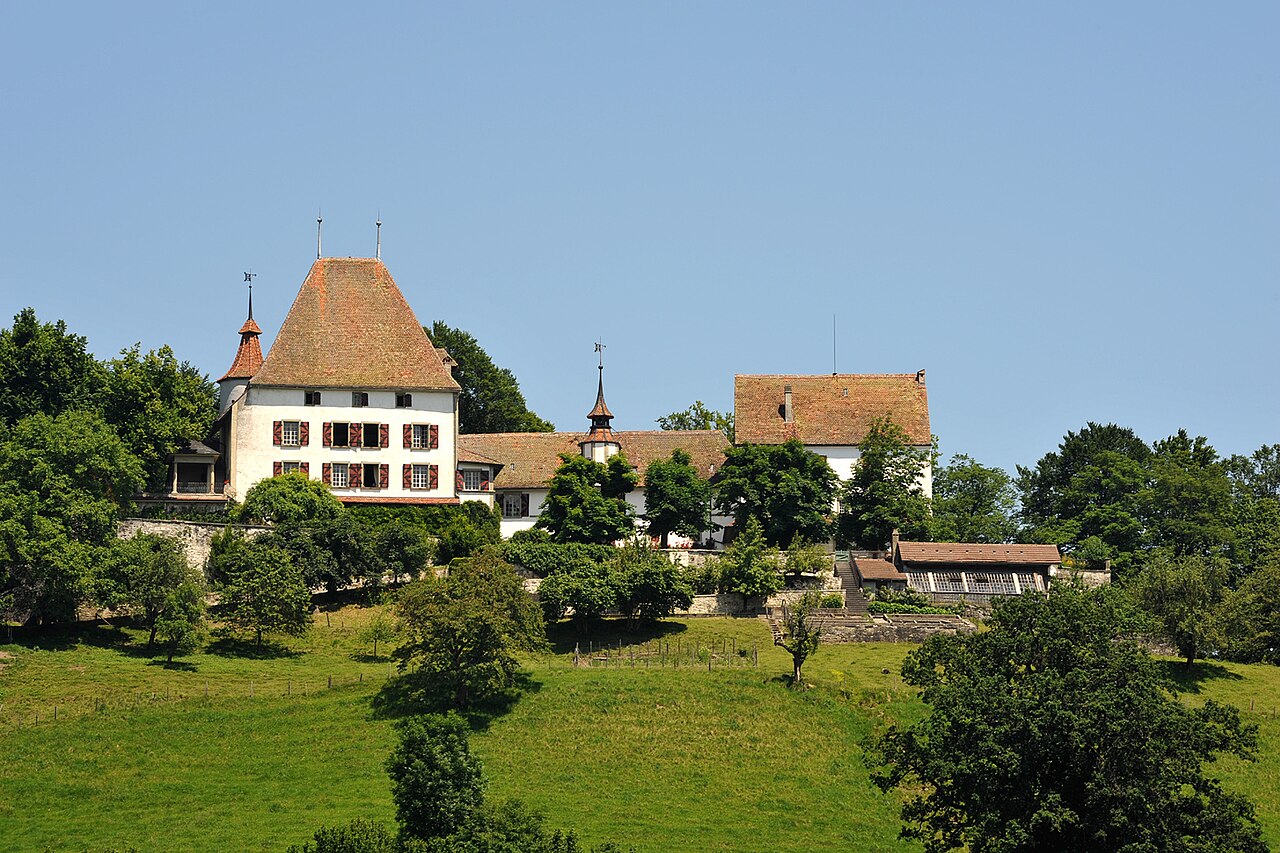
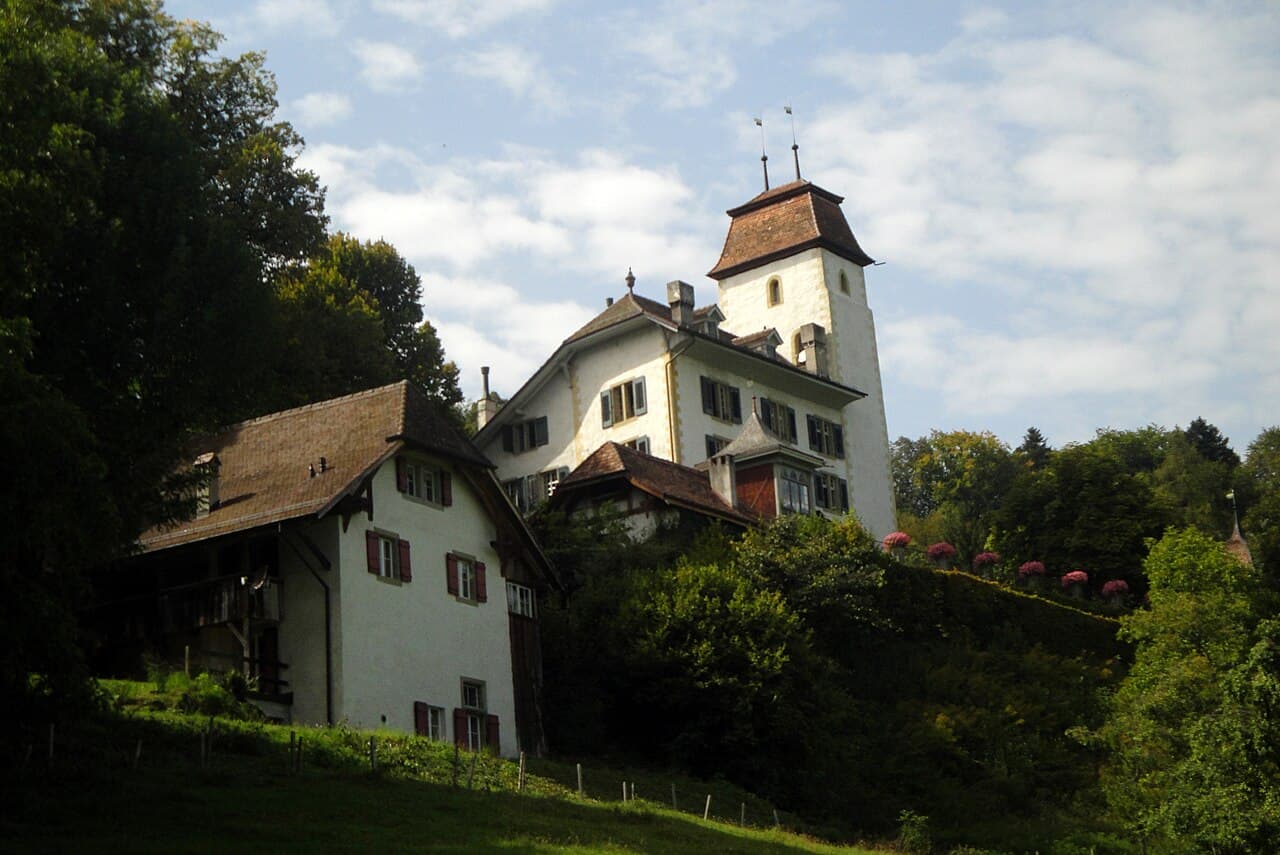
The castle's most prominent medieval feature is its tower, which remains visible above the later Baroque additions. This tower was given a Baroque mansard roof during the 18th-century renovations. The residential wing located to the south of the tower likely dates back to the medieval period but was extensively rebuilt during the Baroque transformation.
The castle complex includes a garden and a courtyard partially enclosed by the tower and residential wing, carved into the hillside. There is speculation that the medieval castle was constructed on or incorporated a much earlier Roman-era watchtower, though this remains unconfirmed.
Later history and current status
Following the French invasion of 1798 and the establishment of the Helvetic Republic, the castle's owners retained the property but lost their manorial rights over the local villagers. The castle remained with the Frisching family until 1838, when it passed to the von Wattenwyl von Bursinel family through marriage.
After the death of Friedrich von Wattenwyl in 1877, the castle was inherited by Dr. Ludwig Moritz Albert Tscharner, who resided there frequently until his death in 1927. Today, Rümligen Castle stands as a well-preserved example of a hill castle that integrates medieval and Baroque architectural elements, reflecting the complex history of noble families and Bernese influence in the region.
Frequently asked questions (FAQ)
- How do I visit Rümligen Castle?
- Rümligen Castle is privately owned and not regularly open to the public. Visitors should check local tourism websites for any special open days or events when access might be granted.
- What is the historical significance of Rümligen Castle?
- Rümligen Castle was the seat of the Freiherr von Rümligen family from the High Middle Ages and reflects the political and social history of the Bernese region, including ties to Bernese governance and military history.
- When was the Baroque renovation of Rümligen Castle completed?
- The Baroque renovation was completed in 1709 by Samuel Frisching II, who built a new castle structure around the medieval core, adding mansard roofs and residential wings.
- Is Rümligen Castle a Swiss heritage site?
- Yes, Rümligen Castle is listed as a Swiss heritage site of national significance, recognizing its historical and architectural value.
- Are there any notable architectural features at Rümligen Castle?
- The castle features a medieval tower with an 18th-century Baroque mansard roof, a residential wing rebuilt in the Baroque style, and a courtyard and garden carved into the hillside.
Photo gallery

Information
Loading map...
Visitor reviews
No reviews yet. Been here? Write the first review and help other travelers!
Write the first reviewVisited this castle? Share your experience
Your review helps other travelers and adds first-hand knowledge to our encyclopedia.