Ruine Lichtenburg
Ruine Lichtenburg is a remarkable example of a medieval hill castle strategically perched on the Schlossberg hill overlooking the town of Ostheim in the Rhön region of Germany. Constructed originally in the 12th century, this fortress was built by a branch of the Counts of Henneberg, a prominent noble family influential in the region during the High Middle Ages. The castle's earliest documented mention dates to 1161, marking it as a significant military and administrative site for centuries.
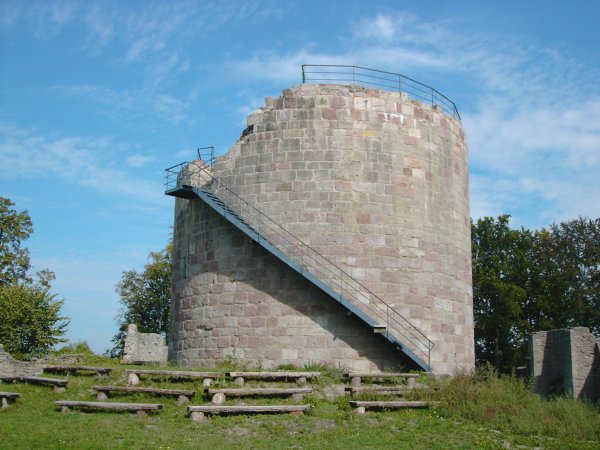
The castle initially served as a fortified noble residence, described as a "Castrum" in 1230, indicating its role as a military stronghold. Its importance grew in the early 14th century when Abbot Heinrich VI of Fulda enhanced its defenses by constructing the imposing bergfried, a tall, tower-like keep typical of German castles. This bergfried, rising to over 31 meters including a modern viewing platform, remains the tallest in the Rhön area and exemplifies medieval defensive architecture.
Historical significance and ownership transitions
Throughout its history, Ruine Lichtenburg played a pivotal role as the administrative center of the Amt Lichtenberg, a regional district under the ecclesiastical authority of Fulda Abbey. Ownership shifted several times, returning to the Henneberg family through the Römhild line in the mid-14th century before passing to Saxon control. The castle endured significant damage during the 16th-century Peasants' War, a major uprising against feudal lords, but was swiftly repaired to continue its function.
By the late 17th century, the castle's strategic and administrative importance waned, particularly after the departure of the last local overseer, Friedrich Sebastian von Stein, in 1680. Although briefly refortified during the conflicts between the Holy Roman Empire and France in the early 1670s, the castle was eventually abandoned and slated for demolition by 1719. Subsequent ownership by Carl August of Weimar and restoration attempts by Ernst August of Sachsen-Weimar-Eisenach in the mid-18th century were only partially successful, and the castle fell into ruin.
Architectural features and layout
The castle complex is defined by extensive defensive ramparts encircling the precinct, reflecting its military purpose. Visitors today approach via a paved path leading to a Renaissance-era gatehouse, which replaced an earlier drawbridge. This gatehouse features thick walls and a robust gate designed to withstand assaults, illustrating the evolution of castle defenses over time.
The centerpiece of Ruine Lichtenburg is its bergfried, constructed under Abbot Heinrich VI in the early 14th century. This tower, originally built for defense and surveillance, stands as a testament to medieval masonry techniques with its well-preserved stonework reaching 28 meters in height. The bergfried has been adapted with a modern viewing platform and protective roof, preserving its commanding presence and offering panoramic views of the surrounding landscape.
Within the castle grounds, a forecourt leads to the main castle area, which was separately fortified. This inner enclosure contains the remains of key residential and functional buildings including the palas, the great hall serving as the lord's principal living quarters, and the kemenate, or women's chamber, which provided private quarters for noblewomen. The presence of stables and a chapel further highlight the castle's dual military and domestic functions, typical of knightly residences.
The chapel ruins remain visible as fragmentary walls, underscoring the spiritual dimension of the castle complex. The spatial arrangement reflects a clear hierarchy, with the bergfried positioned near the entrance for maximum defensive advantage, surrounded by interconnected buildings enclosed by walls and earthworks. This design exemplifies the integration of fortification and habitation in medieval castle architecture.
Preservation and modern significance
Today, Ruine Lichtenburg is recognized as a valuable cultural heritage site. The substantial survival of original stonework in the bergfried and palas provides rare insight into medieval construction methods. The castle's ruins have been carefully preserved since the 19th century, following periods of neglect and partial quarrying.
A dedicated preservation society now oversees the site, ensuring ongoing maintenance and public accessibility. The castle’s location on Schlossberg hill not only offers historical context but also spectacular views of Ostheim and the surrounding Rhön landscape, making it a popular destination for visitors interested in medieval history and architecture.
Ruine Lichtenburg stands as a compelling example of a hill castle that evolved through centuries of military, administrative, and domestic use. Its architectural features, from the towering bergfried to the Renaissance gatehouse, provide a tangible link to the region's High and Late Medieval periods. The castle's layered history and well-preserved ruins contribute significantly to our understanding of German medieval fortifications and noble residences.
Frequently asked questions (FAQ)
- How do I get to Ruine Lichtenburg?
- Ruine Lichtenburg is located on Schlossberg hill near Ostheim in the Rhön region of Germany. Visitors can reach the site by car or local transport to Ostheim, followed by a walk up the paved path to the castle ruins.
- What is the best time to visit Ruine Lichtenburg?
- The castle is best visited during spring through autumn when the weather is favorable for exploring the hilltop ruins and enjoying panoramic views from the bergfried.
- Can I climb the bergfried at Ruine Lichtenburg?
- Yes, the bergfried has been adapted with a viewing platform and protective roof, allowing visitors to safely climb and enjoy expansive views of the surrounding landscape.
- Is Ruine Lichtenburg wheelchair accessible?
- Due to its hilltop location and uneven terrain, Ruine Lichtenburg is not fully wheelchair accessible. Visitors should be prepared for some walking on slopes and rough paths.
- Are there guided tours available at Ruine Lichtenburg?
- Guided tours may be available through local tourist offices or the preservation society. It is recommended to check in advance for scheduled tours and special events.
Information
Website
Visit websiteSources & official resources
Verify the information above using these authoritative references.
Loading map...
Visitor reviews
No reviews yet. Been here? Write the first review and help other travelers!
Write the first reviewVisited this castle? Share your experience
Your review helps other travelers and adds first-hand knowledge to our encyclopedia.