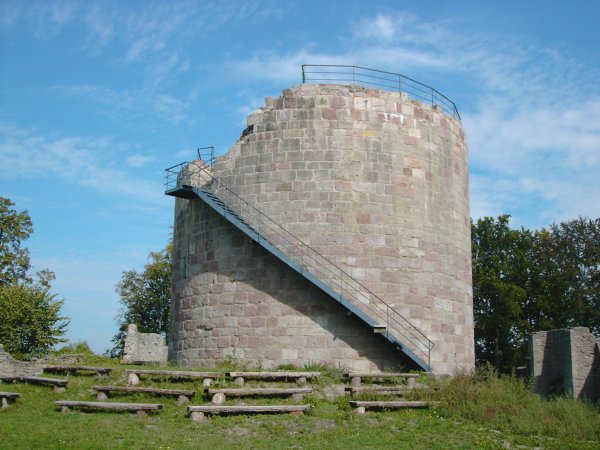
Roßrieth Castle
Roßrieth Castle stands as a remarkable example of a Renaissance water castle located in the municipality of Mellrichstadt, Germany. Its origins reach deep into the medieval period, with the site first documented in 1140, highlighting its early importance in the region. Established by local Germanic nobility during the High Middle Ages, the castle embodies centuries of architectural evolution, feudal dynamics, and regional history.
Medieval origins and feudal history
The castle's earliest recorded mention dates to 1140, situating it firmly within the High Medieval period. By 1345, individuals such as Conrad von Rosserieth were associated with the estate, indicating its role as a noble residence within the complex feudal landscape of medieval Germany. Ownership transitioned in 1361 to the Schenken von Stretelingen family, who engaged in typical feudal practices by transferring parts of the estate to the Abbey of Fulda, only to receive it back as a fief. This reflects the intricate relationships between secular and religious powers during the Middle Ages.
In 1401, the castle was significantly damaged when local peacekeepers attacked it due to its alleged use as a base for robber barons, noble outlaws who threatened trade and local authority. Despite this destruction, the castle's core structures endured, allowing it to remain habitable and strategically important through subsequent centuries.
Renaissance transformation and architectural features
The 16th century marked a pivotal era for Roßrieth Castle, with the Counts of Mansfeld granting it to the Freiherren von Thüngen in 1548. A significant rebuilding phase occurred in 1563, focusing on the castle's lower sections to enhance its defenses and residential spaces. Ownership passed in 1589 to the Herren von Bibra, who undertook extensive remodeling around 1590, transforming the castle into a quintessential example of Renaissance architecture in the region.
The castle's current form features a roughly square layout with two main wings, surrounded by a moat approximately 20 meters wide and 2 meters deep, characteristic of water castles designed for defense. The use of half-timbered construction in the main buildings reflects typical German Renaissance building techniques, combining wooden frameworks with infill materials. This method allowed the integration of earlier medieval fabric into the new structures, preserving the castle's historical continuity.
A particularly striking element is the former bergfried or main defensive tower, which retains its medieval form up to the level where the half-timbered upper stories begin. This tower still features original arrow slits, narrow vertical openings used for defense, providing a direct link to the castle's martial past. The gate complex also reveals pre-Renaissance masonry and design, indicating its role as a fortified entrance during the castle's medieval heyday.
Later ownership and preservation efforts
Following the Renaissance period, Roßrieth Castle passed through several noble families, including Hilmar von Grappendorf in 1681 and the Freiherren von Stein from 1768. The latter family maintained ownership until 1835, when the castle was voluntarily transferred to the Bavarian state, reflecting broader political changes in the region.
In the 20th century, the castle's function shifted dramatically. After World War II, it was repurposed for agricultural uses under private ownership, serving as grain storage and a chicken coop. This utilitarian phase marked a significant departure from its noble origins but also contributed to the preservation of the structure by maintaining its use.
A major restoration between 1980 and 1985 focused on preserving the castle's exterior and Renaissance character, ensuring that its layered architectural history remains visible and accessible. Today, Roßrieth Castle stands as a well-preserved monument that illustrates the evolution from medieval fortification to Renaissance residence, embodying the cultural heritage of Mellrichstadt and the wider region.
Architectural layout and defensive features
The castle's design reflects its dual role as a defensive stronghold and noble residence. The surrounding moat, a defining feature of water castles, provided a formidable obstacle against attackers, while the square layout with two main wings optimized both defense and domestic functionality.
The corner towers served as key defensive and observation points, enhancing the castle's ability to monitor and repel threats. The integration of medieval basement structures within the castle's core underscores the continuity of fortification strategies from the Middle Ages through the Renaissance.
The half-timbered upper structures, typical of 16th-century German architecture, not only contributed to aesthetic appeal but also allowed for flexible interior layouts suited to the needs of the noble families who resided there. The presence of the alliance coat of arms of the Bibra and Gebsattel families on the stair tower symbolizes the social and political alliances that shaped the castle's history.
Cultural significance and visitor experience
Roßrieth Castle is a valuable cultural landmark, representing the architectural and historical transitions of German noble estates over several centuries. Its preservation and restoration efforts have made it accessible to those interested in medieval and Renaissance architecture, feudal history, and the complex social dynamics of the region.
Visitors can appreciate the castle's unique combination of medieval defensive elements and Renaissance residential features, gaining insight into the lifestyle and strategic concerns of its former inhabitants. The castle's setting within the scenic landscape of Mellrichstadt further enhances its appeal as a heritage site.
Frequently asked questions (FAQ)
- When was Roßrieth Castle originally built?
- Roßrieth Castle was first mentioned in historical records in 1140, indicating its establishment during the High Medieval period.
- What architectural style characterizes Roßrieth Castle?
- The castle prominently features Renaissance architectural elements, especially from the extensive remodeling around 1590, combined with medieval foundations.
- Is Roßrieth Castle surrounded by a moat?
- Yes, the castle is a water castle with a moat approximately 20 meters wide and 2 meters deep, which served as a defensive feature.
- Can visitors see medieval defensive features at the castle?
- Visitors can observe original medieval elements such as the bergfried tower with arrow slits and the pre-Renaissance gate complex, highlighting its defensive history.
- Who were some of the notable owners of Roßrieth Castle?
- Notable owners include the Schenken von Stretelingen family, Freiherren von Thüngen, Herren von Bibra, Hilmar von Grappendorf, and the Freiherren von Stein.
Information
Current owner
Private owner
Loading map...
Visitor reviews
No reviews yet. Been here? Write the first review and help other travelers!
Write the first reviewVisited this castle? Share your experience
Your review helps other travelers and adds first-hand knowledge to our encyclopedia.