Rudkhan Castle
Rudkhan Castle, a formidable medieval fortress nestled in the lush mountains of Gilan province, Iran, stands as a remarkable testament to the region's rich military and architectural heritage. Constructed originally during the Sasanian Empire period, this hill castle was strategically placed to guard against invasions, notably during the era of the Arab conquest of Persia. Its enduring presence highlights its significance as a defensive stronghold in northern Iran.
The castle's history is deeply intertwined with the Seljuk period, during which it underwent extensive reconstruction to adapt to the evolving needs of warfare and governance. This phase of rebuilding enhanced its fortifications, making it a critical bastion for the Ismaili sect, who utilized Rudkhan Castle to consolidate their influence in the region. The castle's strategic importance continued into the early 16th century under the leadership of Sultan Hesam al-Din Dabaj Fumani, also known as Muzaffar al-Sultan. Between 1513 and 1515 CE (918-921 AH), he undertook significant renovations that strengthened the fortress's defenses and infrastructure.
Sultan Hesam al-Din's tenure was marked by fierce resistance against the expanding Safavid dynasty and incursions by English forces. From Rudkhan Castle, he successfully repelled multiple attacks, underscoring the fortress's formidable design and strategic location. Despite his efforts, he was ultimately captured, taken to Tabriz, and executed, marking a pivotal moment in the region's turbulent history.
Remarkably, throughout its extensive history, Rudkhan Castle is recorded as never having been breached by enemy forces, a testament to its robust construction and tactical advantages. Its recognition as a national historical monument of Iran on August 21, 1975 solidifies its cultural and historical significance. The castle first gained modern scholarly attention through the work of Polish researcher Aleksander Chodżko, who documented it during his travels in 1830.
Architectural layout and defensive features
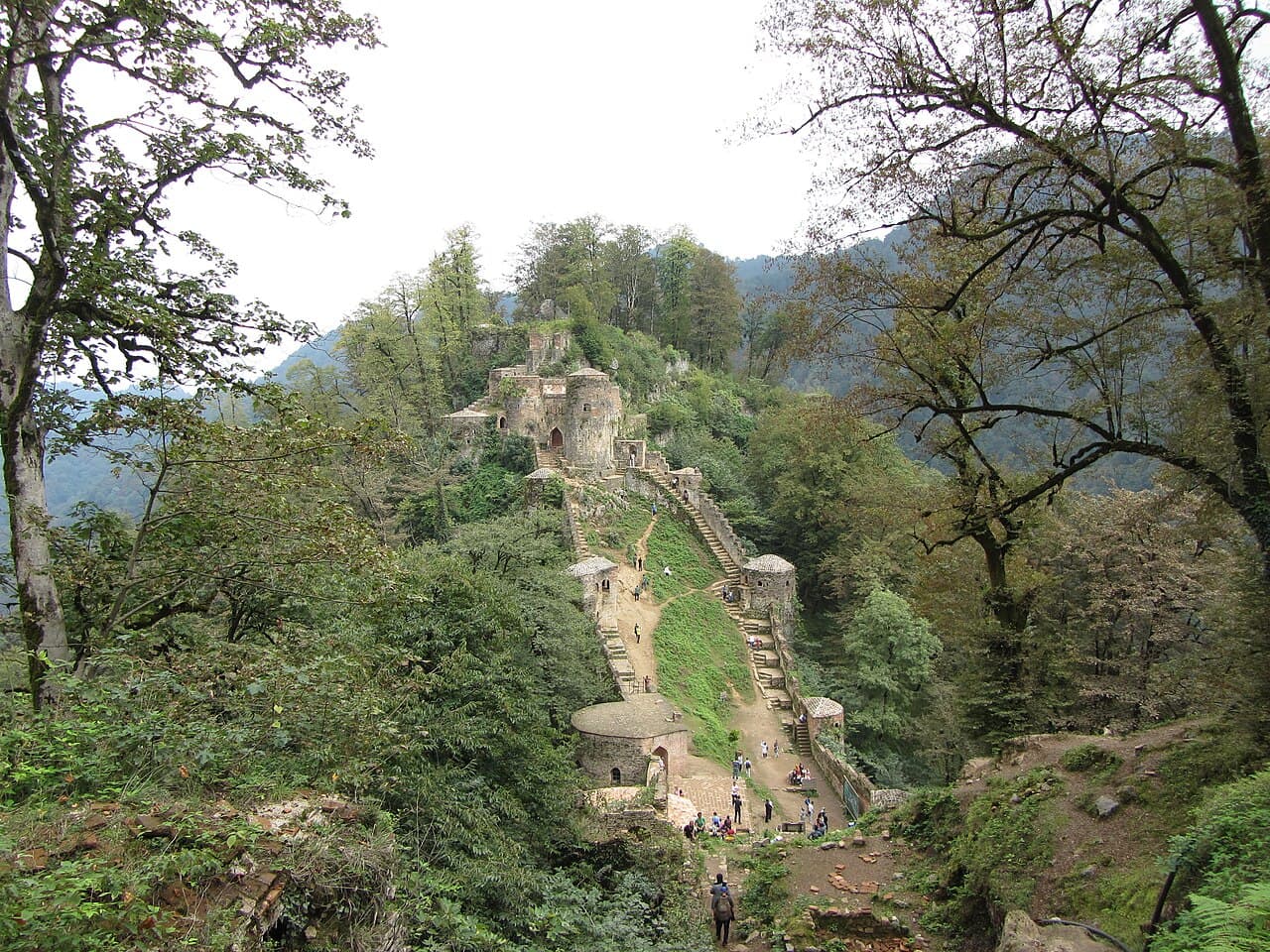
Set amidst the dense forests and rugged terrain adjacent to the Rudkhan River, the castle's footprint spans an impressive area estimated between 26,000 and 62,000 square meters. Its fortress walls stretch approximately 1,500 meters, following the natural contours of a narrow ridge about five kilometers long and varying between ten to fifty meters wide. This integration of natural landscape with man-made defenses exemplifies sophisticated medieval military architecture.
Division into citadel and eastern quarters
The castle is distinctly divided into two main sections. The western part functions as the citadel or main keep, featuring a large two-story brick building that served as the residence of the ruling elite and included a harem. This area also housed essential amenities such as water reservoirs, bathhouses, a cold storage room, and multiple residential units. These facilities were protected by thick defensive walls and numerous towers, providing both security and comfort for its inhabitants.
The eastern section was primarily dedicated to military functions, containing barracks and an armory. It featured twelve entrances, including a prison, an emergency exit, and additional bathhouse and sanitation facilities. The barracks were constructed over two stories with numerous windows and defensive openings, allowing for effective surveillance and protection of the surrounding area.
Fortifications and towers
The fortress's defensive architecture is reinforced by 65 towers, of which 42 remain intact. Most notable among these are 40 octagonal watchtowers topped with domed vaults, a distinctive architectural feature. The walls and towers are built from a combination of stone and brick bonded with sarooj, a traditional waterproof mortar known for its durability against the region's humid climate.
The walls vary in height and thickness, ranging from three to ten meters depending on their location along the ridge. They incorporate sloped loopholes, narrow angled openings designed to enable defenders to pour boiling substances or launch arrows and spears at attackers while remaining protected. This level of defensive detail reflects advanced military engineering of the period.
Water supply and access
Ensuring a reliable water source was critical for the castle's sustainability during sieges. A natural spring is located within the lower reaches of the fortress, providing fresh water to its occupants. The castle's construction deliberately avoided the use of wood due to the area's high humidity, opting instead for more resilient materials to prevent decay and maintain structural integrity over centuries.
Access to the fortress is challenging, involving an ascent of approximately 1,620 steps along the mountainous terrain, with elevations ranging from 655 to 715 meters above sea level. This difficult approach added an additional layer of defense, deterring potential attackers and emphasizing the castle's strategic siting.
Historical significance and legacy
Rudkhan Castle exemplifies the fusion of natural landscape and human ingenuity in medieval military architecture. Its continuous use and maintenance across different ruling periods—from the Sasanian Empire through the Seljuk era and into the early modern period—highlight its enduring importance as a military and administrative center.
The castle's resilience against numerous sieges and its role as a bastion for the Ismaili sect and later regional rulers underscore its strategic value. Today, Rudkhan Castle remains a well-preserved monument, attracting historians, architects, and tourists interested in Iran's rich cultural heritage and medieval fortification techniques.
Visitors to Rudkhan Castle can explore its extensive walls, towers, and internal structures, gaining insight into the defensive strategies and daily life of its historic inhabitants. The castle's integration with the surrounding natural environment also offers a unique experience of Iran's mountainous and forested landscapes.
Frequently asked questions (FAQ)
- How do I get to Rudkhan Castle?
- Rudkhan Castle is located in the Gilan province of Iran, approximately 20 kilometers from the city of Fuman. The best way to reach the castle is by car or taxi, as public transportation options are limited. The journey involves a scenic drive through lush landscapes, followed by a short hike to the castle itself.
- What is the historical significance of Rudkhan Castle?
- Rudkhan Castle dates back to the Sassanid era, around the 10th century, and serves as a significant example of Persian military architecture. It is believed to have been used as a fortress to protect the region from invasions, particularly during the Islamic period. The castle's strategic location and robust walls reflect the military ingenuity of its time.
- When was Rudkhan Castle last renovated?
- Rudkhan Castle has undergone several renovations, with the most significant restoration occurring in the early 2000s. These efforts aimed to preserve the castle's structure and enhance its appeal to visitors. The restoration has allowed tourists to explore its impressive towers and walls while ensuring the site's historical integrity.
- Can I visit Rudkhan Castle year-round?
- Yes, Rudkhan Castle is open for visitors year-round, but accessibility may vary depending on weather conditions. The best times to visit are during spring (March to May) and autumn (September to November) when the climate is mild and the surrounding nature is particularly beautiful. Winter visits can be challenging due to snow and cold temperatures.
- Why is Rudkhan Castle considered a popular tourist attraction?
- Rudkhan Castle is renowned for its stunning architecture and picturesque setting amidst the lush forests of Gilan. The combination of historical significance and breathtaking views makes it a must-visit destination for both history enthusiasts and nature lovers. Visitors enjoy hiking to the castle and exploring its ancient structures while soaking in the surrounding beauty.
- Is it possible to hike to Rudkhan Castle?
- Yes, hiking to Rudkhan Castle is a popular activity among visitors. The trail leading to the castle is well-marked and offers a moderately challenging hike that takes approximately 30 to 45 minutes. Along the way, hikers can enjoy the scenic views and lush greenery of the region.
- What are the opening hours for Rudkhan Castle?
- Rudkhan Castle is typically open from early morning until sunset, allowing visitors ample time to explore the site. During peak tourist seasons, the opening hours may be extended to accommodate more visitors. It is advisable to check local resources for the most current information before planning your visit.
- Are there any ticket prices for entering Rudkhan Castle?
- Yes, there is a nominal entrance fee to visit Rudkhan Castle, which helps support its maintenance and preservation. The ticket prices are quite affordable, making it accessible for a wide range of visitors. Children under a certain age may be eligible for free entry, so check the latest pricing details before your visit.
- What nearby attractions can I explore after visiting Rudkhan Castle?
- After visiting Rudkhan Castle, you can explore other attractions in the Gilan province, such as the beautiful city of Fuman and the stunning Masuleh village, known for its unique architecture and mountainous scenery. The region is also famous for its lush nature and opportunities for hiking and enjoying local cuisine. Make sure to allocate time to experience the rich culture and natural beauty of the area.
Photo gallery

Information
Loading map...
Visitor reviews
No reviews yet. Been here? Write the first review and help other travelers!
Write the first reviewVisited this castle? Share your experience
Your review helps other travelers and adds first-hand knowledge to our encyclopedia.