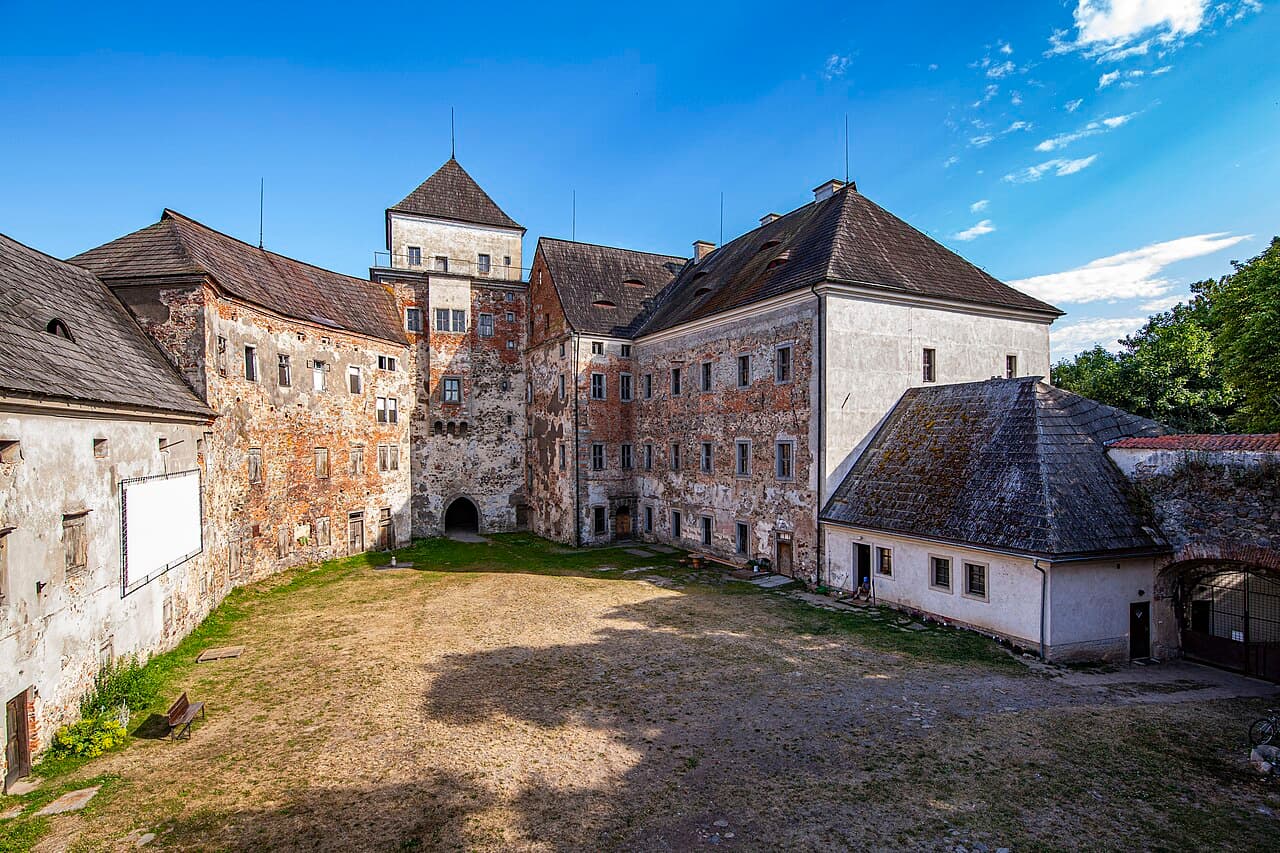
Rožmitál pod Třemšínem Castle
Rožmitál pod Třemšínem Castle stands as a significant medieval fortress located in the town of Rožmitál pod Třemšínem, within the Central Bohemian Region of the Czech Republic. Founded in the first half of the 13th century by Oldřich of the Buzic family, it became the ancestral seat of the Lords of Rožmitál, a noble lineage that played an important role in regional administration and defense. The castle's strategic position on a hill with natural water defenses made it a formidable stronghold during the High Medieval period.
The original construction reflects typical Gothic architectural elements of the 13th century, characterized by an oval-shaped perimeter wall and a moat supplied by a northern pond. This moat was crossed by drawbridges, enhancing the castle's defensive capabilities. The earliest surviving masonry, particularly in the eastern wing, dates back to this initial phase, showcasing the robust stonework and fortification techniques of the era.
Medieval origins and early history
The castle's early history is marked by notable events and complex ownership dynamics. In 1347, Sezima of Rožmitál donated half of the castle and its estates to the Archbishopric of Prague, which led to disputes with his brother Zdeněk and Archbishop Arnošt of Pardubice. These conflicts reflected broader tensions between secular and ecclesiastical powers during the period. Despite the disputes, the archbishops retained their share until the Hussite Wars in the early 15th century, after which the property was reunited under the Lords of Rožmitál.
The Rožmitál family produced prominent figures such as Joanna of Rožmitál, queen consort to King George of Poděbrady, and Jaroslav Lev of Rožmitál, a diplomat and cultural patron. However, financial difficulties in the mid-16th century forced Zdeněk Lev of Rožmitál to relinquish the estate to creditors, prompting his descendants to move to Moravia.
Renaissance transformation under florián gryspek
Between 1550 and 1555, the castle was acquired by Florián Gryspek, a nobleman with Bavarian and Austrian ties and a royal official. He initiated a comprehensive reconstruction from 1559 to 1564, transforming the medieval fortress into a Renaissance residence. This included the construction of the Great Palace (Gryspekovský Palace), a two-story building arranged in three wings around an irregular courtyard, which extended beyond the original oval walls.
The gate tower was heightened by two floors and embellished with decorative elements such as sgraffito and rosette window frames from the 1570s. The castle's facades still retain traces of rustic plaster from this period, highlighting the Renaissance aesthetic. Gryspek also expanded the estate's infrastructure, adding facilities for brewing, baking, grain storage, and water supply, turning the castle into a multifunctional complex.
Ancillary buildings and estate development
Among the ancillary structures were a brewery, bakery, granaries, malt house, silos, apiaries, hop gardens, and a tavern. The brewery was particularly notable, operating from the 17th century until 1941, with facilities including malt houses, fermentation and storage cellars, and a brewmaster's residence. Despite the malt house's demolition in 1979, the brewery remained a key economic feature through the 19th century, incorporating late 19th-century innovations such as a cooling box to preserve beer quality.
Archiepiscopal ownership and decline
Following the confiscation of the Gryspek estate in 1622 due to their participation in the Estates Revolt, Emperor Ferdinand II granted the castle to Archbishop Ernst Adalbert of Harrach in 1623. The archbishops used it as a summer residence, but the castle suffered four major fires in 1660, 1724, 1813, and 1940. These fires caused extensive damage, especially to the Great Palace and the gate tower, which was reduced by one floor after the 1724 fire.
Repairs were often slow or incomplete, contributing to the gradual decline of the castle’s structural integrity over the centuries. Restoration efforts in the 20th century focused on roofing, facades, and water supply systems, including the restoration of the tower gallery and gateway.
Modern era and conservation efforts
After World War II, the castle was nationalized in 1948 and repurposed by the Czechoslovak State Forests for apartments and offices until the 1970s. In 1974, ownership transferred to the town of Rožmitál, which intended to establish a regional history museum. However, political changes following the Velvet Revolution in 1989 interrupted these plans. The castle was returned to the Archbishopric of Prague in the 1990s and later sold to a private investor in 1998, who began renovations that ceased by 2006 due to financial issues.
In 2014, neglect led to the collapse of part of the roof in the oldest section, a former brewery. Starting in 2017, a civic initiative supported by the Czech National Trust formed the Rožmitálský zámek association in 2019, which undertook conservation and reopened the castle to the public by late 2018. Since then, the castle has hosted cultural events managed by volunteers and served as a filming location for the 2024 film Nosferatu.
Architectural features and layout
The castle’s layout reflects its evolution from a medieval fortress to a Renaissance noble residence. The original oval perimeter wall, moat, and drawbridges highlight its defensive origins. The late Gothic period introduced a large tower with bay windows and a four-room palace, requiring partial demolition of the outer wall. Fortifications were enhanced with ramparts and round bastions.
The Renaissance Great Palace extends beyond the medieval walls, featuring three wings around an uneven courtyard. The gate tower, raised and decorated during the Renaissance, remains a dominant feature despite fire damage and alterations. The castle grounds include remnants of the brewery complex and a garden transformed into an English-style park in the late 18th century, which was publicly accessible until the mid-19th century.
Recent restoration and public access
Recent conservation efforts have focused on clearing vegetation, removing debris, and conducting minor repairs. New main gate doors were installed, and shingle roofing on the Old and Small Palaces has been partially replaced between 2023 and 2024. The castle is partially accessible to visitors, with guided tours available to the tower, preserving its role as a historical monument shaped by centuries of architectural and ownership changes.
Frequently asked questions (FAQ)
- When was Rožmitál pod Třemšínem Castle originally built?
- Rožmitál pod Třemšínem Castle was originally constructed in the first half of the 13th century, reflecting Gothic architectural styles.
- What architectural styles are visible at Rožmitál pod Třemšínem Castle?
- The castle features primarily Gothic architecture from its original construction, with significant Renaissance modifications made during the 16th century.
- Can visitors tour the castle today?
- Yes, the castle is partially accessible with guided tours available, including access to the tower. Conservation efforts have improved visitor access since 2018.
- What notable historical figures are associated with the castle?
- Notable figures include Joanna of Rožmitál, queen consort to King George of Poděbrady, and Jaroslav Lev of Rožmitál, a diplomat and cultural patron.
- How did the Renaissance reconstruction change the castle?
- Between 1559 and 1564, Florián Gryspek transformed the medieval fortress into a Renaissance residence, adding the Great Palace and raising the gate tower with decorative sgraffito and rosette windows.
- What caused the castle's decline in the 17th to 20th centuries?
- The castle suffered four major fires and slow repairs, leading to gradual structural decline. Ownership changes and political events also affected its maintenance.
Photo gallery

Information
Sources & official resources
Verify the information above using these authoritative references.
Loading map...
Visitor reviews
No reviews yet. Been here? Write the first review and help other travelers!
Write the first reviewVisited this castle? Share your experience
Your review helps other travelers and adds first-hand knowledge to our encyclopedia.



