Rougemont Castle
Rougemont Castle, also known as Exeter Castle, is a significant hill castle located in the city of Exeter, Devon, England. Constructed shortly after the Norman Conquest in or around 1068, the castle was built into the northern corner of the Roman city walls of Exeter. This strategic position allowed it to serve as a stronghold following the city's rebellion against William the Conqueror. The castle's location on a natural elevation, composed of distinctive red sandstone, gave rise to its name, "Rougemont," referring to the red stone used in its original construction.
Early construction and medieval fortifications
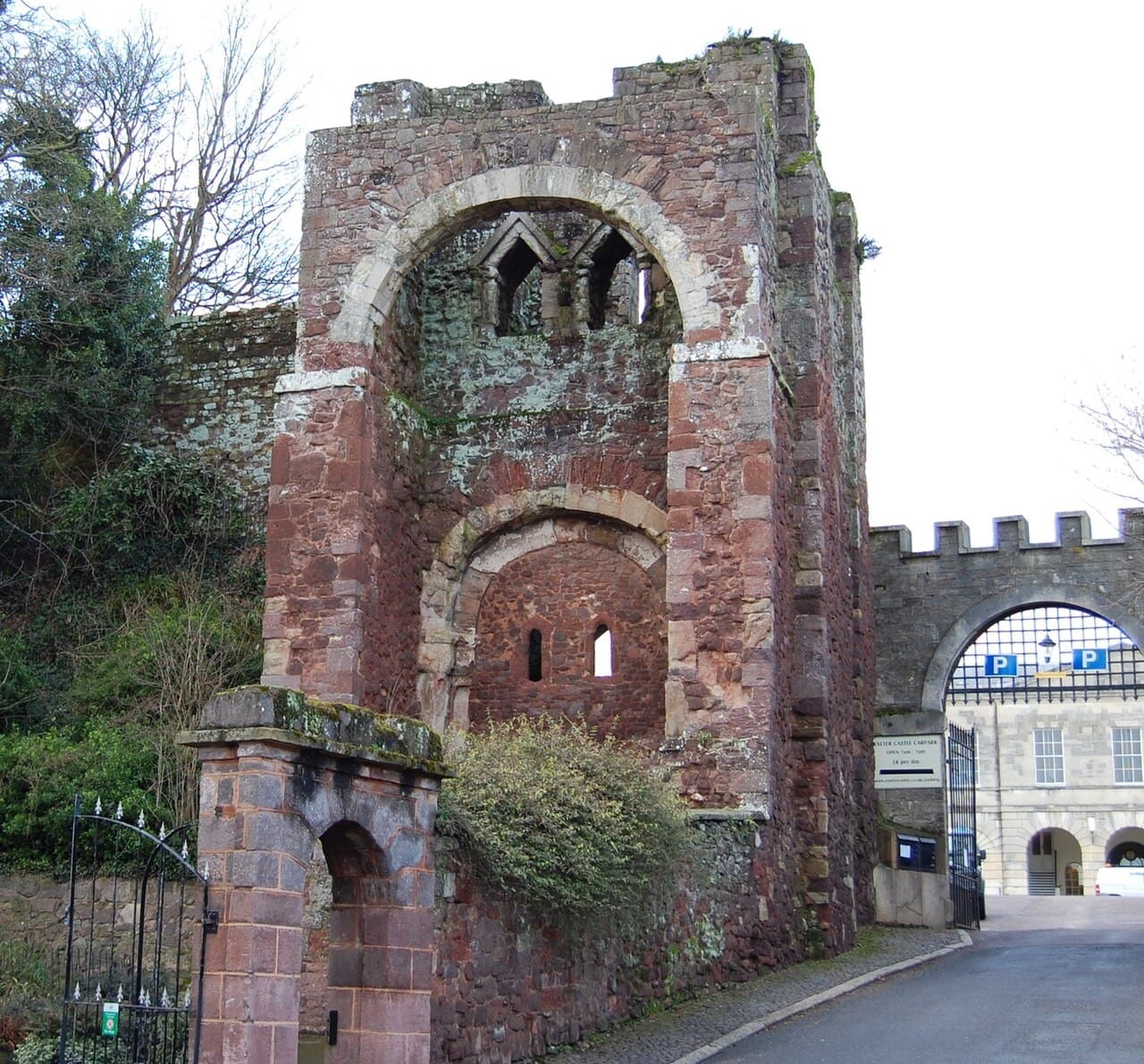
The initial structure of Rougemont Castle was primarily a Norman motte-and-bailey design integrated with the existing Roman fortifications. The most prominent surviving feature from this period is the large early Norman gatehouse, which exemplifies the military architecture of the late 11th and early 12th centuries. The gatehouse's robust stone walls, narrow arrow slits, and defensive towers reflect the castle's purpose as a fortified administrative center and military base.
In the 12th century, specifically after the initial construction, an outer bailey was added to enhance the castle's defensive capabilities, though little of this addition remains visible today. The castle played a notable role during the civil war known as The Anarchy when it was besieged for three months in 1136 by forces loyal to King Stephen. This siege highlighted the castle's military importance and the strength of its fortifications at the time.
Historical significance and legal functions
Rougemont Castle is referenced in William Shakespeare's play Richard III, which mentions King Richard III's visit to Exeter in 1483. Beyond its military role, the castle became a center for local governance and justice. From at least 1607, it housed Devon's county court, serving as the location for legal proceedings for centuries. One of the castle's darker historical moments was in 1682, when the infamous Devon Witches, the last people in England executed for witchcraft, were tried and convicted at the Exeter Assizes held within the castle walls.
Architectural transformation and modern use
In the 1770s, a major transformation took place as all the buildings inside the castle walls were demolished to make way for a new courthouse. This building was later expanded with additional wings in 1895 and 1905, reflecting the evolving needs of the judicial system. Due to its function as a courthouse, the castle's interior was not accessible to the public until the courts relocated in 2004.
Following the court's departure, the castle site was sold to a developer aiming to revitalize the area and transform it into a cultural and commercial hub, sometimes described as "the Covent Garden of the South West." This redevelopment plan seeks to preserve the castle's historic fabric while adapting it for contemporary uses.
Surrounding landscape and preservation
The castle is surrounded on three sides by Rougemont Gardens and Northernhay Gardens, two public parks maintained by Exeter City Council. These gardens provide a green buffer around the castle, enhancing its setting and offering visitors scenic views of the historic structure. The castle's red sandstone walls remain a striking visual feature, contrasting with the lush greenery of the gardens.
Today, Rougemont Castle is recognized as a well-preserved hill castle with significant historical and architectural value. Its Norman gatehouse stands as a testament to early medieval military architecture in Devon, while its later adaptations reflect the changing social and judicial functions of the site through the centuries.
Frequently asked questions (FAQ)
- What is the historical significance of Rougemont Castle?
- Rougemont Castle was built shortly after the Norman Conquest in 1068 and played a key role in Exeter's defense. It also served as Devon's county court for centuries and was the site of notable trials such as the Devon Witches in 1682.
- Can I visit the interior of Rougemont Castle?
- The castle's interior was historically used as a courthouse and was not open to the public until 2004. Since then, redevelopment efforts have aimed to make the site more accessible, but visiting hours and access may vary depending on ongoing projects.
- What architectural features remain at Rougemont Castle?
- The most prominent surviving feature is the large early Norman gatehouse, showcasing Romanesque military architecture. The castle's red sandstone walls and remnants of the outer bailey are also visible.
- Where is Rougemont Castle located?
- Rougemont Castle is located in the city of Exeter, in the county of Devon, England. It is situated on a hill within the historic Roman city walls.
- Why is the castle called Rougemont?
- The name 'Rougemont' refers to the red sandstone found in the hill on which the castle was built, which was used in the construction of the original buildings.
Photo gallery

Photo by Rougemont_Castle_gatehouse,_2010.jpg: Juan J. Martínez from Exeter, UK derivative work: Nev1 (talk)•CC BY-SA 2.0
Information
Loading map...
Visitor reviews
No reviews yet. Been here? Write the first review and help other travelers!
Write the first reviewVisited this castle? Share your experience
Your review helps other travelers and adds first-hand knowledge to our encyclopedia.