Powderham Castle
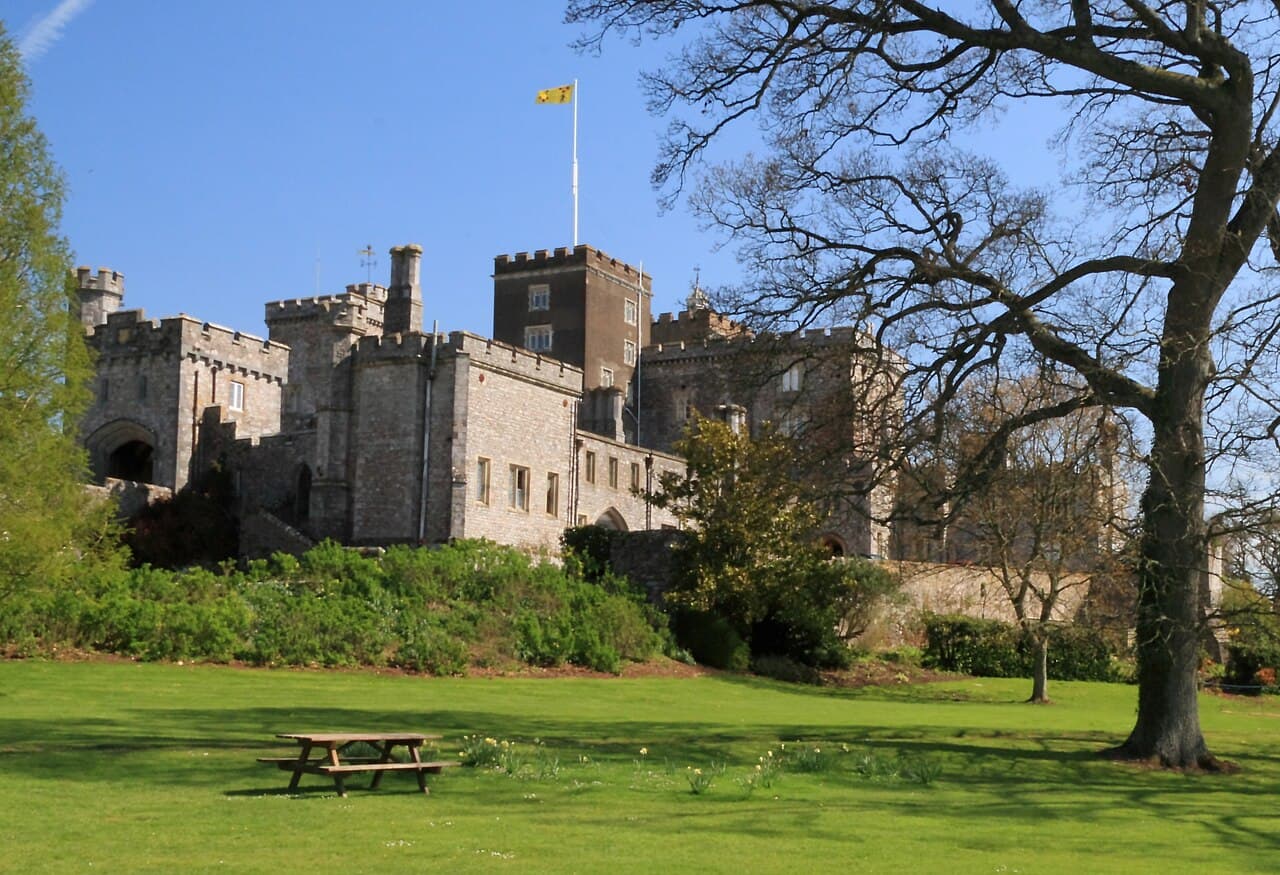
Powderham Castle is a remarkable example of a fortified manor house located approximately 6 miles south of Exeter, in Devon, England. Positioned on the west bank of the River Exe estuary, the castle has been a significant seat of the Courtenay family, Earls of Devon, for over six centuries. Its architectural evolution and rich history reflect the turbulent and dynamic nature of English nobility and regional power struggles from the late medieval period through the Victorian era and into modern times.
Constructed initially in the late 14th century by Sir Philip Courtenay, a younger son of the 2nd Earl of Devon, Powderham Castle was established as the seat of a cadet branch of the Courtenay family. The castle’s strategic location near Exeter made it a focal point during several historical conflicts, including the Wars of the Roses and the English Civil War. Over the centuries, it has undergone significant architectural modifications, blending medieval defensive features with later Gothic revival and Victorian stylistic enhancements.
The medieval origins and early history
The core structure of Powderham Castle dates from the 14th and early 15th centuries. It was designed as a thick-walled, rectangular building typical of fortified manor houses of the late medieval period. The original layout included essential domestic and defensive spaces such as a great hall, screens passage, withdrawing room, and kitchens, arranged from north to south. These medieval spaces survive today in adapted forms, including the Marble Hall and the Victorian kitchen.
During the Wars of the Roses, Powderham Castle was a contested stronghold. It was held by the Bonville family, rivals to the Courtenays, and famously endured a two-month siege in 1455 by Thomas de Courtenay, 5th Earl of Devon. This siege was part of the broader regional power struggles culminating in the First Battle of Clyst Heath, illustrating the castle’s military and political importance in the 15th century.
Architectural evolution in the 17th to 19th centuries
The castle sustained significant damage during the English Civil War in the 1640s when it was garrisoned by Royalist forces. In January 1646, Parliamentarian troops captured Powderham after an assault that inflicted structural harm. Restoration efforts began in the early 18th century under Sir William Courtenay, 2nd Baronet, who repaired war damages and adapted the building for continued residential use.
The 18th century brought notable interior enhancements, including the creation of the Marble Hall in 1755. This hall, occupying the lower part of the former great hall, features a distinctive black and white marble floor and was originally double-height before a ceiling was inserted to create bedrooms above. The hall also houses a fine 18th-century fireplace, a tall longcase clock made circa 1745 by William Stumbels of Totnes, and a large 17th-century Brussels tapestry depicting rustic farmyard scenes after the artist Teniers. A carved wooden over-mantel from 1553 bearing the Courtenay family arms adds to the hall’s historical significance.
In the mid-19th century, the castle underwent substantial expansion and stylistic modification under the direction of architect Charles Fowler. Between 1845 and 1859, Fowler designed a new gatehouse and a Victorian dining hall in Gothic revival style. The dining hall features three Gothic windows and a heraldic chimneypiece replicating a medieval example from Exeter’s Bishop’s Palace (circa 1485). This chimneypiece displays numerous ancestral shields and heraldic supporters, including the Bohun swans and dolphins, symbolizing the Courtenay family and allied lineages such as Pepys and Leslie.
Defensive features and landscape changes
Originally, Powderham Castle was protected by a curtain wall and a yard on its eastern side, including a barbican or bulwark which was demolished in the 18th century to open views towards the River Exe estuary. The castle’s defensive elements are recorded in a 1745 engraving, though many were removed or altered in later centuries to enhance the estate’s aesthetic appeal rather than military utility.
The west front of the castle, serving as the main entrance, was enhanced in the 19th century with castle-like features including the tall rectangular gatehouse tower. The surrounding park and gardens are recognized for their historic and aesthetic value, listed as Grade II* in the National Register of Historic Parks and Gardens. These grounds have evolved since the mid-18th century, incorporating formal gardens, a rose garden, and extensions to the chapel wing.
Interior features and curiosities
Inside, Powderham Castle offers a blend of medieval architecture and refined 18th-century decoration. Notable interior features include the surviving Gothic-arched doorways in the south stone wall of the screens passage, which lead to the kitchens, and the remnants of a wooden minstrels’ gallery, now lost but once accessed via a high doorway.
The castle also houses unique artifacts such as a narwhal tusk traditionally believed to be a unicorn horn, reflecting the medieval fascination with mythical creatures. The preservation of original elements alongside Victorian additions provides visitors with a vivid sense of the castle’s layered history.
Modern significance and cultural role
Powderham Castle remains the family seat of the Courtenay Earls of Devon, maintaining a continuous link to its medieval origins. It was designated a Grade I listed building in 1952, highlighting its international architectural and historical importance.
The castle has also gained prominence as a cultural venue, serving as a filming location for the 1993 film "The Remains of the Day" and hosting major public events such as BBC Radio 1’s Big Weekend in 2016 and a popular food festival starting in 2019. Despite some controversies, including the temporary revocation of its wedding license in 2009, Powderham continues to be a vibrant heritage site managed by the current 19th Earl of Devon.
Visitors today can explore the castle’s rich architectural heritage, its expansive gardens, and enjoy a variety of cultural events that celebrate its enduring legacy in Devon and English history.
Frequently asked questions (FAQ)
- How do I visit Powderham Castle?
- Powderham Castle is open to visitors with guided tours available during the warmer months. It is advisable to check the official website for current opening times and ticket information before planning your visit.
- What is the historical significance of Powderham Castle?
- Powderham Castle has been the seat of the Courtenay family since the 14th century and played important roles in the Wars of the Roses and the English Civil War, reflecting its strategic and noble heritage.
- Can I host events or weddings at Powderham Castle?
- Yes, Powderham Castle offers facilities for weddings and events, though its wedding license was temporarily revoked in 2009 and later reinstated. It is recommended to contact the estate directly for current event hosting policies.
- What architectural styles are seen at Powderham Castle?
- The castle exhibits a mix of late medieval fortified manor house architecture with significant 18th-century interiors and 19th-century Gothic revival additions, including a Victorian dining hall and gatehouse.
- Is Powderham Castle accessible for visitors with mobility issues?
- The castle grounds and gardens are generally accessible, but some historic interior areas may have limited accessibility due to their age and preservation requirements. Visitors should inquire in advance about specific needs.
Photo gallery

Information
Sources & official resources
Verify the information above using these authoritative references.
Loading map...
Visitor reviews
No reviews yet. Been here? Write the first review and help other travelers!
Write the first reviewVisited this castle? Share your experience
Your review helps other travelers and adds first-hand knowledge to our encyclopedia.