Rotteln Castle
Rotteln Castle stands as one of the most significant medieval fortifications in southwestern Germany, located in the town of Lörrach in the state of Baden-Württemberg. Perched on a wooded hill overlooking the Wiese valley, the castle offers commanding views of the surrounding landscape, including the nearby Swiss city of Basel and distant Alpine peaks. As the third largest castle ruin in Baden, Rotteln Castle is an important cultural and historical landmark, reflecting centuries of architectural evolution and regional power struggles.
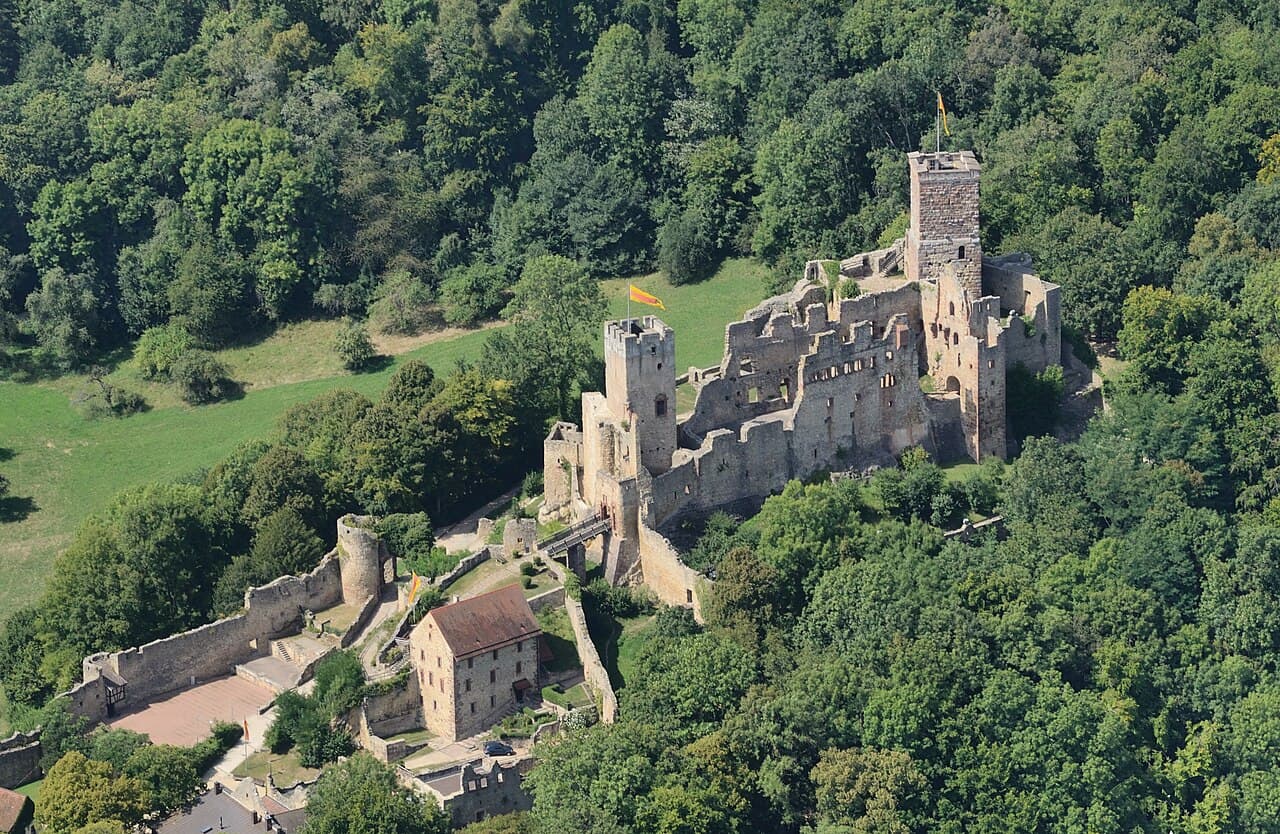
The castle complex extends approximately 300 meters along a ridge, divided into the upper castle and the lower castle or outer bailey. The upper castle, dominated by the imposing "Green Tower" keep, is the oldest section and exemplifies high medieval military architecture. The lower castle is more expansive, containing administrative buildings, economic structures, and a traditional restaurant housed in the bailey, accessible to visitors year-round. The site combines natural defensive advantages with sophisticated fortifications developed over several centuries.
Historical development and ownership
The origins of Rotteln Castle date back to the mid-12th to early 13th century, with documentary evidence first mentioning the site in 1259. Initially, the castle was a fief under the Abbey of Murbach and was held by the noble Lords of Rötteln, a family documented from 1102/03. These lords held influential ecclesiastical positions in the bishoprics of Basel and Konstanz during the 13th century, underscoring their regional prominence.
Following the extinction of the male line of the Lords of Rötteln in 1316, the castle passed to the Margraves of Hachberg-Sausenberg, who made it their residence and administrative center. The castle's strategic importance was highlighted during the 1332 siege by Basel forces, when it successfully resisted capture. Although the 1356 Basel earthquake may have caused some damage, no records indicate significant destruction.
The castle reached its architectural and political zenith under Margrave Rudolf IV (1441–1487). During this period, it hosted notable visitors such as Duke Philip the Good of Burgundy in 1454, reflecting its stature. The castle was expanded, incorporating Burgundian influences into its design. Upon the death of Philip of Hachberg-Sausenberg in 1503, ownership transferred to the Margraves of Baden. Although it remained an administrative hub, its military role diminished over time.
Rotteln Castle experienced turmoil during the German Peasants’ War (1525), when peasants briefly occupied the site, plundering archives and supplies but sparing the structure itself. The castle also endured the ravages of the Thirty Years’ War (1633–1638), changing hands among Imperial, Swedish, and French-allied forces and suffering damage from sieges.
The castle's military significance ended during the Franco-Dutch War (1678), when French troops under Marshal François de Créquy besieged and captured Rotteln, subsequently burning and destroying it. After this, local administration moved to Lörrach, and the castle fell into ruin. Preservation efforts began in the 19th century, led by groups such as the Black Forest Society and the Röttelnbund association, continuing into the present day with restoration and archaeological research.
Architectural features and layout
Site and defensive structures
Rotteln Castle is a classic example of a hill castle or spur castle, situated at an elevation of approximately 417 to 422 meters above sea level. The site spans roughly 300 meters north to south and 50 meters east to west, with a height difference of about 50 meters between the lower and upper sections. The castle is divided into two main parts: the upper castle (main castle) and the lower castle (outer bailey), separated by a deep neck ditch originally crossed by a drawbridge.
The lower castle is about four times larger than the upper castle and was protected by a double ring wall with three shell towers on the west side. It housed administrative buildings like the Landschreiberei (district office and archive), economic structures, and a medieval inn. The southern tip featured the Kapf bastion, used as a regional court and execution site, later modified into a star-shaped bastion before its demolition by French forces in 1689.
Upper castle and towers
The upper castle is accessed via a steep wooden bridge spanning a moat, leading to a heavily fortified gatehouse adorned with the Margraves of Hachberg-Sausenberg coat of arms dated 1468. Adjacent is a narrow postern gate for individual access.
The centerpiece is the "Green Tower" keep, a nearly square tower measuring eight meters per side, rotated about 45 degrees relative to the castle's main axis. Its walls are 2 to 2.3 meters thick, constructed from finely worked bossed stones typical of the mid-12th to early 13th century. This tower served multiple functions including watchtower, refuge, and prison.
The South Tower, known as the Giller, was built around 1300 from coarse limestone blocks. Approximately seven meters square, it functioned as a gate defense tower and prison, originally with three stories and a high entrance six meters above ground. In 2001, a concrete battlement was added to facilitate visitor access.
Palas and chapel
The Palas, or manor house, extends along the east side of the upper castle between the two main towers. It comprises three adjoining multi-story sections from different periods. The oldest southern section dates to circa 1200, with additions and modifications continuing into the late 15th century. The Palas boasts richly decorated portals, including one from 1494 bearing the coat of arms of Margrave Philip and his wife Maria of Savoy. Inside were representative halls such as the knights’ hall, a ballroom occupying the entire top floor, and smaller heated rooms featuring cocklestoves and projecting latrines.
The castle chapel of St. Mary, consecrated in 1504, stood on the north side of the courtyard. This late Gothic hall featured ribbed vaulting supported by two central columns. It is believed that Margrave Rudolf IV was interred within the chapel, underscoring its significance.
Materials, water supply, and archaeological finds
The castle's construction utilized local sandstone varieties from the Wiese valley. Pale red, silicified sandstone blocks formed the towers, while fine-grained red sandstone was reserved for sculptural elements such as window and door frames, consoles, vault ribs, floor tiles, and heraldic stones.
A notable feature is the filter cistern dating back to at least 1420, which collected surface water and purified it through layers of sand and gravel. This system provided high-quality water during sieges, an advanced solution for medieval castles.
Archaeological excavations and restoration efforts have uncovered a variety of artifacts including stove tiles with biblical reliefs, arrowheads, crossbow bolts, cannonballs, iron shackles, horse harness parts, coins, tools, and furniture fragments. These finds provide insight into the castle's military, domestic, and artisanal functions over the centuries.
Preservation and visitor experience
Today, Rotteln Castle is partially preserved with several restored walls, towers, and gatehouses accessible to the public. The Bergfried (keep) and Giller towers remain open to visitors, while the reconstructed Landschreiberei building serves as a museum and event space, showcasing the castle's history and archaeological discoveries.
The castle's layout, including moats, curtain walls, gate complexes, and bastions, illustrates medieval and early modern fortification techniques. In the 17th century, bastion-like earthworks were added during the Thirty Years’ War, highlighting the adaptation of the site to evolving military technologies.
Surrounding the castle is a protected landscape area established in 1938, covering over 50 hectares of forest, meadows, and gardens. This natural setting enhances the cultural and historical ambiance, making Rotteln Castle a popular destination for tourists, history enthusiasts, and hikers.
Visitors can explore the extensive ruins, enjoy panoramic views from the Green Tower, and experience the blend of medieval architecture and natural beauty. The on-site museum and traditional restaurant in the bailey provide additional amenities, making Rotteln Castle a comprehensive heritage site.
Frequently asked questions (FAQ)
- How do I get to Rotteln Castle from Basel?
- Rotteln Castle is located near Lörrach, Germany, just northeast of Basel. Visitors can reach the castle by car or public transport, with local buses and trains connecting Basel to Lörrach. From Lörrach, the castle is a short taxi ride or a pleasant hike up the wooded hill.
- What are the opening hours and ticket prices for Rotteln Castle?
- The castle grounds and lower castle area are open year-round daily, and admission is free. The museum in the Landschreiberei building may have specific opening times, so checking locally before visiting is recommended.
- Is Rotteln Castle accessible for visitors with limited mobility?
- Due to the hilltop location and steep paths, access to the upper castle and towers can be challenging for visitors with limited mobility. The lower castle and museum areas are more accessible, but some uneven terrain should be expected.
- What is the historical significance of Rotteln Castle?
- Rotteln Castle was a major medieval fortress and administrative center in southwestern Germany. It played a key role in regional politics, survived sieges, and was associated with notable noble families such as the Lords of Rötteln and the Margraves of Hachberg-Sausenberg.
- When was Rotteln Castle built and who were its original owners?
- The castle was likely constructed between the mid-12th and early 13th centuries and first mentioned in 1259. It was originally held by the noble Lords of Rötteln as a fief under the Abbey of Murbach.
- Can I visit the towers and enjoy views from Rotteln Castle?
- Yes, visitors can climb the Green Tower and the Giller (South Tower) for panoramic views of Lörrach, the Wiese valley, and the Swiss Alps. The towers are accessible during the castle's open hours.
Photo gallery

Information
Opening hours
Year-round, daily
Ticket prices
Free
Current owner
Municipality
Website
Visit websiteSources & official resources
Verify the information above using these authoritative references.
Loading map...
Visitor reviews
No reviews yet. Been here? Write the first review and help other travelers!
Write the first reviewVisited this castle? Share your experience
Your review helps other travelers and adds first-hand knowledge to our encyclopedia.