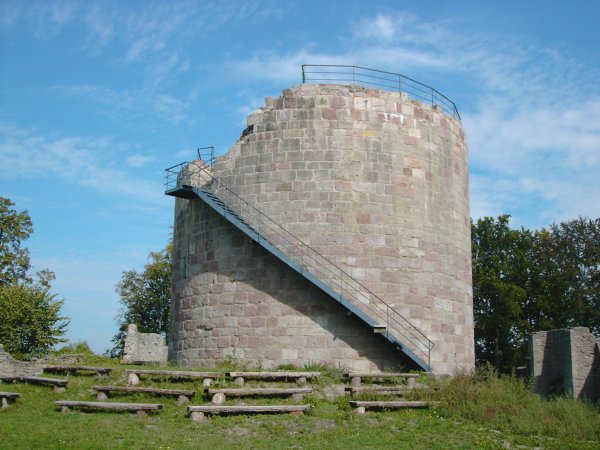
Castle Bibra stands as a remarkable example of a medieval water castle located in the municipality of Grabfeld, Germany. Constructed during the 12th century by the noble von Bibra family originally from Franconia, the castle's earliest documented owner was Rubertus de Bibera, recorded in 1119. This historic fortress was strategically positioned on an artificial island, surrounded by a moat, reflecting the defensive architectural style common among moated castles of the period.
Strategic location and early history
Castle Bibra was purposefully built to control the vital north-south trade routes along the Werra River valley, situated between the towns of Untermaßfeld and Meiningen. Its location allowed the von Bibra family to exert influence over commerce and regional movement, a key factor in the castle's significance through the centuries. By 1486, the castle had gained the prestigious status of a royal Pfalz, serving as a temporary imperial residence, which underscores its importance within the Holy Roman Empire's territorial network.
Architectural features and fortifications
The castle's design as a fortified manor includes multiple defensive features typical of Franconian castles. The artificial island was surrounded by a water-filled moat, which served as a primary defense mechanism against attackers. The surviving elements include fragments of the outer defensive walls and several corner towers dating mainly from the 16th-century reconstruction following damage sustained during the Peasants’ War of 1525. These towers functioned as lookout points and defensive bastions, providing coverage over the surrounding landscape and trade routes.
The castle complex originally consisted of multiple buildings arranged around courtyards, typical of fortified manors, allowing for both residential and military functions. The walls and towers were constructed with robust masonry, reflecting the evolving military architecture of the late medieval period.
Historical challenges and restorations
Castle Bibra endured several periods of conflict and reconstruction. The Peasants’ War in 1525 caused significant damage, necessitating extensive rebuilding efforts by the von Bibra family. Later, the castle suffered near destruction during the Thirty Years’ War (1618–1648), a prolonged and devastating conflict that affected much of central Europe. Following this, the castle was restored once again, maintaining its role as a noble residence and regional stronghold.
Ownership remained with the von Bibra family for centuries until the aftermath of World War II, when the estate was nationalized by the East German government. After the German reunification in 1990, the property was returned to the von Bibra descendants. Since then, parts of the castle have been adapted for modern use, including the establishment of a seminar center in 1994, providing accommodation and event facilities within the historic setting.
Preservation and cultural significance
Restoration efforts have been pivotal in preserving Castle Bibra's architectural heritage. The castle received significant funding from the Thuringian government in 2002, which supported conservation and stabilization projects. These efforts were recognized with the Thuringian Monument Protection Prize, highlighting the cultural and historical value of the site.
Today, visitors can observe the remaining moat remnants, outer walls, and corner towers, which collectively illustrate the castle’s defensive capabilities and architectural evolution. The integration of modern facilities within the historic complex exemplifies a successful balance between preservation and contemporary use, ensuring that Castle Bibra remains a vibrant part of the region’s heritage.
Architectural style and period
Castle Bibra's architecture reflects the transition from the High Medieval to the Late Medieval periods, with fortifications updated in the 16th century. Its style is characteristic of fortified manors and moated castles in Franconia, featuring robust stone masonry, defensive towers, and water defenses. The castle’s evolution mirrors broader trends in medieval military architecture, adapting to advances in siege technology and changing political circumstances.
The von bibra family legacy
The von Bibra family, a noble lineage from Franconia, played a central role in the castle’s history and regional influence. Their stewardship over several centuries ensured the castle’s maintenance and adaptation through turbulent historical periods. The family’s return to ownership after German reunification symbolizes the enduring connection between aristocratic heritage and cultural preservation in modern Germany.
Visitor experience and modern use
Since the 1990s, Castle Bibra has been partially adapted for contemporary functions, including a seminar center that accommodates up to 17 guests. This modern use complements the castle’s historical ambiance, offering visitors an immersive experience within a medieval setting. While the castle is not fully restored, its preserved ruins and adaptive reuse provide valuable insights into medieval architecture and noble life.
Frequently asked questions (FAQ)
- How do I get to Castle Bibra?
- Castle Bibra is easily accessible by car or public transport. If you are driving, you can follow the signs from the nearest major city, which is around 15 kilometers away. For public transport, check local bus schedules that connect to Bibra.
- What is the historical significance of Castle Bibra?
- Castle Bibra dates back to the 12th century and has played an important role in the region's history. It served as a stronghold for local nobility and has witnessed numerous historical events over the centuries. The castle's architecture reflects its strategic importance and evolving design through different periods.
- When was Castle Bibra built?
- Construction of Castle Bibra began in the early 12th century, making it one of the oldest fortifications in the area. Over the years, it has undergone several renovations and expansions, preserving its historical essence while adapting to changing architectural styles. The castle's rich history is evident in its well-preserved structures.
- Can I visit Castle Bibra year-round?
- Yes, Castle Bibra is open to visitors year-round, but it's advisable to check specific opening hours, as they may vary by season. The best time to visit is during the warmer months when guided tours and outdoor activities are available. Special events may also be hosted during the summer.
- Why is Castle Bibra popular among tourists?
- Castle Bibra attracts visitors due to its stunning architecture, rich history, and picturesque surroundings. The castle offers guided tours that provide insights into its historical significance and architectural features. Additionally, its scenic location makes it a great spot for photography and leisurely walks.
- Is it possible to explore the castle's interior?
- Yes, visitors can explore the interior of Castle Bibra through guided tours. These tours offer a fascinating glimpse into the castle's rooms, historical artifacts, and architectural details. Be sure to check the schedule for tour timings to make the most of your visit.
- What are the ticket prices for visiting Castle Bibra?
- Ticket prices for Castle Bibra are generally affordable, with discounts available for students and seniors. Children under a certain age may enter for free. It's best to check the castle's official website for the most up-to-date pricing information and any special offers.
- What are the opening hours for Castle Bibra?
- Castle Bibra typically opens at 10 AM and closes at 5 PM, but hours may vary seasonally. It is advisable to check the castle's official website for any changes or special events that might affect opening times. Planning your visit during regular hours ensures you have ample time to explore.
- Are there any nearby attractions to visit?
- Yes, there are several attractions near Castle Bibra, including beautiful hiking trails and other historical sites. Visitors can enjoy the scenic landscapes and nearby quaint villages, which offer additional cultural experiences. Local restaurants and cafes also provide a taste of the regional cuisine.
Information
Website
Visit websiteSources & official resources
Verify the information above using these authoritative references.
Loading map...
Visitor reviews
No reviews yet. Been here? Write the first review and help other travelers!
Write the first reviewVisited this castle? Share your experience
Your review helps other travelers and adds first-hand knowledge to our encyclopedia.