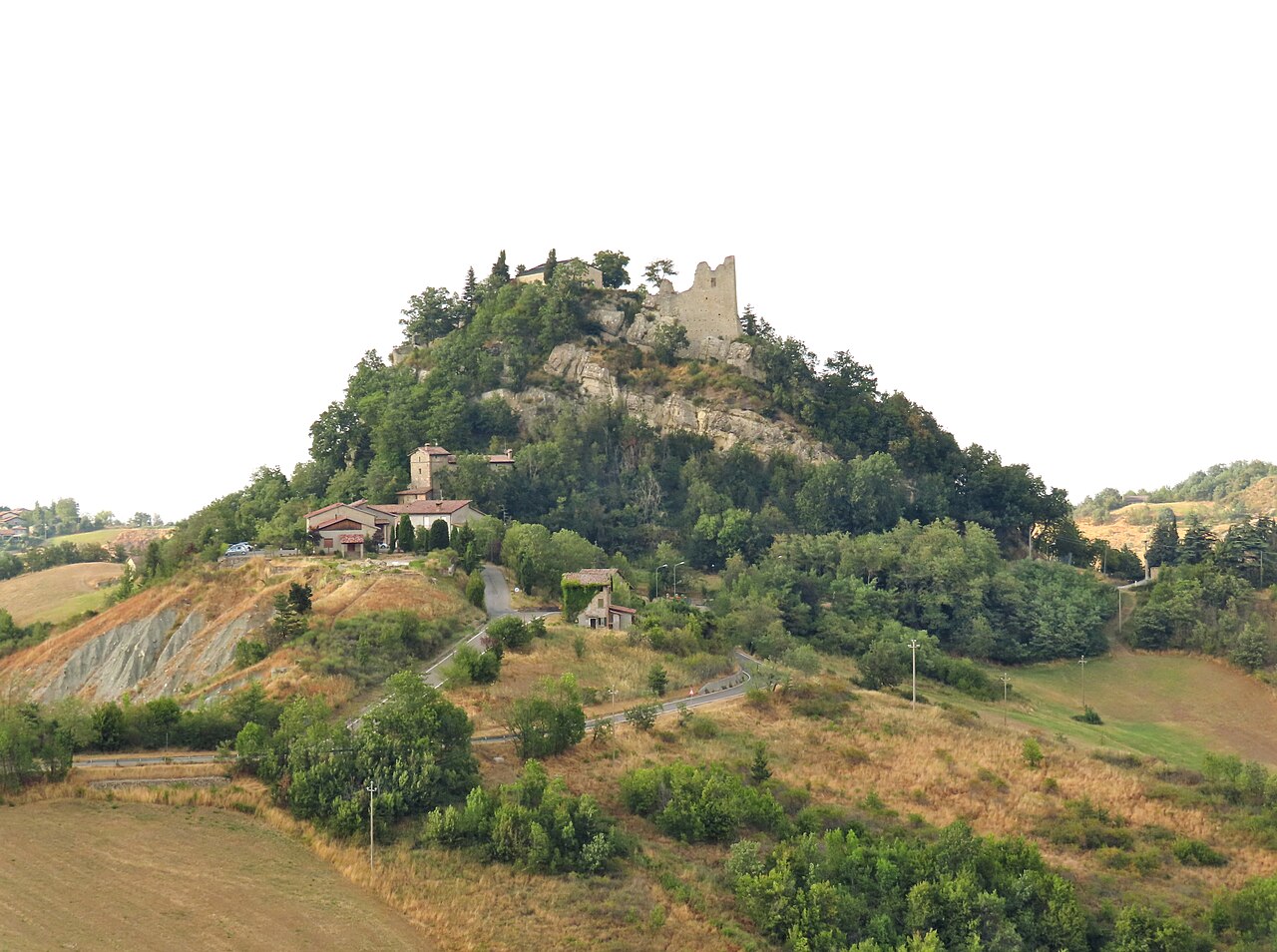
Rossena Castle
Rossena Castle stands as a remarkable example of medieval military architecture in the Emilia-Romagna region of Italy. Perched atop a distinctive volcanic cliff known for its reddish hue, the castle commands sweeping views over the surrounding plain and the Tuscan-Emilian Apennine ridge. This strategic location not only provided natural defense but also allowed control over vital routes through the Enza valley, underscoring its historical importance as a fortress within the Matildic area.
The origins of Rossena Castle trace back to the 10th century, with the earliest parts of the structure, notably the keep, believed to have been constructed around 950 AD. This keep shares typological similarities with the nearby Rossenella Tower, suggesting a coordinated defensive system designed to protect the nearby Castello di Canossa. The castle's initial function was primarily military, serving as a watchtower and stronghold to monitor enemy movements and secure the region.
Throughout its history, the castle changed hands among prominent noble families. Initially under the control of the Canossa lineage, specifically Bonifacio di Canossa in the 11th century, it later passed to the Da Correggio family in the 13th century. The Da Correggio maintained ownership until 1612 when the castle was confiscated by the Duchy of Parma following political upheavals. The castle also endured military conflict, notably suffering damage in 1558 during an assault by forces loyal to Alfonso II d’Este, which targeted its powder magazine.
Architectural features and layout
Rossena Castle is a quintessential hill castle that integrates seamlessly with its natural rocky foundation. The fortress is organized across three main levels, each serving distinct functions linked to defense and habitation.
The keep and defensive walls
The oldest part of the castle is its keep, a robust stone tower that formed the core of the original fortification. This tower is enclosed by three concentric defensive walls, each reflecting different phases of medieval military architecture. The innermost wall surrounds the keep and the piazza d'armi (main courtyard), while the second wall features high curtain walls designed to repel attackers and includes a small chapel and guardhouse. The outermost wall is equipped with bastions adapted for artillery defense, highlighting the castle’s evolution in response to changing warfare technologies.
Interior spaces and living quarters
The castle’s internal layout includes a variety of functional spaces such as a weapons room, prisons, a refectory, and a cistern for water storage. These rooms are connected by irregular stone and brick staircases that navigate the steep terrain. Decorative plasterwork found in several rooms dates to the 18th century, indicating a period when the castle was transformed from a purely military fortress into a noble residence.
Historical significance and ownership
The castle’s history is deeply intertwined with the political and military dynamics of the region. Its initial establishment served to protect the powerful Castello di Canossa and control the surrounding valleys. The castle’s possession by the Canossa family links it to the influential Matilda of Canossa, a key figure in medieval Italian history.
After its seizure by the Duchy of Parma in the early 17th century, the castle continued to play a role in regional affairs. It hosted notable figures such as Duchess Maria Luigia of Austria in the 19th century, reflecting its status as a residence of significance. The castle also endured natural disasters, including a major earthquake in 1832, after which restoration efforts were undertaken.
Surrounding structures and village
Opposite Rossena Castle stands the Rossenella Tower, a well-preserved medieval tower that once formed part of the broader defensive network protecting the Canossa territories. The nearby village of Rossena retains elements of its medieval past, including a tower-shaped house and sections of ancient stone walls built with traditional medieval techniques.
The castle complex also includes the church of San Matteo Apostolo, emphasizing the integration of religious life within the fortress. The combination of military, residential, and religious structures illustrates the multifaceted role the castle played throughout its history.
Preservation and modern use
Today, Rossena Castle remains partially preserved, with significant restoration efforts completed by the early 21st century. While some upper fortifications have been lost, the castle’s core structures, including the keep and concentric walls, offer valuable insights into medieval fortification techniques and noble residence adaptations.
The castle’s transformation into a hotel in recent decades has allowed for adaptive reuse while maintaining its historical integrity. It also serves as a cultural landmark, hosting the Istituto Superiore di Studi Matildici since 1979, which promotes scholarly research on Matilda of Canossa and the region’s medieval heritage.
Rossena Castle stands as a testament to the enduring legacy of medieval fortifications in Italy, embodying centuries of architectural evolution, noble lineage, and regional history within its stone walls.
Frequently asked questions (FAQ)
- How do I visit Rossena Castle?
- Rossena Castle is typically open to visitors by appointment or during special events. It is recommended to check ahead with the Istituto Superiore di Studi Matildici for visiting hours and tour availability.
- What is the historical significance of Rossena Castle?
- Rossena Castle played a crucial role in medieval defense as part of the Canossa family's fortifications. It guarded the Enza valley and protected the nearby Castello di Canossa, linking it to important regional power struggles.
- Can I see original medieval architecture at Rossena Castle?
- Yes, Rossena Castle retains its original 10th-century keep and concentric defensive walls. Visitors can observe medieval stone masonry, battlements, and the layout reflecting its military origins.
- Is Rossena Castle accessible for visitors with mobility issues?
- Due to its hilltop location and steep, irregular stone steps, Rossena Castle may present challenges for visitors with mobility impairments. It is advisable to inquire in advance about accessibility accommodations.
- When is the best time to visit Rossena Castle?
- The best time to visit Rossena Castle is during spring and autumn when the weather is mild and the surrounding landscape is particularly scenic. Special events hosted by the Istituto Superiore di Studi Matildici also offer unique opportunities to explore the castle.
Information
Opening hours
Variable, typically by appointment or during special events
Ticket prices
Varies, often by appointment or event
Current owner
Istituto Superiore di Studi Matildici
Loading map...
Visitor reviews
No reviews yet. Been here? Write the first review and help other travelers!
Write the first reviewVisited this castle? Share your experience
Your review helps other travelers and adds first-hand knowledge to our encyclopedia.