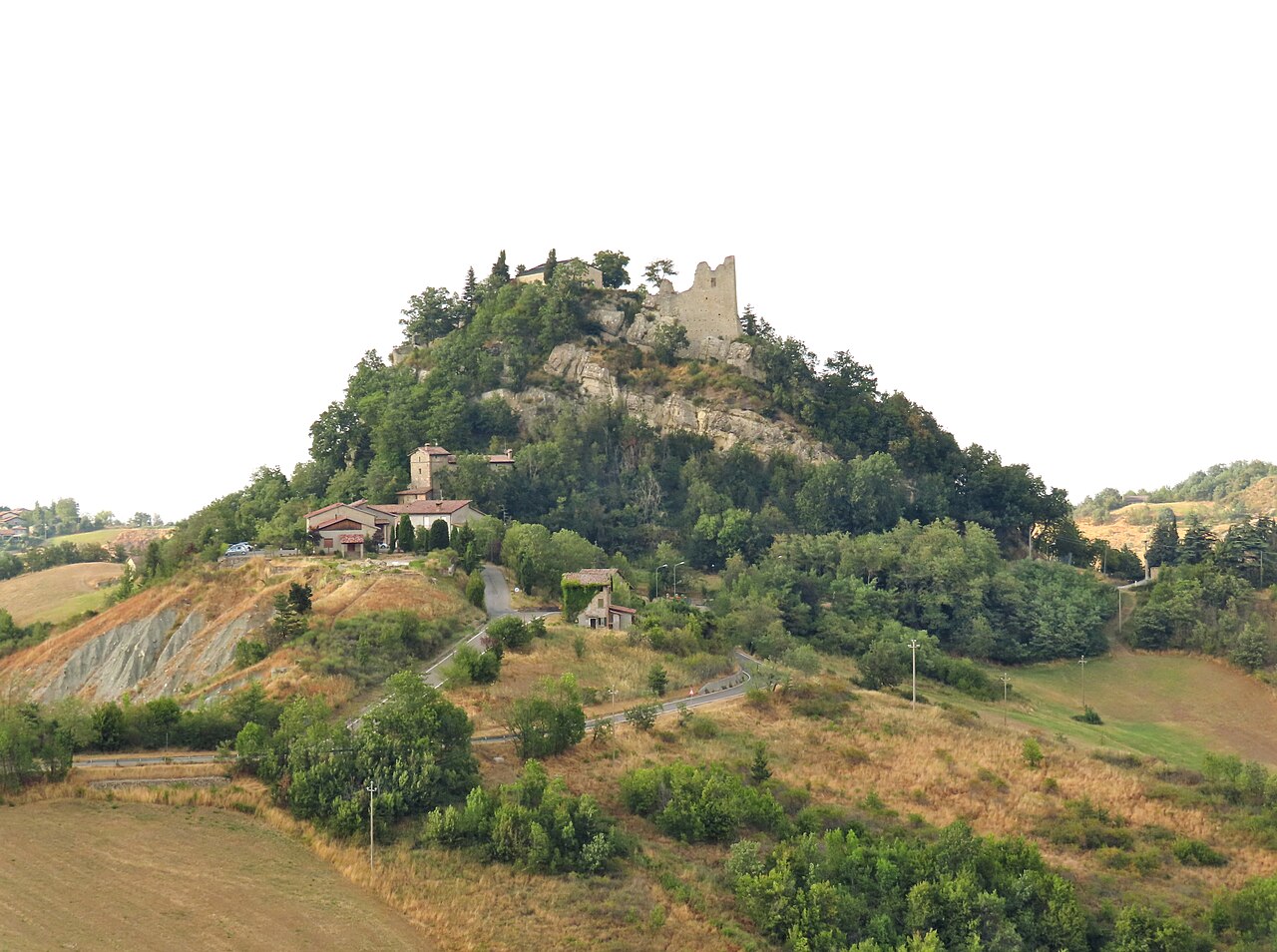
Castle of Bianello
The Castle of Bianello stands as a remarkable example of early medieval military architecture in the municipality of Quattro Castella, Italy. This hill castle is the sole surviving fortress from an original group of four defensive towers established in the 8th century, strategically positioned along a series of hills to guard the region. Its elevated location atop the Apennine Mountains underscored its critical role as a natural defensive outpost against northern invaders, marking it as a key stronghold in the medieval landscape of northern Italy.
Historical records first mention the castle in 835, within a document by Queen Cunegonda referring to a "Curte de quatuor arcas," or court of four castles, which likely included Bianello. By the mid-11th century, the castle became part of the extensive territories controlled by the powerful Canossa family. Their dominion spanned from the Po River in the north to Tuscany in the south, with the Apennine Mountains serving as a fortified natural boundary. The castle's association with the Canossa lineage is particularly significant due to its connection with Countess Matilda of Canossa, one of medieval Italy's most influential noblewomen.
The castle’s role in medieval imperial politics
The Castle of Bianello gained historical prominence during the late 11th and early 12th centuries through its association with the Investiture Controversy, a major conflict between the papacy and the Holy Roman Empire. In 1077, Emperor Henry IV stayed at Bianello in a state of penance before his famous journey to Canossa, where he sought reconciliation with Pope Gregory VII. This event symbolized the castle's importance as a site of imperial penitence and political negotiation.
Later, in 1111, Emperor Henry V visited the castle after his coronation in Rome and officially appointed Matilda of Canossa as Imperial Viceroy of Italy. This appointment marked a significant moment in the castle's history, ushering in a period of relative peace and stability that contributed to the eventual Concordat of Worms in 1122, a pivotal agreement resolving the Investiture Controversy. The castle's role in these events is commemorated annually through a historical procession, reflecting its enduring cultural significance.
Ownership transitions and architectural evolution
In 1160, control of the fortress passed to Guido of Canossa, founding a distinct "Bianello" branch of the family. The castle changed hands several times in the following centuries, including acquisition by Gilberto III da Correggio in the early 14th century and later reversion to another Canossa branch by 1342. Imperial confirmations of ownership came from Emperor Charles IV in 1358 and Emperor Frederick III in 1459, underscoring the castle's continued strategic and noble importance.
The Canossa family maintained possession until 1742, when it was sold to Count Giovanni Gabbi. The feudal fief associated with the castle was abolished in 1796 amid the political upheavals of the time. The Gabbi family repurchased the castle in 1803, and during the Restoration period, it served as the municipal seat for Quattro Castella under the House of Este. The castle was later used as a military barracks following Italian unification in the 19th century before being converted into a summer residence by Dr. Luigi Caggiati after its auction in 1867. Subsequent owners included the Genoese shipowner Giovanni Battista Bacigalupo and his son Carlo, until the Cantelli family acquired it in 1897 and retained ownership until its sale to the municipality in 2003.
Architectural features and artistic heritage
The Castle of Bianello retains much of its medieval character, with its robust fortifications and elevated position reflecting its original defensive purpose. A notable architectural feature is the grand neo-Baroque staircase leading to the first noble floor, indicative of later renovations that enhanced the castle's ceremonial and residential spaces.
Inside, visitors can admire 17th and 18th-century frescoes adorning several rooms on the upper level, showcasing the castle's continuous occupation and adaptation over centuries. The preservation of former prison cells is particularly remarkable; these confined spaces bear inscriptions left by prisoners from different periods, offering poignant insights into the castle's judicial and military functions.
Near the main entrance of the surrounding wall, a stone plaque inscribed with "Comitissae Matildis opus" ("the work of Countess Matilda") highlights the historical renovations attributed to Matilda of Canossa, although the castle's foundational elements predate her era. Within the castle, a distinguished 14th-century painting depicts Matilda holding a pomegranate flower, symbolizing her regency and wisdom, further cementing the castle's connection to her legacy.
Defensive structures and layout
The castle's layout reflects typical early medieval fortification principles, with thick stone walls, battlements, and strategically placed towers providing vantage points over the surrounding landscape. Its location atop a hill allowed for extensive visibility and control over the surrounding valleys and routes, essential for monitoring and repelling potential invasions.
Cultural and historical significance
Beyond its military and residential functions, the Castle of Bianello serves as a symbol of feudal authority and political power in medieval Italy. Its association with the Canossa family and key historical figures like Countess Matilda and the Holy Roman Emperors Henry IV and Henry V enriches its cultural heritage. The castle's preserved elements and annual commemorations contribute to its role as a living monument to the complex history of medieval Italian politics and society.
Today, the castle stands as a testament to centuries of architectural evolution, noble lineage, and historical events that shaped the region. Its preservation allows visitors to explore a site where military strategy, artistic expression, and political history converge, offering a comprehensive glimpse into Italy's medieval past.
Frequently asked questions (FAQ)
- When was the Castle of Bianello originally constructed?
- The Castle of Bianello was originally constructed in the 8th century as part of a defensive network of four towers along the hills near Quattro Castella.
- What is the historical significance of Countess Matilda of Canossa to the castle?
- Countess Matilda of Canossa often resided at the Castle of Bianello and was appointed Imperial Viceroy of Italy there by Emperor Henry V in 1111, marking the castle's importance in medieval imperial politics.
- Can visitors see original medieval features at the Castle of Bianello?
- Yes, visitors can explore well-preserved medieval fortifications, including prison cells with prisoner inscriptions, a neo-Baroque staircase, and frescoes from the 17th and 18th centuries.
- Who owns the Castle of Bianello today?
- The Castle of Bianello is currently owned and managed by the municipality of Quattro Castella.
- What role did the castle play during the Investiture Controversy?
- The castle served as a site of imperial penance when Emperor Henry IV stayed there in 1077 before his journey to Canossa, and later as the location where Emperor Henry V appointed Matilda of Canossa as Imperial Viceroy.
Information
Sources & official resources
Verify the information above using these authoritative references.
Loading map...
Visitor reviews
No reviews yet. Been here? Write the first review and help other travelers!
Write the first reviewVisited this castle? Share your experience
Your review helps other travelers and adds first-hand knowledge to our encyclopedia.