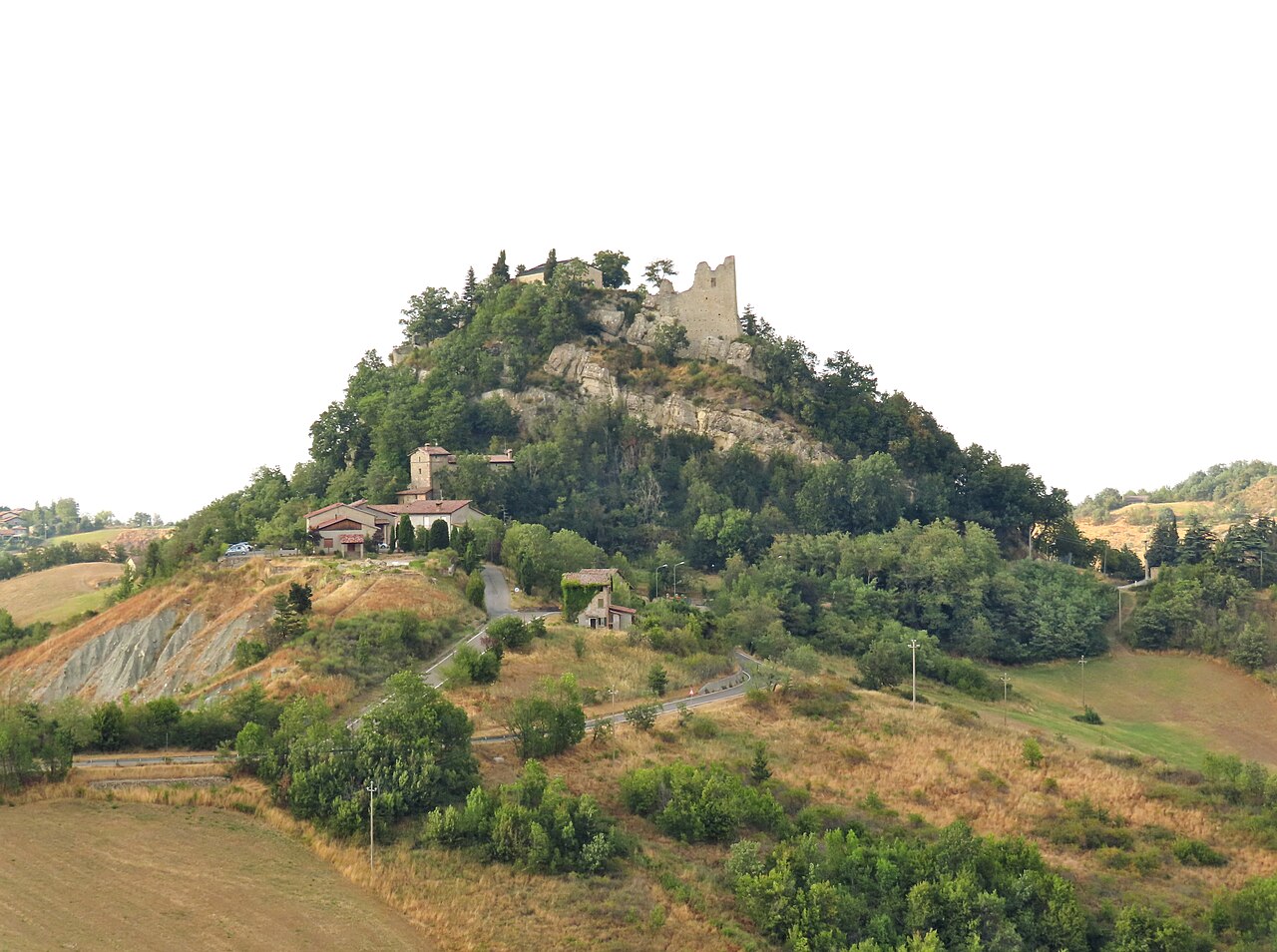
Castle of Sarzano
The Castle of Sarzano stands prominently on Sarzano hill within the municipality of Casina in Italy. This medieval fortress occupies a strategic vantage point that historically controlled the communication and travel routes between the regions of Lombardy and Tuscany. Its location atop a hill classifies it as a hill castle, a common type of fortification in medieval Europe designed to maximize defensive advantage through elevation.
The origins of the castle trace back to the late 9th or early 10th century, a turbulent era marked by frequent incursions such as the Hungarian invasions. It is believed that an earlier fortification existed on the site before the castle's documented history began. The first reliable record dates to 958 AD, when Atto Adalberto of Canossa, an ancestor of the influential Countess Matilda of Tuscany, acquired the castle and its surrounding lands. This acquisition positioned Sarzano within the powerful network of the Canossa family, who played a crucial role in the political and military landscape of northern Italy during the Early and High Middle Ages.
Historical significance and ownership transitions
Under the stewardship of Boniface of Canossa and later Countess Matilda, the Castle of Sarzano was an integral part of a defensive chain protecting the Reggio Emilia territory. It was strategically placed as one of three fortified lines, alongside the castles of Canossa and Rossena, forming a middle tier of defense that helped secure the region from external threats and internal conflicts.
Following the death of Countess Matilda in 1115 without direct heirs, ownership of Sarzano passed to the monastery of Sant’Apollonio di Canossa. This ecclesiastical control was supported by a papal bull issued in 1156, granting the monastery rights to collect tithes from the estate. However, the rise of autonomous city-states, or free communes, in the 12th century shifted the political landscape. By 1190, Sarzano was compelled to acknowledge the authority of the growing municipal power of Reggio Emilia, with formal submission recognized in 1197.
The 13th and 14th centuries were marked by fluctuating control over the castle. The Fogliani family seized Sarzano during internal conflicts in Reggio Emilia, establishing their residence there and asserting dominance over monastic claims. Ownership alternated among the Fogliani, the city of Reggio Emilia, and the influential Este family, who were prominent regional rulers. This period reflects the complex feudal and political dynamics of northern Italy, where noble families, religious institutions, and emerging communes vied for control over strategic fortifications.
Destruction, reconstruction, and architectural evolution
In 1427, the castle suffered significant damage during a siege led by Niccolò III d’Este, resulting in its near-total destruction. The subsequent reconstruction was overseen by architects Beltramo Comastri and Francesco da Salvaterra, who rebuilt the fortress with attention to both defensive capabilities and residential needs. This 15th-century rebuilding phase introduced architectural features characteristic of the period, blending military functionality with emerging Renaissance influences.
Throughout the 15th and 16th centuries, Sarzano was governed by a coalition of noble families, including the Este, Fogliani, Canossa, and Visdomini. In 1568, the Canossa lineage was succeeded by Girolamo Graziani della Pergola, a ducal minister, signaling a shift in administrative control. By 1694, the fiefdom was consolidated under Francesca Graziani della Pergola and her husband Paolo Carandini, who undertook extensive restoration work to preserve and enhance the castle's structure. Their efforts culminated in 1698 with the completion of significant repairs, commemorated by a stone plaque bearing their names and coat of arms, a symbol of their legacy despite the original plaque’s later theft and faithful reconstruction from photographs.
The abolition of feudal privileges in 1796 marked the end of aristocratic dominion over Sarzano, but the castle's history continued to intertwine with regional political shifts. During the Restoration period, the Este family regained possession before donating the castle to the Church in 1839. The modern era saw the municipality of Casina acquire the castle in 1990, initiating preservation and adaptive reuse projects that have safeguarded its historical character.
Architectural features and defensive layout
Concentric defensive walls and gates
The Castle of Sarzano exemplifies a concentric castle design, characterized by multiple layers of defensive walls arranged in successive rings ascending the hill. The lowest wall encircled the road and featured three entrance gates, controlling access to essential structures such as the church, the canon’s residence, and a civic building. This outermost barrier served as the primary defense line, regulating civilian and religious entry to the fortress.
The middle wall enclosed a courtyard designed as a refuge for local inhabitants during sieges. Access was secured by a drawbridge, emphasizing the importance of controlled entry points in medieval fortifications. This layer provided an intermediate defensive zone, combining protection with functional space for the community.
The innermost and highest wall surrounded the central courtyard, where the main keep or mastio was situated. This tower served as the ultimate stronghold within the castle, embodying both military and residential functions.
The keep and castle tower
The keep is the most imposing structure at the hilltop, notable for its rectangular shape and elongated corbels—stone supports that project from the walls, a distinctive architectural feature. This building housed living quarters that were occupied from the feudal era until approximately 1920, illustrating the castle's prolonged residential use.
Adjacent to the keep stands the castle tower, rising to about 20 meters with six floors. Originating in the 13th century, it has been continuously maintained due to its function as the bell tower for the Church of San Bartolomeo. This religious association ensured its preservation over centuries, protecting it from the neglect often experienced by isolated military towers.
Church of san bartolomeo
The Church of San Bartolomeo within the castle precincts dates back to the 12th century. It is a simple, single-nave structure with a modest gabled façade and central doorway. The church underwent reconstruction in the 16th century, reflecting contemporary architectural styles. Restoration efforts in 1997 uncovered an early Christian altar in the apse, indicating the site's longstanding sacred significance. Inside, fragments of 17th-century frescoes remain visible, and a choir loft added in 1904 contributes to the interior's historical layering.
Defensive walls and battlements
The castle’s defensive walls are topped with Guelph merlons, the characteristic upward-projecting blocks typical of medieval fortifications in Italy. A bastion provides additional protection against enemy advances, enhancing the fortress's defensive depth. The design of the tower, featuring large windows alongside defensive elements, reflects the dual military and residential nature of the castle, adapting over time to changing needs.
Modern preservation and archaeological discoveries
Since the municipality's acquisition in 1990, extensive conservation efforts have been undertaken not only on the castle itself but also on the surrounding village buildings and ancillary structures such as the choir and sacristy of the church. These restorations have stabilized the site and allowed parts to be repurposed for modern uses, including dining and lodging facilities, thus integrating heritage preservation with contemporary community needs.
Archaeological excavations during restoration uncovered a small medieval chapel within the castle courtyard. Evidence suggests this chapel was later converted into a storage space, highlighting the castle's multifaceted role encompassing military, residential, religious, and utilitarian functions over the centuries.
The Castle of Sarzano remains a significant cultural landmark, embodying centuries of medieval military architecture, noble lineage, and religious heritage. Its well-preserved concentric defenses, historic buildings, and ongoing conservation efforts make it a valuable site for understanding the complex history of northern Italy's fortifications and feudal society.
Frequently asked questions (FAQ)
- How do I get to the Castle of Sarzano?
- The Castle of Sarzano is located in Casina, Italy, and can be accessed by car or public transportation. If you're driving, follow the local signs to Casina, and there is parking available nearby. For public transport, check the local bus schedule for routes that connect to Casina.
- What is the historical significance of the Castle of Sarzano?
- The Castle of Sarzano dates back to the 12th century and served as a strategic military stronghold during various conflicts in the region. It showcases the architectural style of the period and has witnessed significant historical events, making it a valuable site for understanding the local history. Visitors can explore its storied past through informative displays and guided tours.
- When was the Castle of Sarzano built?
- The construction of the Castle of Sarzano began in the 12th century, with various modifications and restorations occurring over the centuries. It reflects the evolution of military architecture and has been preserved to maintain its historical integrity. The castle's age adds to its charm and significance as a historical landmark.
- Can I take guided tours of the Castle of Sarzano?
- Yes, guided tours of the Castle of Sarzano are available for visitors to enhance their experience. These tours provide in-depth information about the castle's history, architecture, and the surrounding area. It is recommended to book your tour in advance, especially during peak tourist seasons.
- Why is the Castle of Sarzano a popular tourist attraction?
- The Castle of Sarzano is popular due to its rich history, stunning views of the surrounding landscape, and well-preserved architecture. Visitors appreciate the chance to explore a piece of Italy's medieval history while enjoying the picturesque scenery. Its accessibility and engaging tours also contribute to its appeal among tourists.
- Is it possible to visit the Castle of Sarzano year-round?
- Yes, the Castle of Sarzano is open for visitors year-round, although specific opening hours may vary by season. It is advisable to check the official website or contact the castle administration for the most up-to-date information regarding opening times. Visiting during spring or fall can provide a more comfortable climate and fewer crowds.
- What are the ticket prices for the Castle of Sarzano?
- Ticket prices for the Castle of Sarzano are usually affordable, with discounts available for students and seniors. Children under a certain age may enter for free, making it a great family-friendly destination. Always check the official website for the latest pricing and any special promotions.
- What are the nearby attractions to the Castle of Sarzano?
- Nearby attractions include beautiful hiking trails and charming villages in the Emilia-Romagna region. The area is rich in natural beauty and historical sites, providing visitors with plenty of options for exploration. Consider visiting local wineries or enjoying traditional Italian cuisine in nearby restaurants to enhance your experience.
- What are the opening hours for the Castle of Sarzano?
- The opening hours for the Castle of Sarzano can vary depending on the season, with longer hours during peak tourist months. Typically, the castle opens in the morning and closes in the late afternoon, but it is best to check the official website for current hours. Planning your visit in advance will help ensure you have enough time to explore all that the castle has to offer.
Information
Website
Visit websiteSources & official resources
Verify the information above using these authoritative references.
Loading map...
Visitor reviews
No reviews yet. Been here? Write the first review and help other travelers!
Write the first reviewVisited this castle? Share your experience
Your review helps other travelers and adds first-hand knowledge to our encyclopedia.