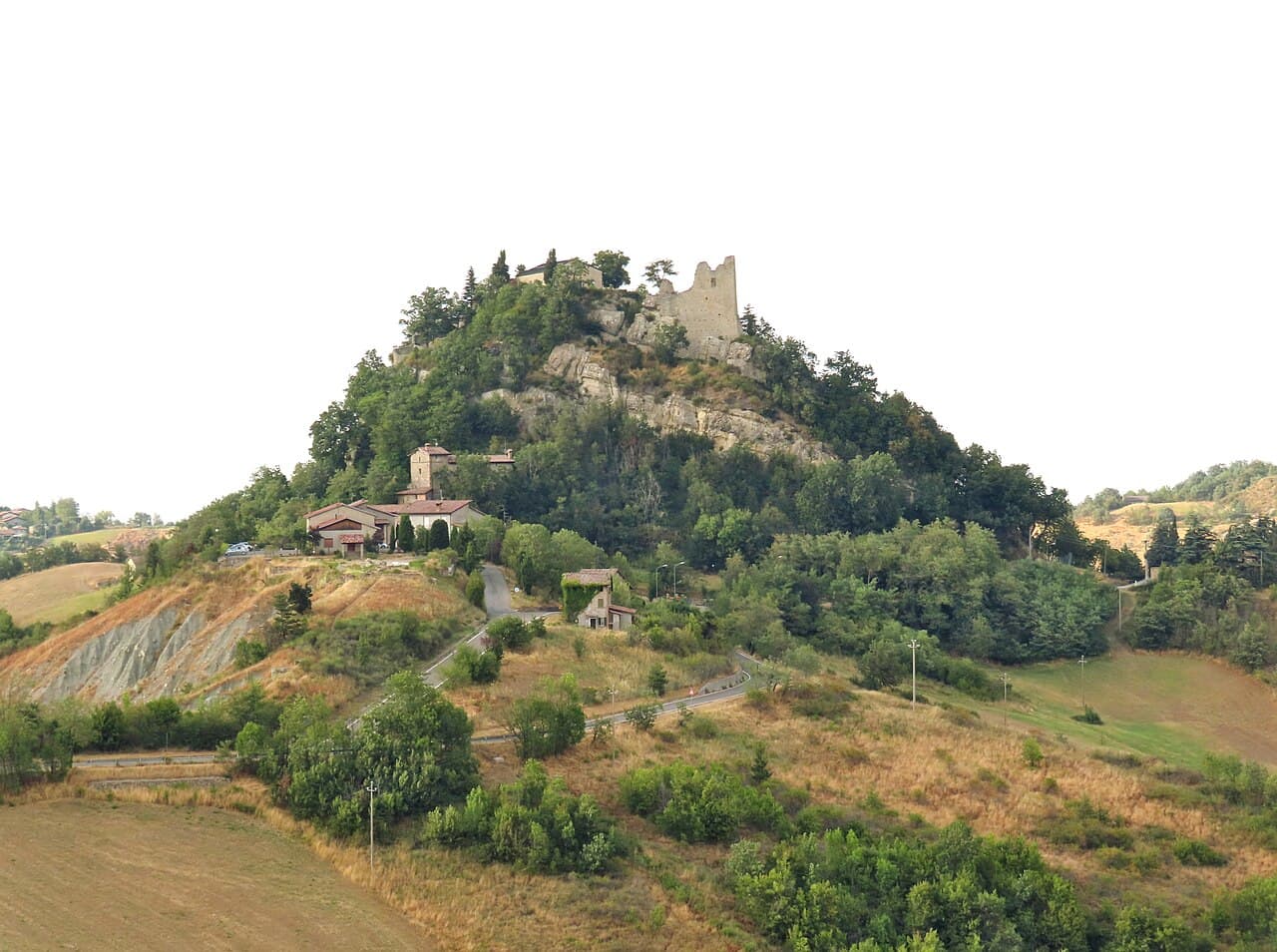
Canossa Castle
Canossa Castle stands as a monumental testament to medieval history and architecture in Italy. Perched strategically atop a rocky summit in the Apennine mountains at 576 meters above sea level, this hill castle was originally constructed around the year 940 by Adalberto Atto, son of Sigifredo of Lucca. Its commanding position allowed control over a vital corridor connecting Bologna and Parma, underpinning its military and administrative importance throughout centuries.
The castle's origins trace back to the Lombard civilization, reflecting early medieval defensive architecture designed to secure territorial dominance and provide refuge. The fortress was more than a military stronghold; it also embodied religious significance through the establishment of a Benedictine monastery housing twelve Cluniac monks and the church of Sant’Apollonio, which became a spiritual center within the complex.
The early history and strategic importance
In the mid-10th century, Canossa Castle played a pivotal role as a sanctuary for Queen Adelaide, who endured a protracted siege lasting approximately three years by Margrave Berengar II of Ivrea around 950. This siege, ultimately unsuccessful, underscored the fortress's formidable defensive capabilities and its significance in regional power struggles.
The castle's strategic value continued to grow, culminating in its most famous historical moment during the 11th century. In 1077, the castle was the site of the renowned Walk to Canossa, when Emperor Henry IV traveled to seek absolution from Pope Gregory VII following his excommunication. This dramatic event symbolized the intense conflict between secular and ecclesiastical authorities during the Investiture Controversy, marking Canossa Castle as a symbol of medieval political and religious power dynamics.
Architectural evolution and fortifications
Originally constructed with defensive needs in mind, the castle evolved architecturally over the centuries to adapt to changing military technologies and political circumstances. The fortress featured a triple ring of defensive walls, a sophisticated system providing multiple layers of protection. Between the first and second walls lay buildings that housed armed guards and servants, supporting the adjacent small villages or borghi.
The construction utilized locally sourced materials typical of the Apennine region, blending functionality with the natural landscape. The castle's core included a lordly residence and the religious complex with the monastery and church, which together formed the heart of the fortress. Despite numerous expansions, renovations, and damage from warfare, the remains still reveal the castle's original layout and defensive ingenuity.
14th-century modifications and firearm defenses
In the 14th century, under the direction of Giberto da Correggio, the castle was fortified to withstand the emerging threat of firearms. These enhancements reflect the transition in military architecture during the late medieval period, as castles adapted to gunpowder weaponry. The restoration after the destructive battles of 1255 between the Ghibellines and Guelphs incorporated these innovations, demonstrating the castle's ongoing strategic relevance.
Political significance and ownership changes
Following the death of Matilda of Canossa in 1115, the castle became the center of a complex inheritance dispute. Control passed through various hands including descendants of the Canossa family, the city of Reggio, the Visconti family, the Este dynasty, and the counts Valentini. This succession reflects the turbulent political landscape of medieval Northern Italy, where castles like Canossa were key assets in regional power struggles.
The Renaissance era brought cultural significance to the castle, notably when the poet and soldier Ludovico Ariosto served as captain in 1502. His residence at Canossa for nearly six months illustrates the castle's role as both a military and cultural site under the Este family's stewardship. The castle remained under Este control until the late 18th century, with a brief occupation by Ottavio Farnese in 1557.
Decline, ruin, and preservation efforts
By the 19th century, Canossa Castle had fallen into a state of ruin. A significant landslide in 1846, caused by a falling rock, inflicted further damage on the already deteriorating structure. Recognizing its cultural and historical value, the Italian government acquired the site in 1878, declaring it a national monument.
Archaeologist Naborre Campanini spearheaded excavations in the late 19th and early 20th centuries, uncovering architectural elements and artifacts that illuminated the castle's extensive history. In 1913, a museum was established nearby to house these finds, facilitating ongoing conservation and scholarly study. These efforts have preserved the ruins from complete destruction and allow visitors to appreciate the castle's historical layers.
Current remains and visitor experience
Today, the ruins of Canossa Castle reveal the extensive fortified complex with its distinctive triple defensive walls. The remains of the lordly residence, monastery, and church of Sant’Apollonio offer insight into the castle's dual military and religious functions. The site provides panoramic views of the surrounding Apennine landscape and nearby fortifications such as the castles of Rossena and Rossenella, highlighting its strategic placement.
The adjacent museum displays artifacts from excavations, including architectural fragments and religious relics, enriching the visitor experience by contextualizing the castle's historical significance. Although much of the original construction has been lost or altered, the preserved walls and foundations allow for an appreciation of medieval fortification techniques and the castle's evolving role through centuries of Italian history.
Frequently asked questions (FAQ)
- What is the historical significance of Canossa Castle?
- Canossa Castle is renowned for its pivotal role in the Investiture Controversy during the 11th century, where Pope Gregory VII famously confronted Emperor Henry IV. This event marked a significant power struggle between church and state, making the castle a symbol of political and religious authority in medieval Europe.
- When was Canossa Castle built?
- Canossa Castle was originally constructed in the 10th century and has undergone various modifications over the centuries. Its strategic location on a hilltop provided a strong defensive position and played a crucial role in the region's history.
- How do I get to Canossa Castle?
- Canossa Castle is accessible by car and is located about 20 kilometers from the city of Reggio Emilia. Public transportation options are limited, but taxis and guided tours are available for visitors wanting to explore the area.
- Is it possible to visit Canossa Castle?
- Yes, Canossa Castle is open to visitors, allowing them to explore its rich history and stunning architecture. Guided tours are available, offering insights into the castle's past and its significance in medieval times.
- What are the opening hours for Canossa Castle?
- Canossa Castle typically opens to visitors from 9 AM to 6 PM, but hours may vary seasonally. It is recommended to check the official website or contact local tourism offices for the most current information before planning your visit.
- Can I take photographs inside Canossa Castle?
- Photography is generally permitted throughout Canossa Castle, allowing visitors to capture its breathtaking views and historic features. However, some areas may have restrictions, so it's best to check signage and respect any rules indicated by the staff.
- What is the best time to visit Canossa Castle?
- The best time to visit Canossa Castle is during the spring and early autumn when the weather is mild and the surrounding landscapes are beautiful. These seasons also see fewer crowds, allowing for a more enjoyable experience while exploring the castle.
- Are there any nearby attractions to visit?
- Yes, nearby attractions include the picturesque village of Canossa, the scenic Apennine mountains, and several medieval churches and ruins. These sites complement your visit to the castle and provide a deeper insight into the region's rich history.
- What are the ticket prices for Canossa Castle?
- Ticket prices for Canossa Castle are generally affordable, with discounts available for students and seniors. It is advisable to check the official website for the latest pricing and any special offers before your visit.
Photo gallery

Information
Website
Visit websiteSources & official resources
Verify the information above using these authoritative references.
Loading map...
Visitor reviews
No reviews yet. Been here? Write the first review and help other travelers!
Write the first reviewVisited this castle? Share your experience
Your review helps other travelers and adds first-hand knowledge to our encyclopedia.



