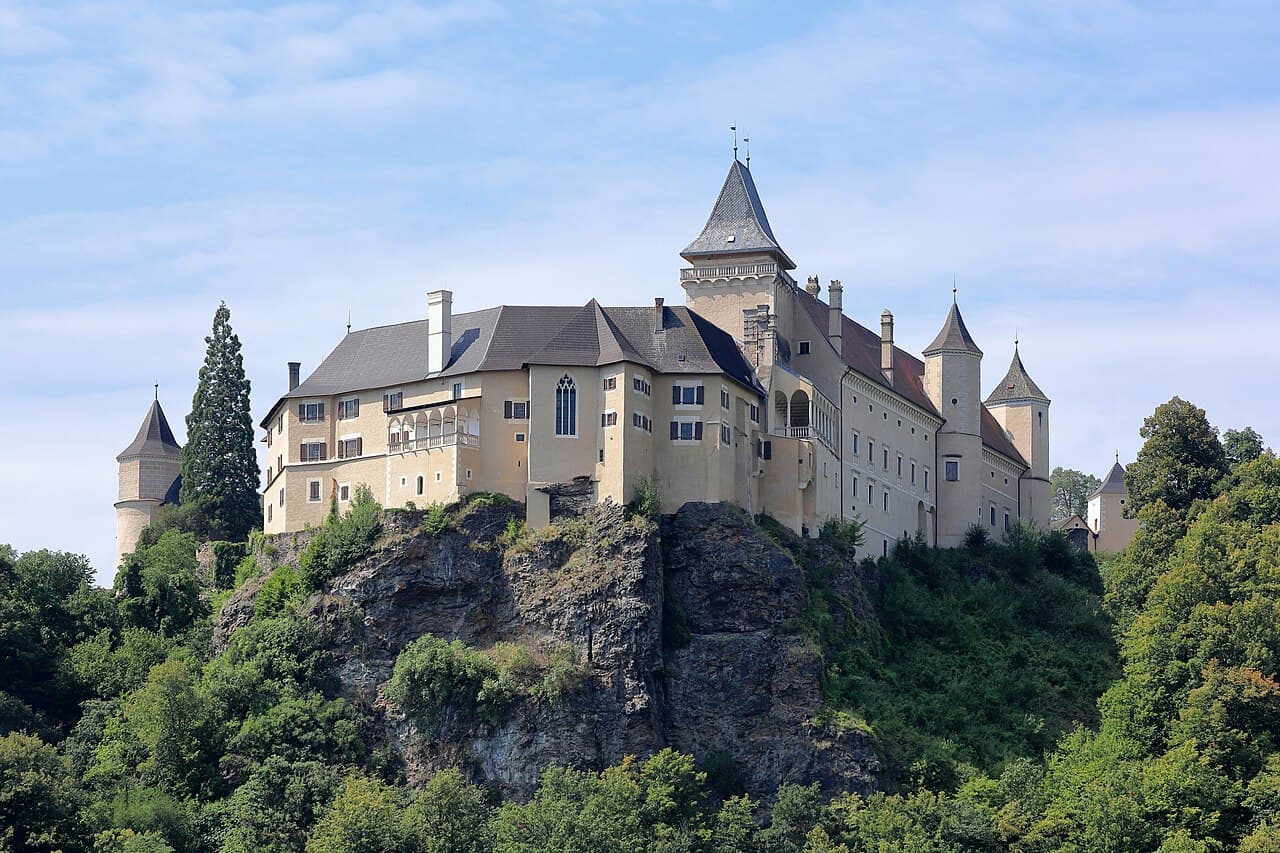
Rosenburg Castle
Rosenburg Castle stands as one of the most iconic Renaissance castles in Austria, nestled within the scenic Kamptal Nature Park in Lower Austria. Its commanding position on a cliff overlooking the Kamp valley at 345 meters above sea level offers visitors breathtaking views and a palpable sense of history. The castle's origins trace back to the 12th century, initially constructed in the Romanesque style as a fortress to oversee and control vital trade routes between Bohemia and Vienna.
The earliest written record of Rosenburg dates to 1175, describing a central stronghold or citadel surrounded by a pentagonal inner courtyard. Foundations of this original Romanesque bergfried (keep) remain visible at the base of the current structure, offering a tangible link to the castle's medieval beginnings. Over the centuries, Rosenburg evolved architecturally and functionally, reflecting the shifting political, religious, and cultural tides of Austria.
Medieval origins and gothic transformation
During the 15th century, Rosenburg underwent significant expansion and stylistic transformation under Count Kaspar von Rogendorf, chamberlain to Emperor Frederick III. This period saw the castle's conversion into a Gothic fortress, with the addition of a chapel and the outer defensive walls that largely survive today. The Gothic elements emphasized both the castle's military strength and its role as a religious center. The castle's strategic importance was underscored by its repeated use as a stronghold during conflicts with Hungarian forces.
In 1433, the castle suffered partial destruction during a siege by Hussite forces led by Prokop the Lesser, yet it was not completely demolished and remained a significant fortification in the region.
Renaissance rebuilding and protestant influence
The castle's most dramatic transformation came between 1593 and 1597, when Sebastian II Grabner, a Protestant nobleman, ordered the demolition of much of the Gothic structure. He commissioned the construction of a new Renaissance palace featuring an impressive 13 towers. This reconstruction reflected the Renaissance ideals of symmetry, elegance, and fortified comfort rather than purely military function. Around 1614, a large tournament ground measuring approximately 67 by 46 meters was added, along with 46 arcades, underscoring the castle's new role as a noble residence and social venue rather than a strict fortress.
During this era, Rosenburg became a center of the Austrian Reformation. The Grabner family, who owned the castle from 1487 until 1604, adopted Protestantism and operated a printing press within its walls to support religious reform. However, the Counter-Reformation brought significant upheaval. In 1611, Cardinal Franz von Dietrichstein, a Catholic bishop, acquired the castle and converted its chapel for Catholic worship.
Siege and ownership changes in the 17th century
The religious conflict culminated in 1620 when Protestant forces from the Horner Bund besieged and captured Rosenburg during the Thirty Years' War. The siege was brutal, resulting in the deaths of many defenders and inhabitants, an event commemorated today by a memorial column in the castle garden. Following this turbulent period, the castle changed hands multiple times.
In 1681, the Rosenburg passed to the House of Sprinzenstein through the marriage of Countess Maria Regina von Sprinzenstein to Count Leopold Graf Hoyos. The combined von Hoyos-Sprinzenstein family has maintained ownership ever since, demonstrating remarkable continuity amid the castle's turbulent history.
Fires, neglect, and 19th-century restoration
Rosenburg suffered several devastating fires in the 18th and early 19th centuries. Lightning struck in 1721, causing significant damage. Another fire in 1751 destroyed parts of the courtyard gate and chapel. The most severe fire occurred in 1800, after which the castle fell into a prolonged state of neglect, remaining barely used for about 60 years.
The Romantic era sparked renewed interest in medieval and Renaissance castles, inspiring Count Ernst Carl von Hoyos-Sprinzenstein senior to undertake extensive restoration between 1859 and 1889. He rebuilt the castle at great personal expense, basing the restoration on a detailed 1673 depiction of Rosenburg. This work preserved the castle's Renaissance character and made it one of Austria's first castles to open to the public as a museum and cultural site.
Modern cultural significance and visitor experience
Today, Rosenburg Castle is a vibrant cultural venue and one of Austria's most visited Renaissance castles. It offers visitors a rich experience that combines history, architecture, and live performances. The castle features well-preserved interiors, including an armory with weapons spanning the 15th to 18th centuries, and exhibitions on the history of falconry and the von Hoyos family.
The castle's tournament grounds, the largest surviving in Europe, host regular reenactments and medieval-themed events in historic costumes, bringing the Renaissance atmosphere to life. Falconry demonstrations with birds of prey are popular attractions, reflecting the castle's longstanding tradition in this noble sport. The central courtyard serves as an open-air stage for annual theatrical performances, including a renowned Shakespeare Festival.
Visitors can also enjoy a tavern offering traditional fare, enhancing the immersive historical experience. The castle's setting within the Kamptal Nature Park adds natural beauty to the visit, while nearby attractions such as the Altenburg monastery, the medieval town of Horn, and the Wachau River Valley enrich the cultural itinerary.
Architectural highlights and preservation
The castle complex reflects a blend of architectural styles and historical layers. The surviving Romanesque foundations anchor the site, while the Gothic chapel and outer walls testify to 15th-century fortifications. The dominant Renaissance elements, including the 13 towers and arcades, showcase the castle's transformation into a noble residence.
Despite the damage from historic fires, extensive restoration efforts in the 19th and late 20th centuries have preserved Rosenburg's structural integrity and aesthetic appeal. The castle remains in well-preserved condition, managed by the von Hoyos-Sprinzenstein family, who continue to maintain its legacy as a cultural landmark.
Historical legacy and cultural impact
Rosenburg Castle's rich history mirrors the broader religious, political, and social changes in Austria from the Middle Ages through the Renaissance and beyond. Its role as a Protestant stronghold, a site of conflict during the Thirty Years' War, and a Renaissance noble residence encapsulates centuries of Austrian heritage.
The castle's cultural significance extends into modern times, with its depiction on Austrian collector coins, postage stamps, and banknotes underscoring its status as a national symbol. The ongoing falconry demonstrations, theatrical events, and historical reenactments keep the castle's past alive for contemporary audiences, making Rosenburg a dynamic link between history and present-day cultural tourism.
Frequently asked questions (FAQ)
- How do I get to Rosenburg Castle?
- Rosenburg Castle is located in Lower Austria, accessible by car or public transport from Vienna. The nearest town is Horn, and local buses or taxis can reach the castle from there.
- What are the opening hours of Rosenburg Castle?
- The castle is open daily from 10:00 to 17:00, allowing visitors to explore the grounds, museum, and attend various events throughout the year.
- Can I visit the interiors of Rosenburg Castle?
- Yes, guided tours offer access to the castle's well-preserved interiors, including the armory, historic rooms, and exhibitions on falconry and the von Hoyos family history.
- Are there any special events at Rosenburg Castle?
- Rosenburg hosts regular falconry demonstrations, medieval tournament reenactments, and an annual Shakespeare Festival in the central courtyard, providing immersive cultural experiences.
- Is Rosenburg Castle suitable for families?
- Absolutely, the castle offers family-friendly activities such as falconry shows and medieval reenactments that engage visitors of all ages in historical learning and entertainment.
Photo gallery

Information
Opening hours
10:00-17:00, daily
Ticket prices
€10 adult, €7 child
Current owner
von Hoyos-Sprinzenstein family
Website
Visit websiteAddress
Rosenburg 1, 3573 Rosenburg, Austria
Sources & official resources
Verify the information above using these authoritative references.
Loading map...
Visitor reviews
No reviews yet. Been here? Write the first review and help other travelers!
Write the first reviewVisited this castle? Share your experience
Your review helps other travelers and adds first-hand knowledge to our encyclopedia.


