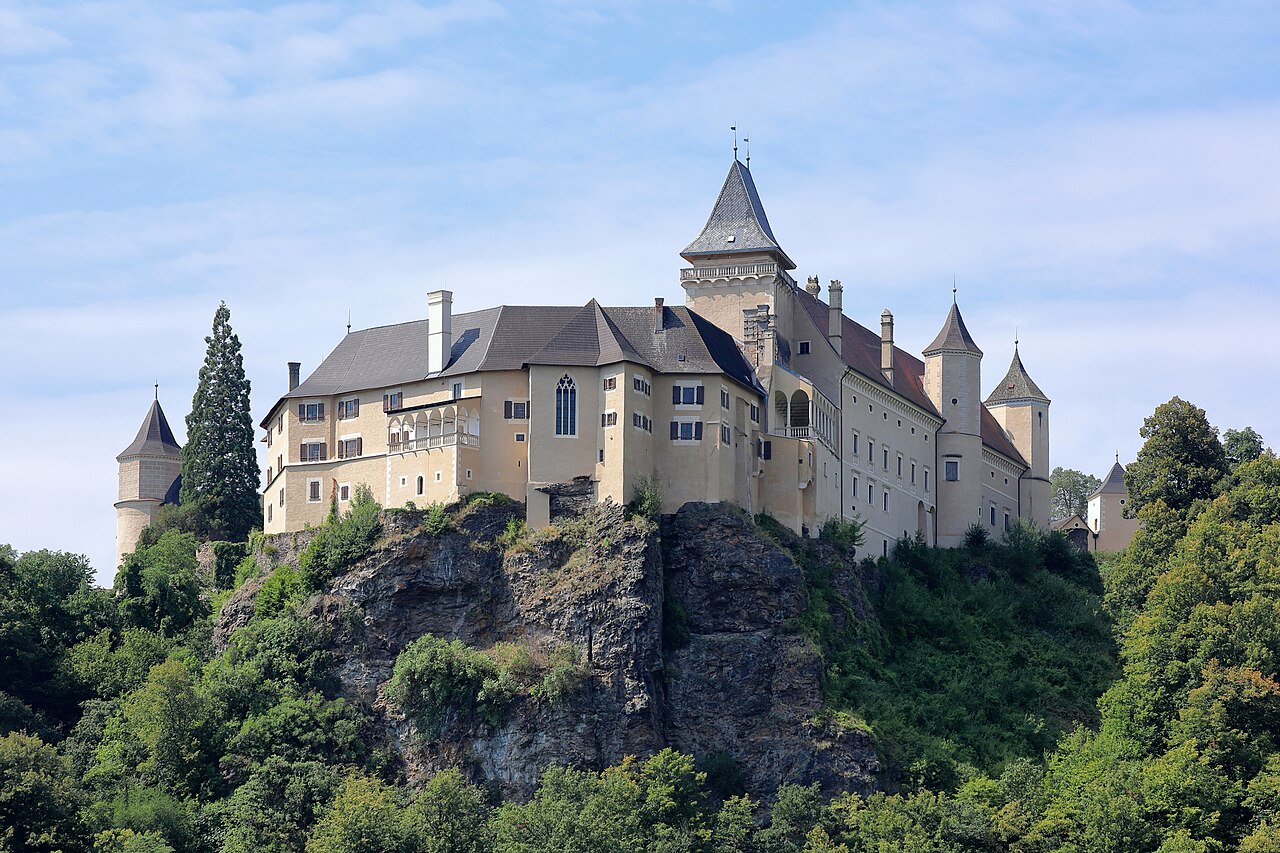
Kamegg Castle
Kamegg Castle, locally known as Burg Kamegg, is a medieval hill castle ruin located in the village of Kamegg, south of the city of Horn in the province of Lower Austria, Austria. The castle is situated on a small hill that commands impressive views over the Kamp valley, with the historic Gars am Kamp Castle visible downstream. This strategic position highlights the castle's historical role in regional defense and control of the valley.
Early history and ownership
The first recorded mention of Kamegg Castle dates back to 1150, when it was owned by the Lords of Chambecha. The castle's name likely derives from this noble family, reflecting its medieval origins. By the mid-14th century, around 1350, ownership transferred to the Lords of Kamegg-Kaja, who maintained control for several centuries. In 1620, the castle's ownership was consolidated with that of the nearby Rosenburg Castle, a significant fortress in the region. Following this consolidation, Kamegg Castle fell into decline and eventual ruin.
Architectural features and layout
The castle is classified as a hill castle, built on elevated terrain to maximize defensive advantage. Though now largely a ruin, the remains provide insight into its original structure. The site includes remnants of the keep, which would have served as the main fortified tower and last line of defense. Surrounding the keep are fragments of the defensive walls, including a gate that controlled access to the inner ward.
One notable defensive feature is a dry moat approximately 5 meters deep, which separates the castle from the rest of the hill, enhancing its defensibility by creating a physical barrier against attackers. Additionally, parts of a residential building remain, indicating the castle's dual function as a military stronghold and noble residence.
Castle chapel
The castle's chapel remained in use until 1786, long after the castle itself had fallen into disrepair. This suggests the site retained some religious or community significance even as the fortress ceased to function militarily.
Current condition and visitor experience
Today, Kamegg Castle is a small ruin that is freely accessible to visitors. The site offers panoramic views over the Kamp valley, making it a popular spot for sightseeing and photography. The proximity to other historic sites like Gars am Kamp Castle adds to its appeal for those interested in medieval architecture and Austrian history.
Despite its ruinous state, the castle's remaining structures provide a tangible connection to its medieval past. The dry moat and surviving walls allow visitors to appreciate the defensive strategies employed in hill castle construction during the High to Late Medieval periods.
Historical significance
Kamegg Castle exemplifies the typical development and decline of many small noble castles in Lower Austria. Its history reflects the shifting ownership patterns and feudal relationships of the region from the 12th to the 17th centuries. The castle's eventual absorption into the holdings of Rosenburg Castle and subsequent abandonment illustrate broader trends in castle consolidation and changing military needs during the early modern period.
While not as grand as some of Austria's more famous fortresses, Kamegg Castle remains an important cultural landmark that offers insights into medieval noble life and defensive architecture in the Kamp valley area.
Frequently asked questions (FAQ)
- How do I get to Kamegg Castle?
- Kamegg Castle is located in the village of Kamegg, south of Horn in Lower Austria. It can be reached by local roads from Horn, and parking is available nearby for visitors.
- What can I see at Kamegg Castle?
- Visitors can explore the ruins including the remnants of the keep, defensive walls, gate, and a dry moat. The site offers panoramic views of the Kamp valley and nearby castles such as Gars am Kamp Castle.
- Is Kamegg Castle accessible to the public?
- Yes, Kamegg Castle is freely accessible to visitors. There are no entrance fees, and the site is open year-round, although facilities are minimal due to its ruinous state.
- When was Kamegg Castle built?
- Kamegg Castle was first mentioned in historical records in 1150, indicating its construction during the High Medieval period.
- Why did Kamegg Castle fall into ruin?
- After its ownership merged with Rosenburg Castle in 1620, Kamegg Castle was no longer maintained as a primary fortress, leading to its gradual decline and ruin.
Information
Address
Kamptal Strasse, Austria
Loading map...
Visitor reviews
No reviews yet. Been here? Write the first review and help other travelers!
Write the first reviewVisited this castle? Share your experience
Your review helps other travelers and adds first-hand knowledge to our encyclopedia.