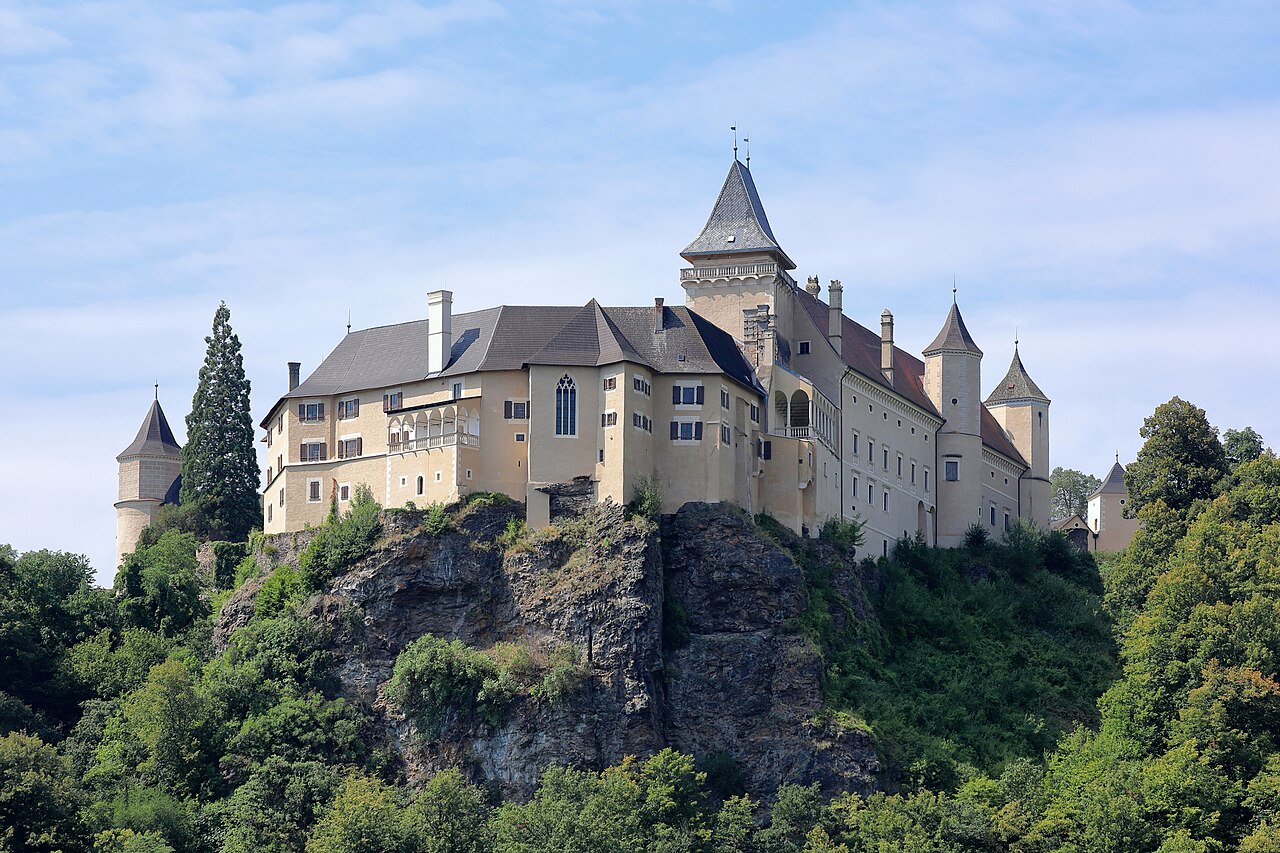
Gars am Kamp Castle
Gars am Kamp Castle, also known as Burg Gars am Kamp, Babenberger Burg, or Burg Gars, is a prominent hilltop castle situated in the town of Gars am Kamp, south of Horn in the province of Lower Austria. This castle stands as a significant monument of High Medieval architecture and history, embodying the legacy of the noble Babenberger family, who played a crucial role in the early formation of the Austrian state.
The castle's origins trace back to the 11th century, with the first documented mention occurring during this period. It was strategically constructed on a rocky promontory overlooking the Kamp River, utilizing the natural defensive advantages of the terrain. This location not only provided military security but also offered commanding views of the surrounding Kamp valley and the town below, emphasizing its role as a fortified residence and regional stronghold.
Historical significance and early ownership
Gars am Kamp Castle was initially built and inhabited by the Babenberger dynasty, one of the most influential noble families in medieval Austria. Notably, Leopold II "The Beautiful" and his son Leopold III "The Saint", both Margraves of Austria, resided here between approximately 1075 and 1095. Their tenure at the castle underscores its importance as a political and administrative center during the formative years of the Austrian march.
Following this period, between 1096 and 1121, the castle came under the ownership of Bishop Ulrich of Passau, indicating a transition from secular to ecclesiastical control, which was common in medieval Europe as church authorities often acquired strategic fortifications.
Subsequent notable owners included the Lords of Maissau and the Barons of Teufel, who maintained the castle and contributed to its architectural evolution. The castle's completion in 1709 marks a significant phase in its structural development, reflecting the architectural styles and defensive needs of the period.
Architectural features and layout
The castle complex is an excellent example of a hill castle with a terraced design descending across three distinct levels along the slope by the Kamp River. The highest terrace hosts the main castle, enclosed by a robust ring wall that provided formidable defense against invaders.
The middle terrace features several important structures, including the southern gate tower, which served as a key point of entry and defense. Adjacent to the gate tower is the castle chapel, a sacred space integral to the castle's daily life and spiritual needs. A hall building dating from the 16th century lies to the west, alongside fortifications from the 13th century that highlight the castle's continuous adaptation to evolving military technologies and threats.
The lowest terrace, connected by a winding castle path, contains the fortified outer bailey which historically housed auxiliary buildings and supported the castle's defensive system. Notably, this level includes the parish church of Thunau am Kamp situated on a southern terrace, illustrating the close relationship between the castle and local religious institutions.
A distinctive feature of the castle is a small coat of arms stone belonging to the Rotthal family, dated 1709, positioned above the portal to the north tower, symbolizing the heraldic legacy and the castle's ownership lineage.
Decline, destruction, and modern restoration
By the late 18th century and into the early 19th century, Gars am Kamp Castle experienced a period of decline. Around 1800, the imposition of roof taxes contributed to the castle falling into disrepair, as maintaining such large structures became financially burdensome. The situation worsened in 1809 when the castle suffered destruction during the French War, reflecting the turbulent military conflicts of the Napoleonic era that affected many European fortifications.
Despite this decline, the castle's ruins remained a prominent landmark. In 1996, ownership was transferred to the town of Gars am Kamp, which undertook efforts to preserve and repurpose the site. Today, the castle serves as a vibrant cultural venue, hosting open-air theatre performances and various community events, thereby maintaining its historical relevance and engaging the public with its heritage.
Visitor experience and cultural importance
Visitors to Gars am Kamp Castle can explore the extensive castle grounds, which offer spectacular views of the town of Gars am Kamp and the surrounding Kamp valley. Although access to the interior of the castle buildings is generally restricted, the freely accessible ruins provide a compelling glimpse into medieval architecture and fortification strategies.
The castle's setting on a rocky hilltop, combined with its layered terraces and surviving architectural elements, makes it an attractive destination for history enthusiasts, photographers, and cultural tourists. The occasional admission fees during cultural events support the maintenance and programming of the site, ensuring its preservation for future generations.
Architectural evolution and defensive adaptations
Over the centuries, Gars am Kamp Castle underwent numerous modifications reflecting changes in military technology and domestic needs. The initial 11th-century construction focused on robust stone walls and strategic positioning. By the 13th century, additional fortifications were added to strengthen the castle's defenses against siege warfare.
The 16th-century hall building exemplifies the transition towards more comfortable residential spaces within the castle complex, balancing defense with habitation. The castle chapel's location near the gate tower also indicates the integration of spiritual life within the defensive perimeter.
The castle in the context of the Babenberger dynasty
The castle's association with the Babenberger family places it at the heart of Austrian medieval history. The Babenberg margraves were instrumental in establishing the foundations of the Austrian state, and their residence at Gars am Kamp reflects the castle's role as a seat of power and governance during the High Medieval period.
Leopold III, known as "The Saint," is a particularly notable figure linked to the castle, revered for his piety and contributions to the development of the region. His time at Gars am Kamp underscores the castle's significance beyond military functions, encompassing religious and administrative roles.
Preservation efforts and cultural programming
Since the late 20th century, concerted efforts have been made to stabilize the ruins and promote the castle as a cultural hub. The municipality's stewardship has enabled the hosting of theatrical productions and community events, which breathe new life into the historic site.
These activities not only enhance public appreciation of medieval architecture and history but also contribute to local tourism and economic development. The castle's preservation as a landmark of Lower Austria's heritage remains a priority, ensuring that its story continues to be told.
Frequently asked questions (FAQ)
- When was Gars am Kamp Castle built and who were its original owners?
- Gars am Kamp Castle was built in the 11th century and originally owned by the noble Babenberger family, including Margraves Leopold II and Leopold III.
- What architectural features can visitors see at Gars am Kamp Castle?
- Visitors can explore the terraced hilltop layout with a main castle ring wall, southern gate tower, castle chapel, 16th-century hall building, and 13th-century fortifications.
- Is Gars am Kamp Castle accessible to the public?
- The castle grounds are freely accessible, offering scenic views and cultural events, but access inside the buildings is generally restricted.
- What events led to the castle's decline and destruction?
- The castle fell into disrepair around 1800 due to roof taxes and was partially destroyed in 1809 during the French War.
- Who owns Gars am Kamp Castle today and how is it used?
- Since 1996, the town of Gars am Kamp owns the castle, using it for cultural activities including open-air theatre performances.
Information
Current owner
Town of Gars am Kamp
Address
Am Schlossberg, Gars am Kamp, Austria
Loading map...
Visitor reviews
No reviews yet. Been here? Write the first review and help other travelers!
Write the first reviewVisited this castle? Share your experience
Your review helps other travelers and adds first-hand knowledge to our encyclopedia.