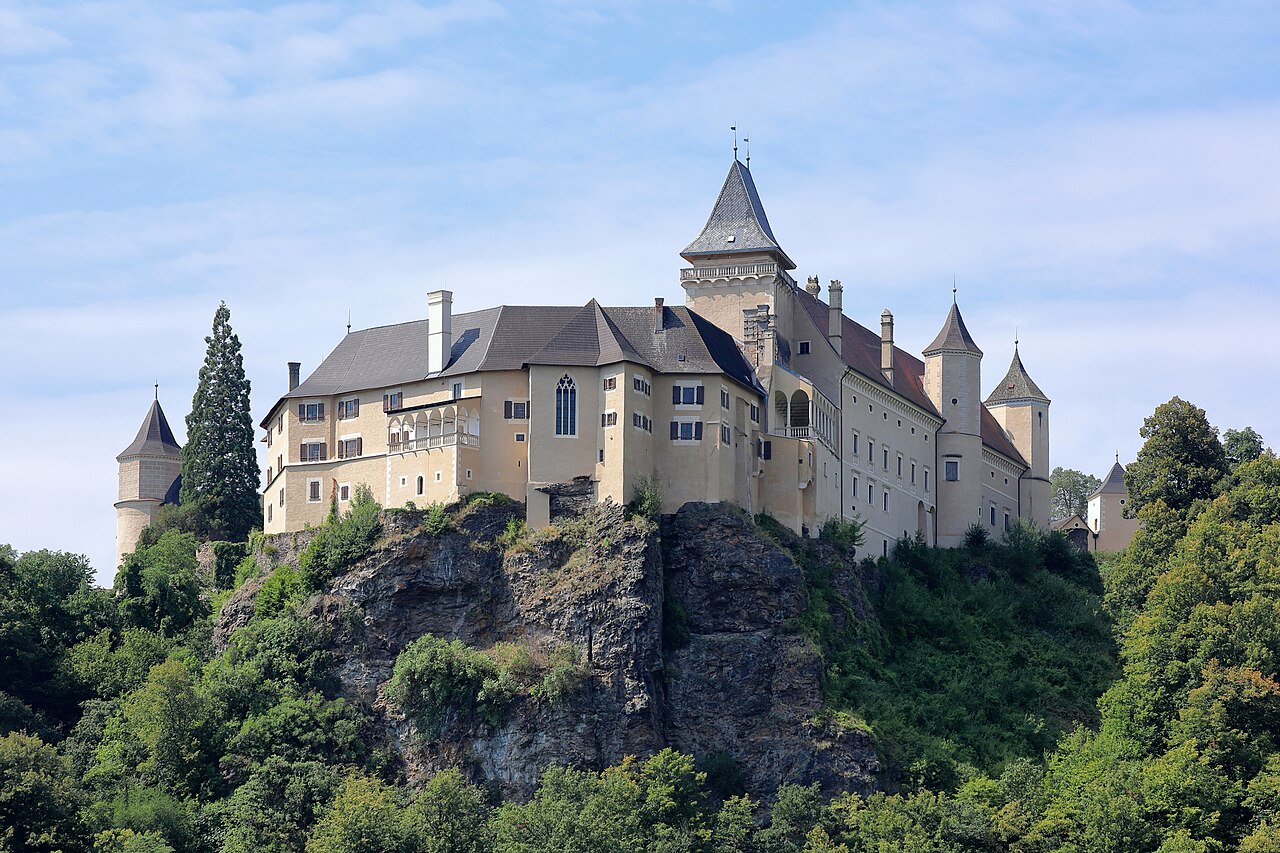
Altenburg Abbey
Altenburg Abbey is a remarkable Benedictine monastery located in Altenburg, Austria, with origins dating back to its foundation in 1144 by Countess Hildeburg of Poigen-Rebgau. This abbey has witnessed centuries of religious devotion, military conflict, and artistic transformation, making it a significant cultural and architectural landmark in the region. The abbey’s enduring presence reflects a continuous monastic tradition that has adapted through turbulent historical periods while preserving its spiritual and architectural heritage.
Founded with twelve monks from St. Lambrecht Abbey in Styria, Altenburg Abbey was established as a religious community dedicated to the Rule of Saint Benedict. The new foundation was named after the monks’ home monastery and served the noble families of the surrounding Poigreich region. Over the centuries, the abbey endured numerous assaults and reconstructions, each shaping its evolving character.
Medieval history and military challenges
The abbey’s early history was marked by repeated military attacks that caused significant damage and necessitated rebuilding efforts. The first recorded assault occurred in 1251, led by Hermann V of Baden. Later, the abbey faced raids by the Cumans between 1304 and 1327, followed by damage during the Hussite Wars from 1427 to 1430. In 1448, combined forces from Bohemia, Moravia, and Hungary attacked the monastery, and in 1552 it was targeted by the Turks. The Thirty Years’ War brought further devastation when Swedish troops destroyed much of the abbey in 1645.
Despite these challenges, the abbey was resilient. Restoration efforts began as early as 1327 under Gertrude, widow of Heidenreich von Gars, and continued through the centuries. The most transformative rebuilding took place in the late 17th and early 18th centuries, when the abbey was redesigned in the Baroque style under the leadership of abbots Maurus Boxler and Placidus Much.
Baroque transformation and artistic achievements
The Baroque reconstruction was supervised by the architect Joseph Munggenast, who worked with some of Austria’s most distinguished artists and craftsmen. The frescoes by Paul Troger are a defining feature of the abbey’s interiors, adorning the library, imperial staircase, and abbey church dome. Troger’s works include vivid biblical scenes such as the Judgment of Solomon, the Wisdom of God, and the Light of Faith. The stucco decorations by Franz Josef Holzinger and marble carvings by Johann Georg Hoppl complement the frescoes, creating a richly textured and elegant environment.
The abbey church, dedicated to Saint Lambert, features an oval-shaped plan crowned by a dome rebuilt between 1730 and 1733. The church’s high altar boasts Troger’s painting of the Assumption of Mary topped by a depiction of the Trinity. The church tower, resting on Romanesque foundations, was completed in 1820 after repairs following fire damage.
The library hall, constructed in 1740, is a three-story Baroque masterpiece stretching 48 meters in length. Its ceiling is richly decorated with Troger’s frescoes, making it one of the most impressive monastic libraries in Austria. Beneath the library lies a crypt with medieval frescoes by unknown artists, including the striking Dance of Death motif, a reminder of mortality common in medieval art.
Architectural features and monastic complex
The abbey complex extends approximately 200 meters along its east-facing façade and incorporates twelve distinct sections, including courtyards, living quarters, and religious buildings. The interiors showcase a fusion of Baroque and Rococo stucco styles, with grand spaces such as the imperial staircase and marble hall reflecting the artistic vision of the 18th century renovations.
Archaeological excavations from 1983 to 2005 uncovered extensive medieval foundations beneath the current Baroque structures. These include the original cloister, refectory, abbot’s residence, monks’ quarters, scriptorium, and a Gothic chapel dedicated to Saint Vitus. These discoveries provide valuable insights into the abbey’s early spatial organization and monastic life.
Gardens and natural surroundings
The monastic community has cultivated several gardens around the abbey, enhancing its spiritual and ecological environment. The Garden of Religions is the largest, dedicated to the five major world religions: Hinduism, Buddhism, Judaism, Christianity, and Islam. This garden features a natural pond, wildflower meadows, and an old plum grove where local livestock graze.
Other gardens include the Apothecary Garden, historically used for growing medicinal herbs; the Creation Garden, which explores theological themes; and the Garden of Silence, with vineyards, butterfly houses, beehives, and stone sculptures by artist Eva Vorpagel-Redl. The Cloister Garden offers a quiet contemplative space within the abbey grounds.
Modern history and cultural significance
In the late 18th century, Emperor Joseph II’s reforms restricted the abbey’s ability to accept new novices, but Altenburg Abbey managed to remain operational, unlike many other monasteries that were closed. The abbey briefly served as a military hospital in 1797, highlighting its role in the community beyond religious functions.
The 20th century brought significant challenges during the Nazi era. Abbot Ambros Minarz’s refusal to display the Nazi flag in 1938 led to the occupation of the abbey by SA forces and the community’s suspension in 1941. The abbot was arrested, and the monks were dispossessed. After World War II, Soviet troops occupied the premises until restoration efforts allowed the monastic community to return under Abbot Maurus Knappek between 1947 and 1968.
Today, Altenburg Abbey remains a vibrant religious and cultural site, continuing its Benedictine traditions while welcoming visitors to explore its rich history, stunning Baroque architecture, and serene gardens. Its musical heritage is preserved through historic organs, including the choir organ built in 2014 by Henk Klop and the large organ originally constructed in 1773 by Anton Pfliegler, which has been carefully restored over the centuries.
Frequently asked questions (FAQ)
- What are the opening hours of Altenburg Abbey?
- Altenburg Abbey is open to visitors from 9 AM to 5 PM daily, with extended hours during the summer months. It is advisable to check the official website for any seasonal changes or special closures.
- How do I get to Altenburg Abbey?
- Altenburg Abbey is easily accessible by public transportation, with frequent bus services from the nearest city. If you're driving, there is ample parking available near the entrance for convenience.
- What is the historical significance of Altenburg Abbey?
- Altenburg Abbey dates back to the 11th century and is renowned for its role in the religious and cultural history of Austria. It served as a center for monastic life and has witnessed significant events throughout the ages.
- Can I take guided tours of the abbey?
- Yes, guided tours are available and are highly recommended to fully appreciate the rich history and architecture of Altenburg Abbey. These tours typically last about an hour and provide in-depth insights into the abbey's past.
- Is Altenburg Abbey accessible for individuals with mobility challenges?
- Yes, Altenburg Abbey is equipped with facilities to accommodate visitors with mobility challenges. Ramps and accessible restrooms are available to ensure a comfortable visit for everyone.
- When is the best time to visit Altenburg Abbey?
- The best time to visit Altenburg Abbey is during the spring and early fall when the weather is mild and the gardens are in full bloom. Additionally, visiting during weekdays can help avoid the weekend crowds.
- What are the ticket prices for Altenburg Abbey?
- Tickets for Altenburg Abbey are reasonably priced, with discounts available for students and seniors. Children under the age of 12 can enter for free, making it a great family-friendly destination.
- Are there any nearby attractions to visit after exploring the abbey?
- Yes, there are several nearby attractions, including the charming town of Altenburg and the scenic hiking trails in the surrounding hills. Additionally, local wineries offer tastings and tours that complement your visit to the abbey.
Information
Website
Visit websiteSources & official resources
Verify the information above using these authoritative references.
Loading map...
Visitor reviews
No reviews yet. Been here? Write the first review and help other travelers!
Write the first reviewVisited this castle? Share your experience
Your review helps other travelers and adds first-hand knowledge to our encyclopedia.