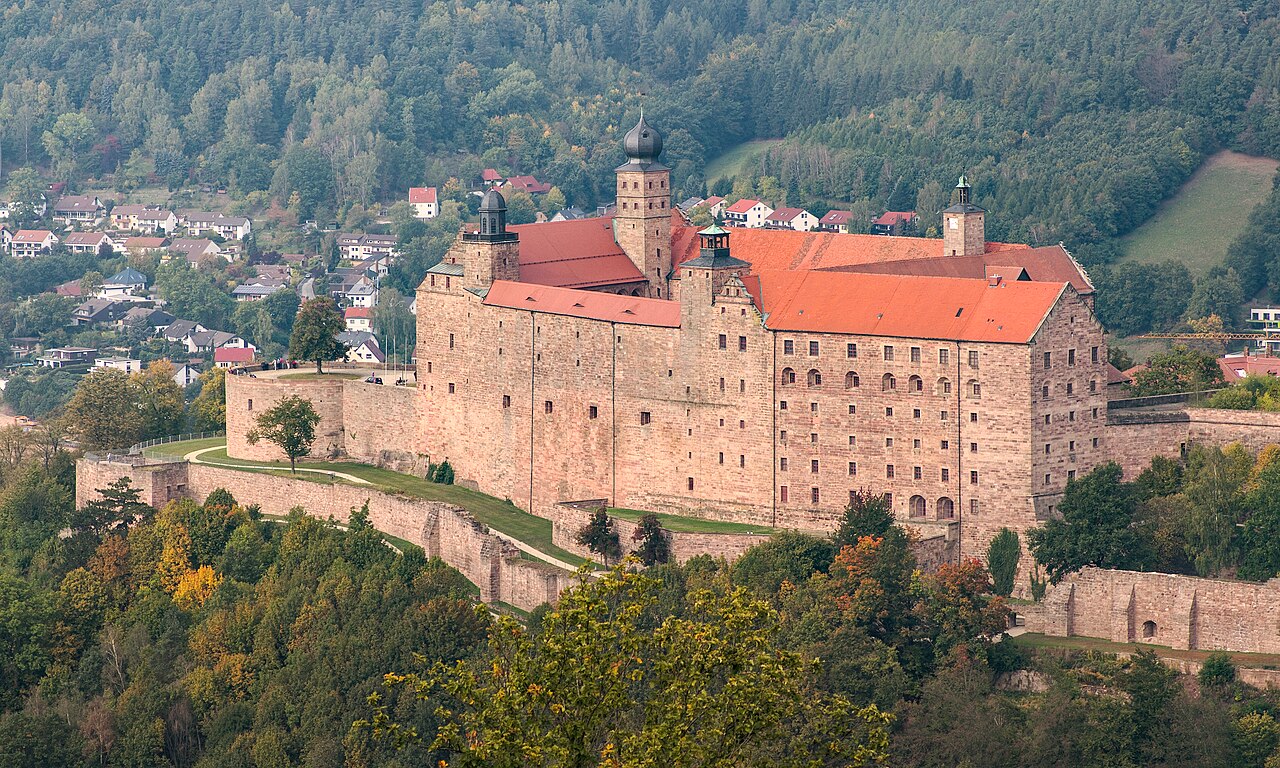
Rosenberg Fortress
Rosenberg Fortress towers prominently above the old town of Kronach on Rosenberg hill, representing one of the most extensive and well-preserved fortifications in Germany. This hill castle was originally constructed in the 13th century and first documented in 1249. It served as the palace of the Prince Bishops of Bamberg and later evolved into a major regional stronghold, reflecting centuries of architectural development and military history.
Medieval origins and early expansions
The earliest structure on Rosenberg hill was established as the castle of the prince-bishop, marking its importance as both a residence and a defensive site. Over the subsequent decades, the castle was significantly fortified and expanded, adapting to the needs of its rulers and the challenges of the period. Under the reign of Prince-Bishop Philipp von Henneberg (1475-1487), key additions included a new section of walls, the Arsenal Gate in the south, the Old Arsenal, and the precursor to the current Commander's Building. These enhancements reflected the growing military and administrative significance of the fortress.
Fortification enhancements and bastion development
The mid-16th century brought further transformation to Rosenberg Fortress. After the Margrave War in 1553, Prince-Bishop Veit II von Würtzburg commissioned master builder Daniel Engelhardt to complete the fortress as a four-winged complex. This included extensions and new constructions for both the Old and New Arsenal. In the 1570s, the fortress saw the development of its bastions, initially constructed from soil and wood, which were vital for its defensive capabilities.
The thirty years' war and resilience
The fortress's strategic importance was tested during the Thirty Years' War when Swedish forces attempted multiple sieges between 1632 and 1634. Despite the outer defenses still being composed largely of earthen and wooden bastions, the fortress and the inhabitants of Kronach successfully resisted these attacks. This steadfast defense prevented the capture of the town and fortress, forcing the Swedish to withdraw.
Post-war modernization and completion
Following the war, Rosenberg Fortress underwent significant modernization. The earthen bastions were replaced with durable lithic bastions shaped in the contemporary style of the late 17th century. Under the leadership of Prince-Bishop Lothar Franz von Schönborn (1693-1729), the fortifications were completed in 1699, giving the fortress its characteristic pentagonal layout with five massive bastions. This design exemplifies the early modern military architecture that combined traditional medieval elements with Renaissance-era fortification principles.
Later history and modern use
In 1867, Rosenberg Fortress ceased to be a military fortification. The town of Kronach purchased the complex in 1888 for 32,000 Deutsche Mark and has maintained ownership since. During World War I, the fortress was repurposed as a prison camp for officers, notably holding Charles de Gaulle, who would later become the president of France.
After World War II, the fortress provided shelter for refugees. Subsequently, parts of the fortress, including the Old Arsenal and the Commander's Building, were converted into residential flats, some of which remained occupied into the 1970s.
Architectural features and current state
Today, Rosenberg Fortress covers an impressive area of 23.6 hectares, making it one of the largest surviving fortifications in Germany. The complex includes extensive walls, moats, gates, bastions, and internal buildings that have been preserved or restored. The fortress is enclosed by a distinctive pentagonal ring with five substantial bastions, a design that illustrates the blend of medieval and early modern defensive architecture.
The fortress's layout, with its four-winged structure and multiple arsenals, reflects the evolution of military architecture from the high medieval period through Renaissance and Baroque modifications. Its preservation offers valuable insight into the defensive strategies and residential needs of the prince-bishops and later military authorities.
Cultural and historical significance
Rosenberg Fortress stands as a testament to the military, political, and social history of the Franconian region. Its role as a bishop's palace, a military bastion, a prison camp, and a refuge highlights its adaptability and enduring importance. The fortress is a key cultural landmark in Kronach, attracting visitors interested in medieval and early modern fortifications, military history, and architectural heritage.
Visitors today can explore the fortress's extensive grounds, including its bastions, gates, and historic buildings, which collectively narrate centuries of European fortification history. The fortress remains under the ownership of the town of Kronach, ensuring its preservation and accessibility for future generations.
Frequently asked questions (FAQ)
- How do I get to Rosenberg Fortress?
- Rosenberg Fortress is located in Kronach, Germany, and can be easily accessed by car or public transport. If you're traveling by train, the nearest station is Kronach, from where you can take a short taxi ride or a scenic walk to the fortress.
- What is the historical significance of Rosenberg Fortress?
- Rosenberg Fortress dates back to the 13th century and served as a key defensive structure in the region. It played a vital role in the defense against various invasions and showcases the military architecture of the medieval period.
- When was Rosenberg Fortress built?
- Construction of Rosenberg Fortress began in the early 13th century, with significant expansions and modifications occurring over the centuries. The fortress reflects various architectural styles due to its long history and renovations.
- Can I visit Rosenberg Fortress year-round?
- Yes, Rosenberg Fortress is open to visitors year-round, though opening hours may vary by season. It is advisable to check the official website for the latest information on visiting times and any special events.
- Why is Rosenberg Fortress a popular tourist attraction?
- Rosenberg Fortress is popular for its impressive architecture, stunning views of the surrounding landscape, and rich history. Visitors can explore its well-preserved structures, learn about its past, and enjoy various cultural events held throughout the year.
- Is it possible to take guided tours of the fortress?
- Yes, guided tours are available at Rosenberg Fortress, providing in-depth insights into its history and architecture. These tours are led by knowledgeable guides and are a great way to enhance your visit.
- What are the ticket prices for visiting Rosenberg Fortress?
- Ticket prices for Rosenberg Fortress are generally affordable, with discounts available for students, seniors, and families. It is best to check the fortress's official website for the most current pricing and any special offers.
- What is the best time to visit Rosenberg Fortress?
- The best time to visit Rosenberg Fortress is during the spring and early autumn when the weather is mild and pleasant. This allows visitors to fully enjoy the outdoor areas and stunning views without the crowds of peak summer.
- Are there any nearby attractions to explore?
- Yes, there are several attractions near Rosenberg Fortress, including the historic town of Kronach, with its charming streets and local shops. Additionally, the beautiful nature trails and parks in the area offer excellent opportunities for hiking and outdoor activities.
Information
Loading map...
Visitor reviews
No reviews yet. Been here? Write the first review and help other travelers!
Write the first reviewVisited this castle? Share your experience
Your review helps other travelers and adds first-hand knowledge to our encyclopedia.