Ropaži Castle
Ropaži Castle is a medieval hill fortress located in the municipality of Ropaži, Latvia, near the Lielā Jugla River. Originally constructed by the Livonian Order in the early 14th century, the castle occupies a site of great historical and strategic importance, built atop an ancient Livonian hillfort. Its earliest mention dates back to 1205, during a battle involving Livonian and Semigallian forces against retreating Lithuanian troops. This area was historically inhabited by the Väina Livs, a subgroup of the Livonian people, highlighting the deep-rooted cultural significance of the site.
The castle was established between 1320 and 1322 under the direction of Livonian Order Master Gerhard von Jorke. Its construction aimed to secure a critical land corridor and protect the route toward Riga, a major regional center. Throughout the Middle Ages, Ropaži Castle served as both an economic hub and administrative center under the Livonian Order, playing a vital role in regional governance and military defense.
Following the decline of the Livonian Order, ownership of the castle passed through noble families, including the Tiesenhausen family and later Heinrich von Dohna. Its strategic importance continued into the 16th century, particularly during the Livonian War. In the harsh winter of 1558–1559, Russian forces attacked and set the castle ablaze. Despite significant damage, the fortress was repaired and remained operational into the early 1600s. In 1601, during conflicts between the Polish-Lithuanian Commonwealth and Sweden, the castle surrendered to Swedish troops without resistance. By 1623, records describe it as largely in ruins, marking the end of its active military use.
Architectural features and layout
Ropaži Castle was strategically constructed on a natural defensive site, utilizing the steep banks of the Lielā Jugla River as a natural moat on its south and west sides. These riverbanks rise sharply between six and ten meters, providing formidable natural protection. The fortress walls were built with thick granite masonry, approximately 1.5 meters thick, arranged in an irregular six-sided shape that adapted to the terrain.
The castle's design follows a free-form defensive layout known as a "laagerkastell", characterized by a pentagonal trapezoidal shape. This layout was uncommon and reflects the adaptation to the natural landscape and evolving defensive needs. The main residential wing, dating from the 14th to 17th centuries, overlooked the river, while a shorter wing built in the 15th or 16th century enclosed a large central courtyard. This courtyard served multiple functional purposes and was surrounded by sturdy walls made from fieldstones set in lime mortar.
Defensive structures
The northwest side of the castle featured the main gate, which was reinforced in the 15th century by a substantial round artillery tower. This addition reflects the castle's adaptation to advancements in siege technology during the late medieval period. On the narrower southeastern side stood a forecastle, a smaller outer fortification or outwork, which opened into the courtyard through a northwest entrance.
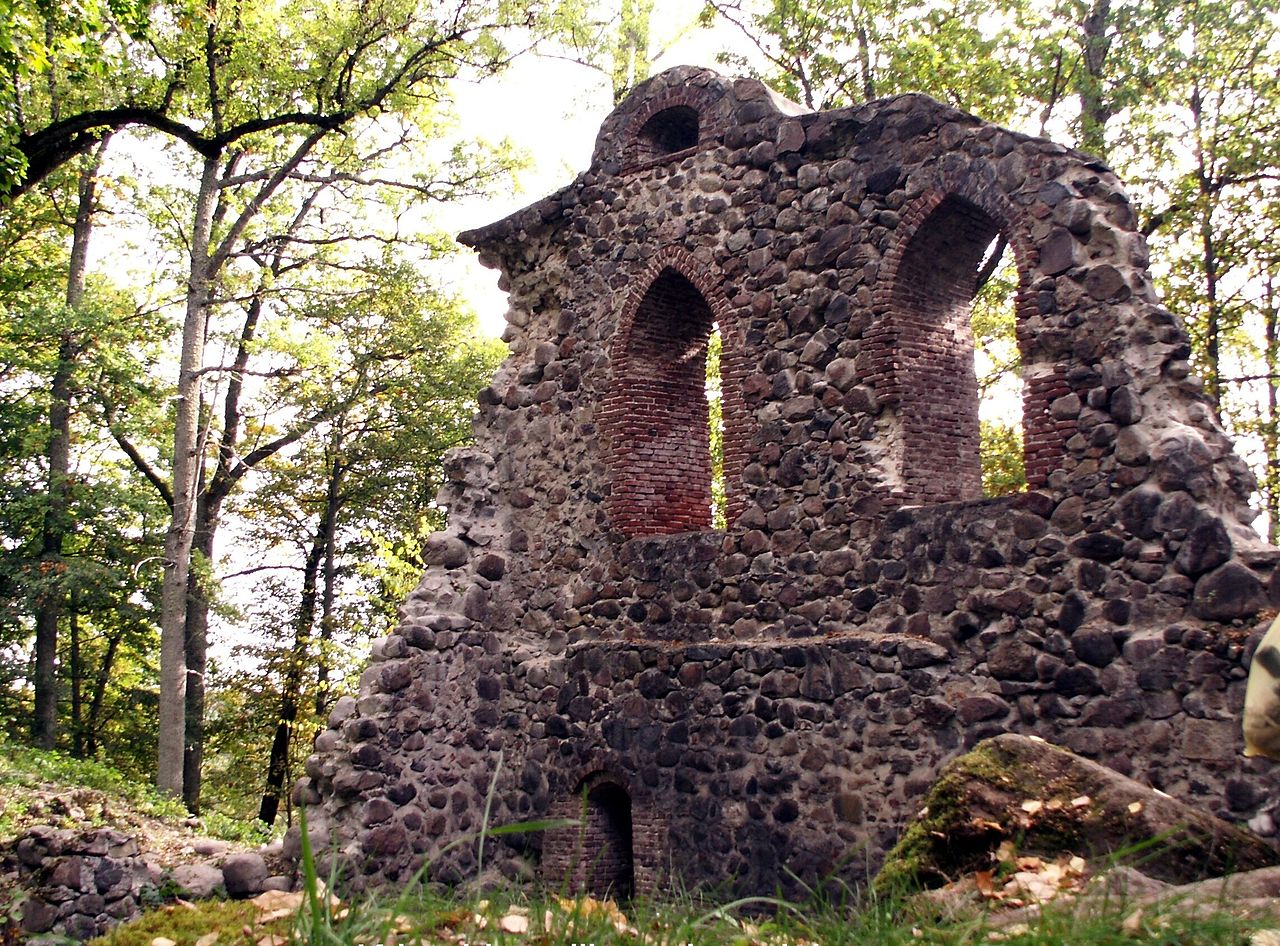
Within the outer walls, wooden buildings once lined the interior, though these were destroyed during the Russian assault in the late 1550s. Today, only two significant masonry fragments remain. The largest fragment measures approximately 13 meters in length and stands about 5 meters tall, providing a tangible sense of the castle's original scale and fortification strength.
Archaeological discoveries and preservation
Excavations conducted in 2006 and 2011 uncovered previously unknown defensive walls, expanding understanding of the fortress's full extent and layout. These archaeological efforts have revealed that the surviving ruins suggest a quadrangular defensive plan, illustrating the strategic design and adaptation over centuries.
Today, Ropaži Castle stands as ruins, with remnants limited mostly to traces of walls atop the hill. The site offers valuable insight into the military architecture of the Livonian Order and the historical conflicts that shaped the region. Its location near Riga and along important trade and military routes underscores its historical significance.
Historical context and significance
Ropaži Castle's history is closely intertwined with the turbulent medieval period in the Baltic region. The Livonian Order, a branch of the Teutonic Knights, built the fortress to consolidate control over the territory and defend against external threats such as Lithuanian and Russian forces. The castle's repeated destruction and reconstruction reflect the shifting political and military landscape of the 15th and 16th centuries.
Its role as an administrative center under noble families after the Livonian Order's decline highlights its continued importance in regional governance. However, the advent of modern warfare and changing political boundaries eventually rendered the castle obsolete, leading to its decline and ruin by the early 17th century.
Cultural heritage and tourism
Today, the Ropaži Castle ruins are a protected cultural heritage site in Latvia. Visitors can explore the remains and learn about the castle's historical context through on-site information and local museums. The site’s natural setting along the Lielā Jugla River adds to its appeal, combining historical exploration with scenic views.
Ongoing archaeological research continues to provide new insights into the castle's construction, defensive features, and the daily life of its medieval inhabitants. The ruins serve as a testament to the region's complex history and the legacy of the Livonian Order in Latvia.
Frequently asked questions (FAQ)
- How do I get to Ropaži Castle?
- Ropaži Castle is located in the municipality of Ropaži, near the Lielā Jugla River in Latvia. It is accessible by local roads from Riga, the capital city, making it a convenient day trip for visitors interested in medieval history.
- What is the historical significance of Ropaži Castle?
- Ropaži Castle was built by the Livonian Order in the early 14th century to secure a strategic land corridor and protect the route to Riga. It served as a military fortress and administrative center during the Middle Ages and played a role in regional conflicts such as the Livonian War.
- Can I visit the ruins of Ropaži Castle?
- Yes, the ruins of Ropaži Castle are open to the public. Visitors can explore the remaining masonry fragments and the site where the castle once stood. It offers a glimpse into medieval fortification architecture and the history of the Livonian Order in Latvia.
- When was Ropaži Castle built?
- Ropaži Castle was constructed between 1320 and 1322 by the Livonian Order on the site of an older Livonian hillfort.
- Why is Ropaži Castle in ruins?
- The castle was severely damaged during the Livonian War when Russian forces attacked and set it on fire in 1558-1559. Although repaired, it eventually fell into disuse and was described as largely in ruins by 1623.
Information
Loading map...
Visitor reviews
No reviews yet. Been here? Write the first review and help other travelers!
Write the first reviewVisited this castle? Share your experience
Your review helps other travelers and adds first-hand knowledge to our encyclopedia.