Rõngu Castle Ruins
Rõngu Castle ruins stand as a significant testament to medieval fortification and ecclesiastical power in Tartumaa, Estonia. Constructed around 1340, this hilltop castellum-type fortress was originally built under the auspices of the Bishopric of Dorpat to defend the southwestern borders against rival forces such as the Livonian Order and Lithuanian armies. Though now largely in ruins, the site offers valuable insight into the military, religious, and noble history of the region over several centuries.
The strategic foundation and medieval context
Situated on the southern tip of Lossimäe hill, rising approximately 12 meters above the nearby Rõngu River and about 73 meters above sea level, the castle's location was carefully chosen for its natural defensive advantages. The fortress occupied an area roughly 30 by 30 meters, oriented along the cardinal points, with a compact design typical of the castellum style. This design focused on a strong, enclosed courtyard surrounded by fortified wings, providing both defense and administrative functionality.
Built during the late medieval period, Rõngu Castle was part of the broader network of fortifications established by the medieval Livonian clergy to secure their territories. The castle's role was both military and religious, as evidenced by the presence of the Holy Cross Chapel within the gatehouse, first documented in 1413. This chapel was notable for offering papal indulgences to visitors and benefactors, highlighting the castle's ecclesiastical significance alongside its defensive purpose.
Ownership and historical events
By the late 15th century, the fortress came under the control of the Tödwen noble family, who maintained its strategic importance. The castle's position at the crossroads of major routes connecting Tartu, Viljandi, Riga, Rannu, and Otepää underscored its military and administrative value in controlling regional movement and trade.
During the Livonian War, the castle experienced violent upheavals. In August 1558, Russian forces led by voivode Pjotr Šuiski captured the fortress, only for it to be retaken by the Livonian Order under Gotthard Kettler in October. Despite the recapture, the castle was deliberately set ablaze and abandoned by November of the same year, marking the end of its active military use.
Subsequently, the Jesuit Order occupied the site until 1625, when Swedish authorities took control and ordered the castle's destruction. Over the following centuries, the ruins passed through the hands of various private owners, including notable figures such as Dmitri Wolkow (1759), Count Manteuffel (1766), Richard von Loewis of Menar (1874), and Conrad von Anrep (1875). These transitions reflect the castle's lasting presence in the local historical landscape despite its ruined state.
Architectural features and surviving remains
The castle's original structure was a compact, fortified enclosure featuring a rectangular courtyard surrounded by wings of the main building. The main gatehouse was a prominent defensive feature, including a vaulted chamber and later a projecting gate extension that housed the Holy Cross Chapel on its upper floor. This chapel served both spiritual and symbolic functions within the fortress complex.
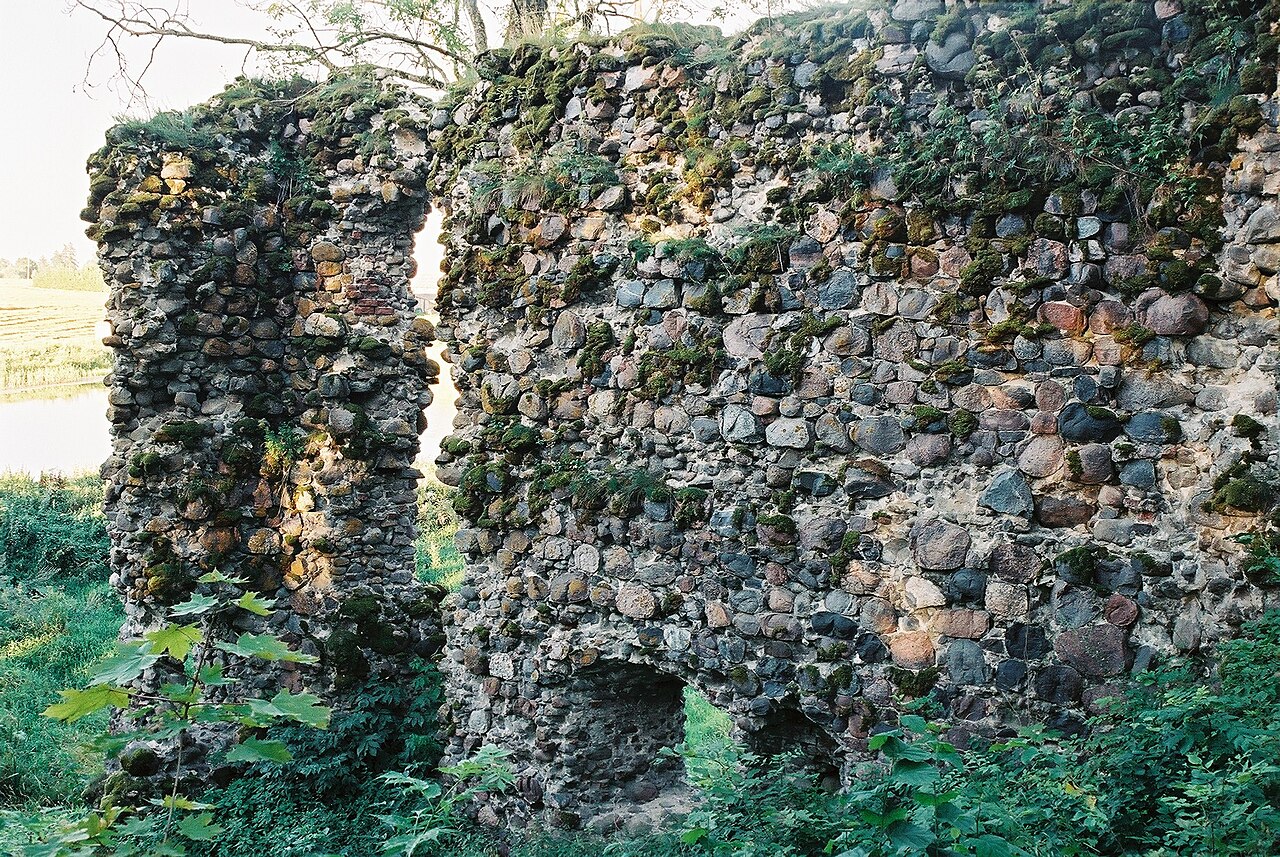
One defensive tower guarded the main entrance, consistent with the castellum design which emphasized controlled access. Today, only a fragment of the northeastern outer wall remains, measuring approximately 25 meters in length. The rest of the fortress lies in ruins, with no visible traces of the outer ward or bailey above ground.
The ruins have not undergone conservation efforts and continue to deteriorate gradually. The castle hill is encompassed by a 12-hectare park featuring majestic ancient trees such as oaks and larches, creating a serene natural setting that complements the historic site.
Relation to local religious sites
Approximately 1.5 kilometers southwest of the castle lies the Rõngu Mikael parish church, illustrating the historical connection between the fortress and local ecclesiastical centers. This proximity highlights the dual military and religious roles the castle played in the region's medieval society.
Preservation and cultural significance
Despite its ruined condition, Rõngu Castle remains an important cultural heritage site in Estonia. The visible remnants, particularly the gatehouse and chapel fragments, offer valuable insights into medieval military architecture and the interplay between secular and religious power during the late medieval period.
The lack of active conservation has allowed natural decay, but the site continues to attract historians, archaeologists, and visitors interested in Estonia's medieval past. The surrounding park provides a tranquil environment for reflection on the castle's historical narrative and architectural legacy.
Visitor information and accessibility
While the ruins are accessible to the public, visitors should be aware that the site is largely unpreserved and can be fragile. There are no formal visitor facilities or guided tours currently available on site. The castle's location near the village of Lossimäe makes it reachable by local roads, and the surrounding park offers pleasant walking opportunities.
Visitors interested in medieval architecture and Baltic history will find Rõngu Castle ruins a compelling destination, providing a tangible connection to Estonia's complex past and the enduring legacy of its medieval fortresses.
Frequently asked questions (FAQ)
- When was Rõngu Castle built and by whom?
- Rõngu Castle was constructed around 1340 by the medieval Livonian clergy under the Bishopric of Dorpat as a defensive stronghold.
- What remains of Rõngu Castle can visitors see today?
- Visitors can see the ruins of the main gatehouse, a 25-meter section of the eastern outer wall, and fragments of the chapel and defensive tower.
- Why was Rõngu Castle abandoned and destroyed?
- The castle was abandoned after being deliberately set on fire in 1558 during the Livonian War and later destroyed by Swedish authorities in 1625.
- Is Rõngu Castle accessible to the public?
- Yes, the ruins are accessible to the public, but the site is largely unpreserved and visitors should exercise caution due to its fragile condition.
- What is the historical significance of the Holy Cross Chapel at Rõngu Castle?
- The Holy Cross Chapel, located in the gatehouse, was first mentioned in 1413 and offered papal indulgences, reflecting the castle's religious importance.
Information
Website
Visit websiteSources & official resources
Verify the information above using these authoritative references.
Loading map...
Visitor reviews
No reviews yet. Been here? Write the first review and help other travelers!
Write the first reviewVisited this castle? Share your experience
Your review helps other travelers and adds first-hand knowledge to our encyclopedia.