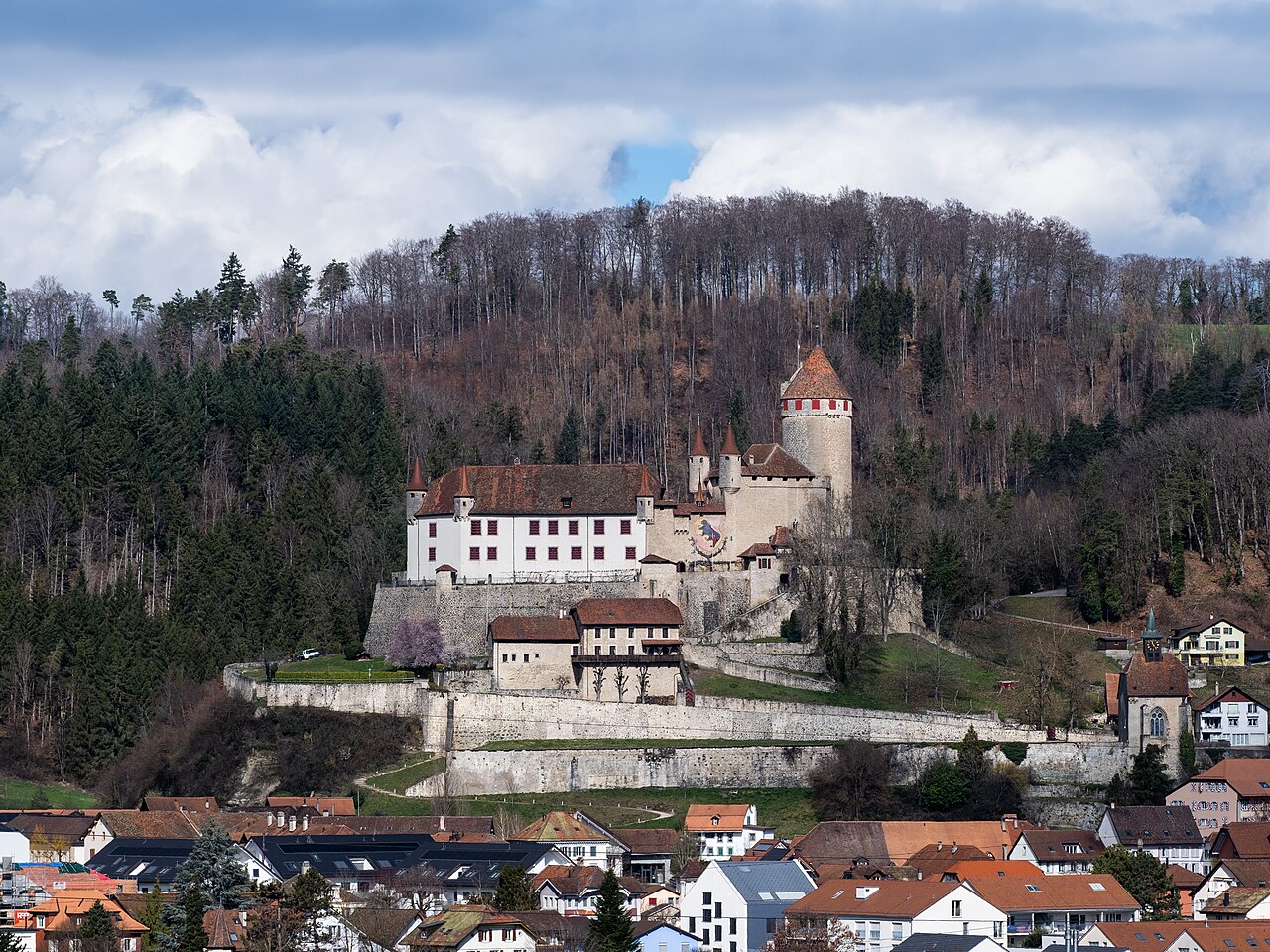
Romont Castle
Romont Castle stands as a remarkable example of High Medieval military architecture in the Swiss canton of Fribourg. Perched atop a picturesque hill at an altitude of 780 meters, it commands sweeping views of the surrounding landscape, including the majestic Alps and Mont Blanc on clear days. This hill castle was originally constructed in the mid-13th century by Peter II of Savoy following his acquisition of the Romont hill in 1239. The castle's strategic location and robust design reflect its role as a fortified administrative center and a symbol of Savoyard power in the region.
The castle's origins are documented in a 1177 record from the Abbey of Hauterive, which described the Romont hill as wooded terrain. After Peter II purchased the rights to the hill, he commissioned the construction of the main fortress, known as the Grand Donjon, completed before 1260. This imposing keep, built in the distinctive "carré savoyard" style—a square fortress layout with a dominant donjon in the southwest corner—served as the core of the castle complex. A second tower, originally called the Petit Donjon and now known as the Boyer tower, was erected around 1250–1260, further enhancing the castle's defenses.
Historical significance and development
Romont Castle played a pivotal role in the territorial expansion and consolidation of the House of Savoy during the 13th and 14th centuries. It became the administrative seat of a castellany overseeing approximately 130 square kilometers. The castle's control passed through various branches of the Savoy family, including the Savoy-Waadt line and Amadeus VI and VIII of Savoy, who elevated its status by granting it county rights in 1439.
Throughout the turbulent Burgundian Wars, the castle changed hands between Bernese and Savoyard forces, reflecting the contested nature of the region. By 1536, following Bern's conquest, Romont aligned with the canton of Fribourg to maintain its Catholic heritage. Subsequently, the castle became the seat of the Fribourg bailiwick, housing local officials and patricians for centuries.
Significant events include the partial collapse of the original castle in 1579 and its subsequent reconstruction completed in 1591. The rebuilding introduced Renaissance architectural elements, including the gate tower and new residential wings. The castle remained an administrative hub until the French invasion of 1798 and later served as a prefecture until 1848. The Savoy family retained the noble title associated with Romont until 1946 despite relinquishing territorial claims earlier.
Architectural features and layout
The carré savoyard design
The defining characteristic of Romont Castle is its adherence to the carré savoyard architectural style. This design features a regular square plan fortified by high walls and anchored by a massive donjon approximately 38 to 40 meters tall, topped with a conical roof. The main tower dominates the southwest corner, providing a formidable vantage point and defensive stronghold.
Fortifications and water defenses
Originally, the castle likely functioned as a water castle, surrounded by moats and accessible only via a drawbridge. The courtyard contains a deep well over 40 meters in depth, which historically supplied water to the castle's inhabitants. An 18th-century wooden draw-wheel, measuring 4.5 meters in diameter, was installed to facilitate drawing water, showcasing the integration of hydraulic technology in castle operations.
Residential and administrative buildings
The eastern side of the complex features multiple square towers integrated into the defensive walls, alongside the "new castle" or château fribourgeois, a two-story building constructed during the Fribourg administration in the late 16th century. This wing includes a hall adorned with 16th-century painted decorations and an octagonal stair tower facing the courtyard, reflecting Renaissance influences.
The southern gate tower, built between 1586 and 1589, displays a coat of arms above its entrance and is connected to battlemented walls with a defensive walkway. The western perimeter maintains high defensive walls with battlements and arrow slits, preserving the castle's military function.
The northern section houses the "old castle," the main residential building with two lower wings. Archaeological investigations revealed that the portico here represents the third construction phase on the site, indicating continuous architectural evolution. Covered galleries along several facades offer sheltered walkways, and a modern glass gallery added in 2006 blends contemporary design with historic fabric.
Cultural heritage and modern use
Since 1981, Romont Castle has been home to the Swiss Museum of Stained Glass and Glass Art (Vitromusée) and the Vitrocentre, a research center dedicated to stained glass craftsmanship. The castle's spacious halls and historic ambiance provide an ideal setting for exhibiting elaborate stained glass works and hosting educational programs.
The castle is a listed cultural property of national significance in Switzerland, recognized for its architectural integrity and historical importance. Restoration efforts in the 20th century, notably between 1921–1929 and again in 2006, have preserved the castle's structure while adapting it for modern museum use. Visitors can appreciate the contrast between the castle's solid sandstone walls and timber roof framework with contemporary additions such as metal stairwells and glass galleries.
Visiting romont castle
Romont Castle remains a prominent landmark in the small town of Romont, contributing to its distinctive medieval skyline alongside the adjacent church and old town walls. The castle's elevated position offers visitors breathtaking panoramic views, making it a popular destination for tourists interested in history, architecture, and art.
The courtyard, with its historic well and large wooden draw-wheel, invites exploration, while the museum's collections provide insight into the region's rich cultural heritage. The combination of medieval fortifications, Renaissance modifications, and modern museum facilities creates a unique experience for visitors.
Architectural highlights
- Grand Donjon: The imposing 13th-century keep with a conical roof and Romanesque masonry.
- Boyer tower: The round tower built circa 1250–1260 as part of the original fortifications.
- Gate tower: Renaissance-era southern entrance with a coat of arms and battlements.
- Château fribourgeois: 16th-century residential wing with painted halls and octagonal stair tower.
- Medieval walls and moats: Defensive structures including battlements, arrow slits, and water defenses.
- Historic well and draw-wheel: An 18th-century hydraulic feature within the courtyard.
- Modern glass gallery: Contemporary addition blending with historic architecture.
Cultural events and exhibitions
The castle hosts exhibitions focused on stained glass art, showcasing works from various periods and styles. Educational workshops and research activities at the Vitrocentre support the preservation and innovation of glass art techniques. The site also serves as a venue for cultural events that celebrate the artistic and historical legacy of the region.
Access and visitor information
Visitors can reach Romont Castle via the town's historic center, which retains much of its medieval charm. The castle is accessible year-round, with guided tours available to explore its history and architecture in depth. The museum offers detailed information in multiple languages, enhancing the educational experience for international guests.
Overall, Romont Castle exemplifies the enduring legacy of Savoyard fortifications and the dynamic history of the region, combining medieval military architecture with Renaissance elegance and modern cultural functions.
Frequently asked questions (FAQ)
- How do I get to Romont Castle?
- Romont Castle is easily accessible by public transport. You can take a train to Romont station and then enjoy a scenic walk of about 15 minutes to reach the castle.
- What is the historical significance of Romont Castle?
- Romont Castle, dating back to the 13th century, was a key stronghold for the Counts of Gruyères. It played a crucial role in the region's defense and has witnessed numerous historical events over the centuries.
- When was Romont Castle built?
- Construction of Romont Castle began in the early 13th century, with significant expansions and renovations occurring in the following centuries. Its architectural evolution reflects the changing styles and needs of the time.
- Can I take guided tours of Romont Castle?
- Yes, guided tours are available and provide an in-depth look at the castle's history and architecture. These tours are offered in multiple languages and can enhance your understanding of this historical site.
- Why is Romont Castle considered an architectural gem?
- Romont Castle showcases a unique blend of medieval architecture and stunning views of the surrounding landscape. Its well-preserved towers and walls exemplify the defensive structures of its time, making it a significant landmark.
- Is it possible to hold events at Romont Castle?
- Yes, Romont Castle offers facilities for hosting events such as weddings, corporate gatherings, and cultural activities. The scenic backdrop and historical ambiance create a memorable setting for any occasion.
- What are the opening hours for Romont Castle?
- Romont Castle is typically open to visitors from April to October, with specific hours varying by season. It's advisable to check the official website for the most current opening times before your visit.
- What are the ticket prices for Romont Castle?
- Ticket prices for Romont Castle are generally affordable, with discounts available for students and seniors. Children under a certain age may enter for free, making it an accessible destination for families.
- When is the best time to visit Romont Castle?
- The best time to visit Romont Castle is during the spring and summer months when the weather is pleasant and the surrounding gardens are in full bloom. This period also hosts various events and exhibitions that enhance the visitor experience.
- What nearby attractions can I explore after visiting Romont Castle?
- After visiting Romont Castle, you can explore the charming town of Romont, known for its medieval streets and local shops. Additionally, the nearby La Gruyère region offers beautiful landscapes and the famous Gruyères Castle, making for a wonderful day of exploration.
Information
Website
Visit websiteSources & official resources
Verify the information above using these authoritative references.
Loading map...
Visitor reviews
No reviews yet. Been here? Write the first review and help other travelers!
Write the first reviewVisited this castle? Share your experience
Your review helps other travelers and adds first-hand knowledge to our encyclopedia.