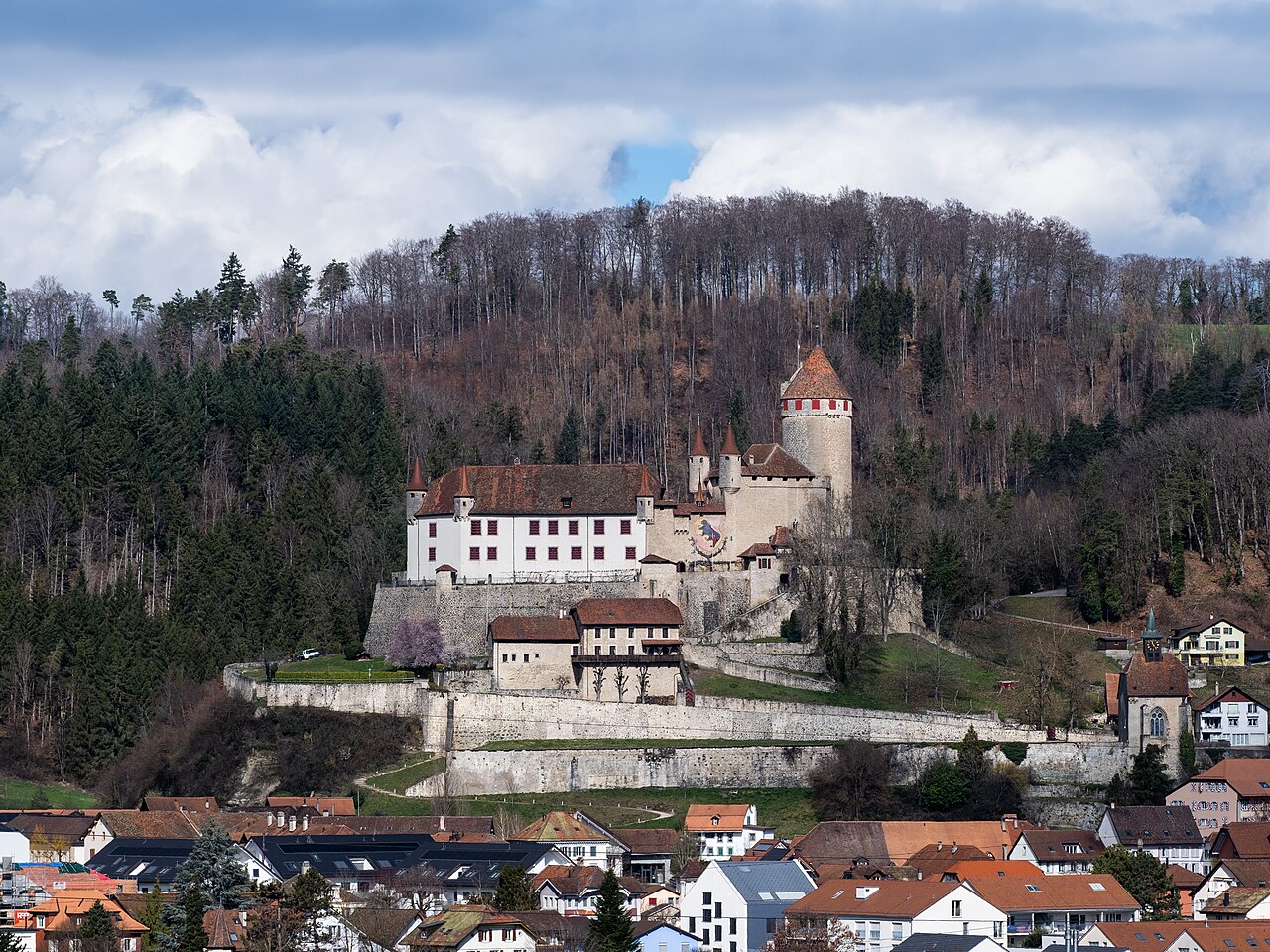
Surpierre Castle
Surpierre Castle is a significant historical fortress located in the Canton of Fribourg, Switzerland. Originally established as a bailiff's castle, it has witnessed centuries of political and military changes that shaped the region. The castle's origins trace back to the 12th century, when a fortification known as Surpetra existed, though its exact location relative to the current castle remains uncertain. The earliest documented ownership began in 1142 with the noble Surpierre family, who held the fief until 1233.
In the 13th century, the castle site came under the control of the de Cossonay family, who owned Surpierre and several nearby villages. It was during this period that the initial construction of a small castle took place on the present site. Elements from this medieval structure survive today, including a prominent square tower and the pointed arch windows of the castle chapel, which reflect the Gothic architectural style typical of the era.
Medieval fortifications and village development
By 1344, the castle was accompanied by a fortified village on the surrounding hill, indicating the strategic importance of the location. Throughout the 14th and 15th centuries, Surpierre Castle changed hands multiple times, reflecting the turbulent political landscape of the region. The castle endured significant damage from fires in 1476 and again in 1539, which necessitated extensive repairs and alterations.
Strategic role during the 16th century conflicts
The mid-16th century was a pivotal period for Surpierre Castle. In 1536, during the conflict involving the cantons of Bern, Fribourg, and Valais against the Savoyard forces, Surpierre was captured by Bernese troops on 21 February. Shortly thereafter, on 1 March 1536, the castle and its lands were transferred to the control of Fribourg, creating a small exclave within the region. This transfer marked the beginning of Surpierre's role as the administrative center for the Fribourg bailiff.
Reconstruction and architectural transformation under fribourg rule
Following another damaging fire in 1544, the Fribourg authorities undertook a comprehensive rebuilding of Surpierre Castle. The reconstruction transformed the medieval fortress into a more imposing government center and a comfortable residence for the bailiff. Significant architectural enhancements included the addition of several auxiliary buildings, an ornate main gate, and a drawbridge spanning a dry moat. The castle grounds were further beautified with carefully designed gardens, reflecting Renaissance influences in the landscaping.
The castle's layout evolved to combine defensive features with residential comfort, illustrating the dual role of Surpierre as both a fortress and administrative hub. The drawbridge and moat, while no longer serving primary military functions, maintained the castle's historic character and symbolic authority.
Later ownership and preservation
Surpierre Castle remained under the governance of Fribourg-appointed bailiffs for several centuries, overseeing the exclave until the political reorganization of 1848. At that time, the exclave was integrated into the Broye District, which subsequently purchased the castle. In 1850, the property was sold to Victor-Henri Leenhart-Imer, a merchant from Marseille. The castle later passed through various private owners, including the Delpech family, before being acquired by Max Bürki in 1951.
Today, Surpierre Castle stands as a well-preserved example of a high medieval fortress adapted through the Renaissance into a government residence. Its surviving architectural features, such as the square tower, pointed arch chapel windows, drawbridge, and ornate gate, offer valuable insights into the region's history and architectural evolution. The castle remains a prominent landmark in Surpierre, reflecting the layered history of feudal authority, military conflict, and administrative governance in the Canton of Fribourg.
Frequently asked questions (FAQ)
- When was Surpierre Castle originally built?
- Surpierre Castle was originally constructed in the 13th century, incorporating elements from an earlier 12th-century fortification.
- What architectural style characterizes Surpierre Castle?
- The castle features Gothic architectural elements, including pointed arch windows in the chapel and a square tower from the medieval period.
- What role did Surpierre Castle play during the 16th century?
- In the 16th century, Surpierre Castle served as a strategic administrative center for the Fribourg bailiff after being captured from Savoyard forces in 1536.
- Is Surpierre Castle open to the public?
- Information about public access and visiting hours for Surpierre Castle is not widely published, so potential visitors should check local tourism sources for current details.
- How did the castle change after the fires in the 15th and 16th centuries?
- Following fires in 1476, 1539, and 1544, the castle was rebuilt with additional buildings, an ornate gate, and a drawbridge, transforming it into a more comfortable and imposing government residence.
Information
Loading map...
Visitor reviews
No reviews yet. Been here? Write the first review and help other travelers!
Write the first reviewVisited this castle? Share your experience
Your review helps other travelers and adds first-hand knowledge to our encyclopedia.