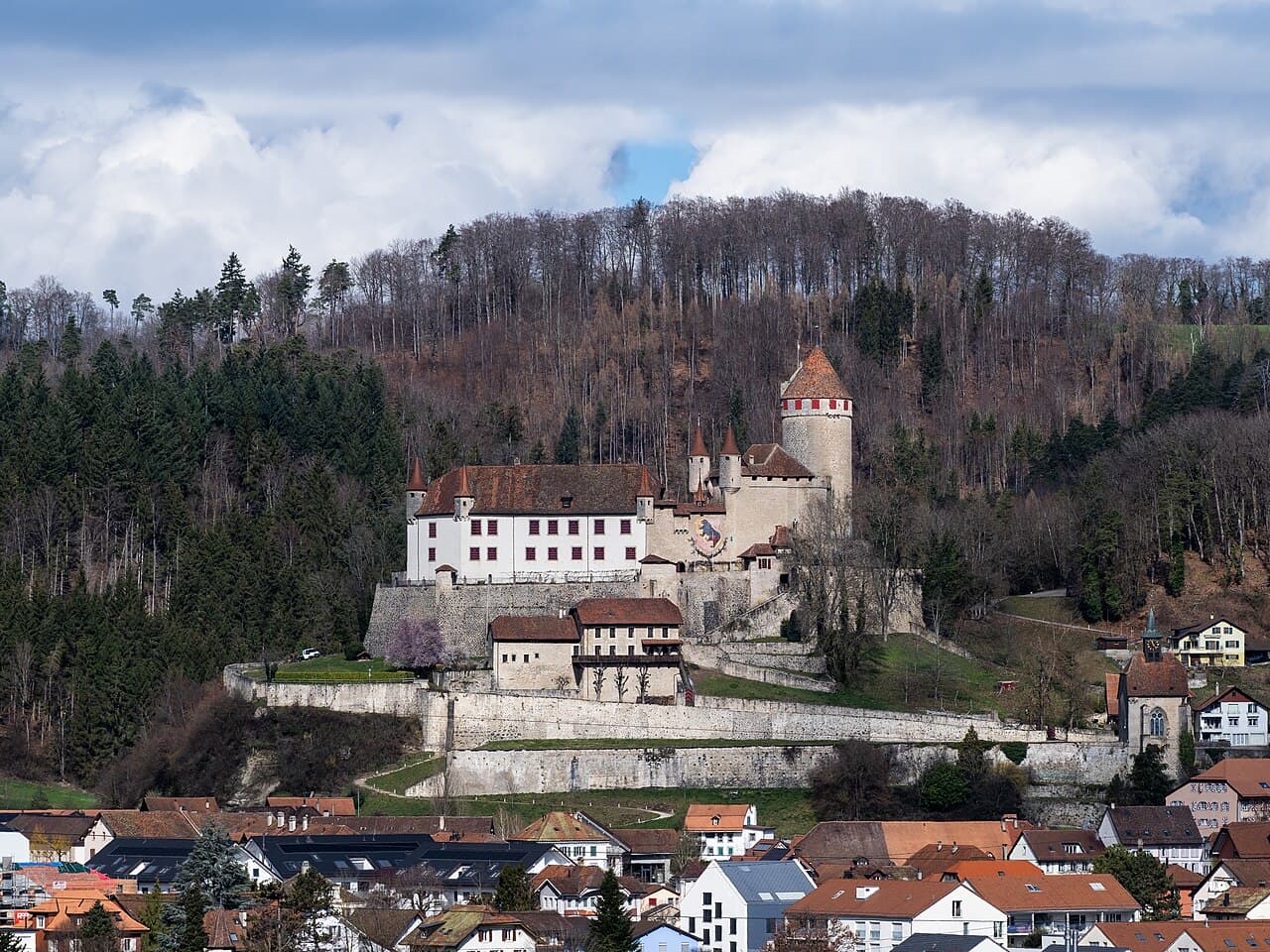
Lucens Castle
Lucens Castle stands as a remarkable example of medieval and early modern fortification in the village of Lucens, Switzerland. Strategically perched on a rocky hill, it commands sweeping views over the Broye valley, a vital transit corridor historically significant for controlling movement and trade in the region. Established in the 12th century, this hill castle served as a residence and defensive stronghold for the Bishops of Lausanne through the High medieval period until the mid-16th century, reflecting the evolving political and military landscape of the area.
The castle's history is marked by cycles of destruction and rebuilding, emblematic of the turbulent medieval era. It was repeatedly damaged during conflicts in the 12th century and later suffered significant destruction in 1476 at the hands of the Swiss Confederation. Despite these setbacks, the castle retained its importance as an episcopal seat, witnessing notable events such as the assassination of Bishop Guillaume de Menthonay in 1406 and hosting dignitaries like Charles III, Duke of Savoy, in 1532.
Architectural evolution and military significance
The medieval core and round tower
The castle's most prominent architectural feature is its massive round tower, constructed around 1275. This tower exemplifies medieval military architecture with thick masonry walls designed for defense and surveillance. Positioned atop the hill, it functioned as both a lookout and refuge during sieges, dominating the surrounding landscape and controlling the approach through the Broye valley.
Bernese expansions and administrative transformation
Following the conquest of the Broye valley by Bern in 1536, Lucens Castle transitioned from ecclesiastical to secular control, becoming the seat of a Bernese bailiwick. Between 1579 and 1586, the castle underwent significant expansion, including the addition of an elongated residential building featuring a central courtyard. This structure, inspired by nearby Oron Castle, introduced more refined architectural elements and enhanced comfort, signaling the castle's new role as an administrative center and fortress on the border with the canton of Fribourg.
Historical roles and ownership changes
Episcopal residence and regional defense
Throughout the Middle Ages, the castle served as a fortified palace for the bishops, who used it to assert control over their lands and protect ecclesiastical interests. Its strategic location enabled effective oversight of the Broye valley, which was crucial for defense and communication. The castle formed part of a network of fortifications that maintained regional security and facilitated signaling between strongholds.
Bernese administration and religious transition
Under Bernese rule, the castle became the administrative hub for the region, housing bailiffs who managed justice, taxation, and governance for over two centuries. This period also saw the local population's conversion from Catholicism to Protestantism, reflecting broader religious shifts in Switzerland. The castle's role evolved from a purely military fortress to a center of civil administration and regional governance.
Later uses and modern history
After Bernese control ended in 1798 during political upheavals, the castle briefly became canton property before being sold to private owners in 1801. In the 19th century, it was transformed into a Swiss Reformed institute for girls, involving significant interior alterations. Restoration efforts in the 20th century aimed to recover its late 16th-century appearance, removing later modifications and restoring original features such as wall paintings and fireplaces.
Between 1965 and 1970, the castle served as the headquarters for the Conan Doyle Foundation, established by Adrian Conan Doyle, son of the famous author Arthur Conan Doyle. The foundation also operated a Sherlock Holmes museum in the castle during this period.
Architectural features and preservation
Structural composition
Lucens Castle consists primarily of two main sections: the medieval round tower and the later Bernese residential building. The round tower, with its robust masonry and commanding height, remains a dominant feature symbolizing the castle's defensive origins. The Bernese addition reflects Renaissance influences with its courtyard-centered layout and more comfortable living quarters.
Interior restorations and modifications
Throughout the 18th and 19th centuries, the castle's interiors were altered to accommodate changing functions, including subdividing rooms and lowering ceilings. Restoration work beginning in 1921 under Otto Schmid reversed many of these changes, aiming to restore the castle's historical character from the late 1500s. This included the revival of original wall paintings, fireplaces, and the removal of non-historic partitions.
Ancillary buildings and estate
The castle is surrounded by a farm estate dating mainly from the 18th century, rebuilt after fires in the 19th century. This complex includes vaulted cellars, residential quarters, barns, stables, and workshops. Some buildings served diverse roles such as a butcher's shop and a Catholic chapel. Restoration efforts in the early 21st century have preserved these structures, which were designated as historic monuments in 2012.
Nearby rural dependencies, including the "new bishop's stable" originally documented in 1392 and rebuilt in 1581, further illustrate the castle's agricultural and logistical support functions. Architectural modifications over the centuries reflect adaptations to changing needs, with 20th-century restorations uncovering original Bernese period features.
Lucens Castle in contemporary context
Today, Lucens Castle remains privately owned and is recognized as a Swiss cultural property of national significance. It stands as a testament to the region's complex history, architectural evolution, and shifting political powers from medieval bishops to Bernese administrators.
In 2012, the castle gained international attention by hosting a meeting of experts that produced the Draft Lucens Guidelines, aimed at protecting educational institutions during armed conflicts. These guidelines have influenced international policies on the military use of schools and universities, underscoring the castle's ongoing relevance beyond its historical and architectural value.
Frequently asked questions (FAQ)
- How do I get to Lucens Castle?
- Lucens Castle is located in the picturesque town of Lucens, Switzerland, easily accessible by car or public transport. The nearest train station is Lucens, from which it’s a short walk to the castle. For those driving, ample parking is available nearby.
- What is the historical significance of Lucens Castle?
- Lucens Castle dates back to the 12th century and has played a crucial role in the region's history, particularly during the feudal era. It has witnessed numerous events and changes in ownership, reflecting the rich tapestry of Swiss history. The castle is a fine example of medieval architecture and offers insights into the life and times of its former inhabitants.
- When was Lucens Castle last restored?
- Lucens Castle underwent significant restoration in the 20th century to preserve its historical integrity and architectural features. The restoration efforts have focused on maintaining the castle's medieval charm while making it accessible to visitors. Ongoing maintenance ensures that the castle remains a treasured landmark in the region.
- Can I take guided tours of Lucens Castle?
- Yes, guided tours are available for visitors interested in learning more about the castle's history and architecture. Tours typically include informative commentary from knowledgeable guides and allow you to explore both the interior and exterior of the castle. It's advisable to check the schedule and book in advance, especially during peak tourist seasons.
- Why is Lucens Castle a popular tourist destination?
- Lucens Castle attracts visitors due to its stunning architecture, rich history, and beautiful surroundings. The castle offers a unique glimpse into Switzerland's medieval past, making it an educational and picturesque spot for tourists. Additionally, its location near other attractions enhances its appeal for those exploring the region.
- Is it possible to host events at Lucens Castle?
- Yes, Lucens Castle is available for hosting various events, including weddings, corporate gatherings, and private functions. The castle's enchanting ambiance and historical charm provide a unique setting for memorable occasions. Interested parties should contact the castle management for details on availability and services offered.
- What are the opening hours for Lucens Castle?
- Lucens Castle is typically open to visitors from April to October, with specific hours varying by season. It is best to check the official website or contact the castle for the most accurate and up-to-date information regarding opening hours and any seasonal changes. Planning your visit around these times ensures you can fully enjoy all the castle has to offer.
- Are there any nearby attractions to visit?
- Yes, the area surrounding Lucens Castle boasts several attractions, including beautiful parks, local museums, and charming villages. Visitors can explore the scenic landscapes and enjoy hiking trails that highlight the natural beauty of the region. Additionally, nearby towns such as Payerne and Avenches offer rich historical sites worth exploring.
- How much do tickets cost for Lucens Castle?
- Ticket prices for Lucens Castle are generally affordable, with discounts often available for students and seniors. Admission fees contribute to the maintenance and preservation of the castle. It’s recommended to check the official website for the latest pricing and any special offers that may be available during your visit.
Photo gallery

Information
Website
Visit websiteSources & official resources
Verify the information above using these authoritative references.
Loading map...
Visitor reviews
No reviews yet. Been here? Write the first review and help other travelers!
Write the first reviewVisited this castle? Share your experience
Your review helps other travelers and adds first-hand knowledge to our encyclopedia.



