Rolle Castle
Rolle Castle, located on the northern shores of Lake Geneva in Rolle, Switzerland, is a significant medieval fortress with a rich history dating back to the 13th century. Constructed in 1261 by the Lords of Mont, the castle was originally intended to protect the strategic pier on the lake and to anchor a planned city that would rival nearby settlements such as Aubonne and Saint-Prex. Although the envisioned city was never fully realized by the Mont family, the castle itself became a focal point of regional power and defense.
Early history and strategic importance
The castle's initial construction coincided with a period of territorial competition in the High Medieval era, particularly between the Counts of Savoy and local lords. By 1291, Count Amadeus V of Savoy had taken possession of Rolle Castle, granting it as a fief to various noble families. To strengthen his influence and consolidate control over the northern shore of Lake Geneva, Amadeus V established a fortified town around the castle by 1319. This settlement, later named Ruelloz in 1330, served as a strategic bulwark closing a gap in Savoyard territories along the lake.
Medieval architecture and fortifications
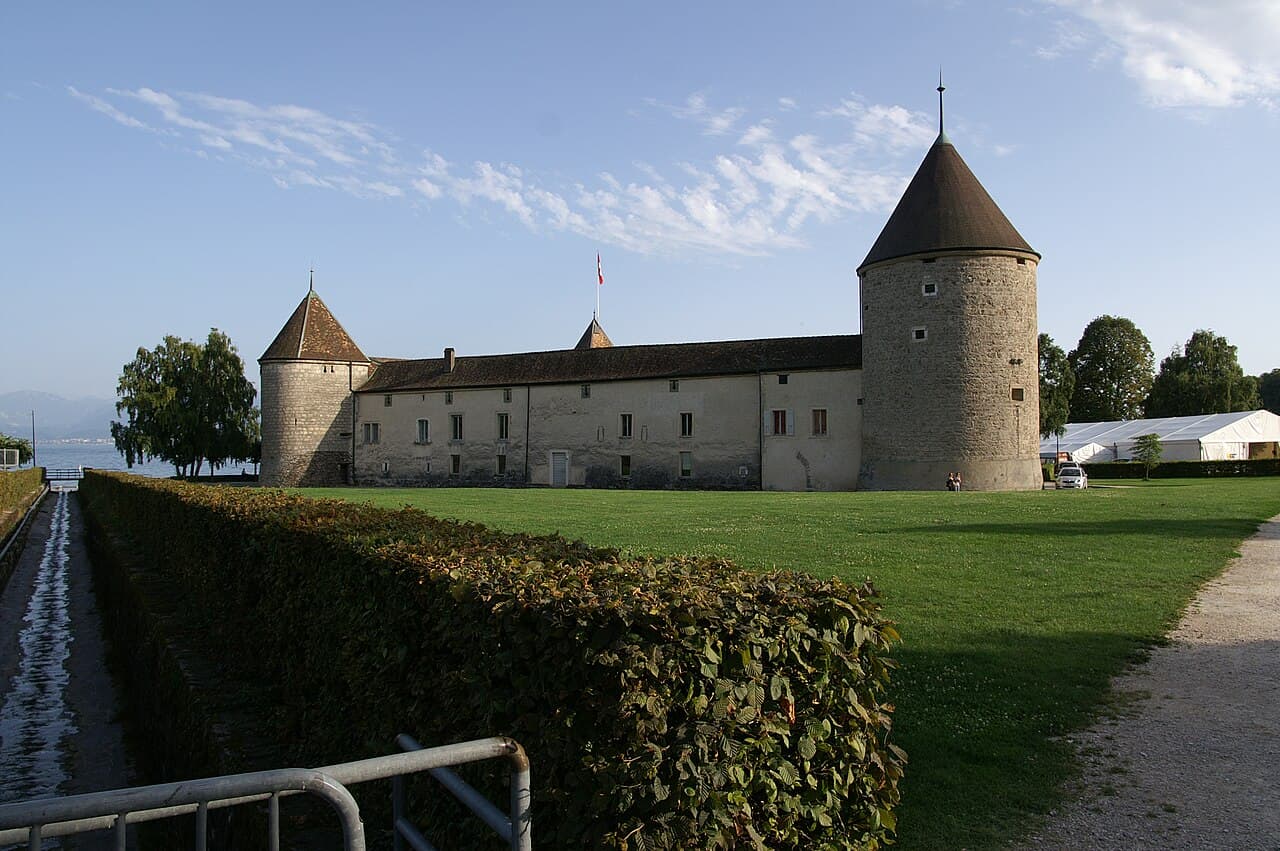
The castle exemplifies typical High Medieval military architecture, featuring an inner courtyard surrounded by sturdy curtain walls and corner towers. These towers provided defensive vantage points and helped secure the perimeter against invaders. The layout of the castle was designed to control access to the lake pier and to oversee the surrounding lands. The courtyard remains a central feature of the castle today, serving as a venue for various cultural and community events.
Conflicts and bernese rule
During the turbulent period of the Bernese invasion of Vaud in the 16th century, Rolle Castle, along with nearby Le Rosey Castle, was attacked and suffered damage from burning. Following the conquest in 1536, the castle and the town of Rolle became part of the bailiwick of Morges under Bernese administration. In 1558, the castle and barony were acquired by Hans Steiger, a prominent Bernese merchant and lord of Mont-le-Grand. The Steiger family maintained control of the property until the upheavals of the French Revolution.
Barony and judicial administration
The barony of Rolle under the Steiger family encompassed not only the town itself but also several surrounding villages and territories, including Tartegnin, Vinzel, Luins, and parts of Essertines-sur-Rolle and Begnins. The judicial court of the barony was composed of the lord, his deputy, a court clerk, and ten members representing Rolle and the district's villages. One of these members was responsible for governing the town. In 1740, the town managed to buy its freedom from certain taxes and duties, signaling a degree of municipal autonomy within the feudal structure.
French invasion and helvetic republic era
The French invasion of Switzerland in 1798 brought significant political change to Rolle. The castle became the seat of the newly created district of Rolle. In 1799, the Helvetic Republic purchased the castle from the municipality and used it as the seat of government until 1974. During the Bourla-papey uprising in 1802, patrician land titles and tax records stored in the castle archives were destroyed by fire, marking a dramatic moment in local history.
Architectural features and current use
Today, Rolle Castle is well preserved, featuring its characteristic inner courtyard and several corner towers that exemplify medieval defensive design. The courtyard is particularly well suited for hosting events, exhibitions, and receptions. The castle currently houses the town's boardroom and a reception area, integrating its historical architecture with modern civic functions. Its location on Lake Geneva and its rich history make it a prominent cultural landmark in the region.
Historical significance and cultural heritage
Rolle Castle stands as a testament to the complex feudal and political history of the Vaud region. Its evolution from a medieval fortress to a seat of government reflects broader historical shifts, including the rise of Savoyard power, Bernese conquest, and the impact of the French Revolution on Swiss territories. The castle's preservation and adaptive reuse underscore its enduring importance as a symbol of local identity and heritage.
Frequently asked questions (FAQ)
- When was Rolle Castle built and by whom?
- Rolle Castle was built in 1261 by the Lords of Mont to protect the pier at Lake Geneva and establish a strategic settlement.
- What architectural features characterize Rolle Castle?
- The castle features an inner courtyard, sturdy curtain walls, and corner towers typical of High Medieval hill castles.
- What role did Rolle Castle play during the Bernese invasion?
- During the Bernese invasion in the 16th century, Rolle Castle was attacked and burned but later incorporated into the Bernese bailiwick of Morges.
- How was Rolle Castle used during the Helvetic Republic?
- From 1799 until 1974, the Helvetic Republic and subsequent Swiss authorities used Rolle Castle as the seat of government for the district.
- Can visitors attend events at Rolle Castle?
- Yes, the castle's inner courtyard is well suited for various events, exhibitions, and receptions, reflecting its ongoing cultural role.
Photo gallery

Information
Sources & official resources
Verify the information above using these authoritative references.
Loading map...
Visitor reviews
No reviews yet. Been here? Write the first review and help other travelers!
Write the first reviewVisited this castle? Share your experience
Your review helps other travelers and adds first-hand knowledge to our encyclopedia.