Medininkai Castle
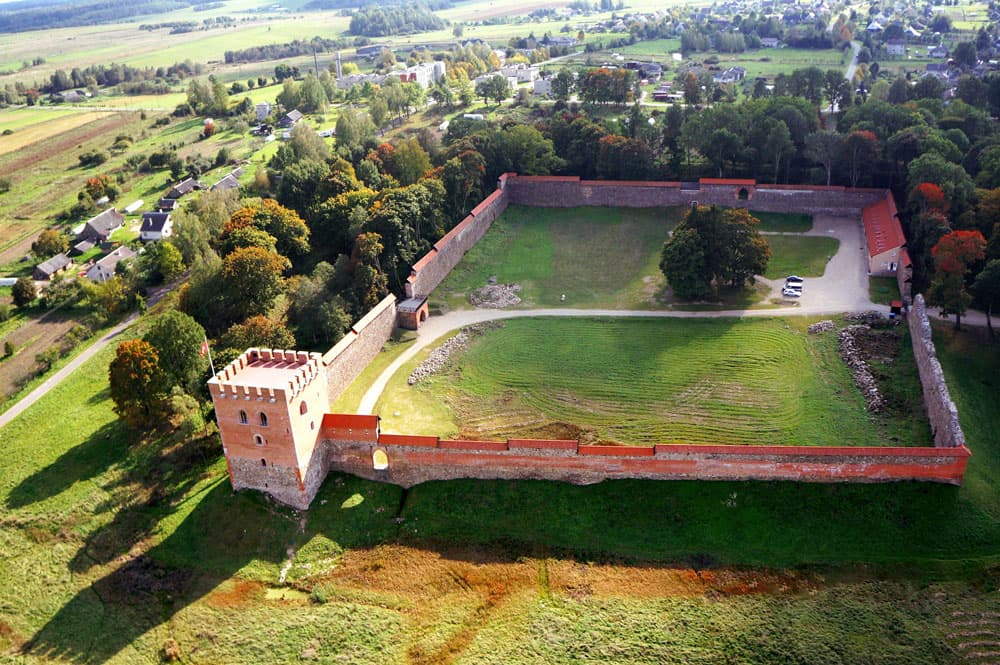
Medininkai Castle stands as a monumental example of late medieval fortification architecture in Lithuania, renowned for its vast defensive perimeter and historical significance. Constructed primarily in the late 13th or early 14th century, it represents the largest enclosure-type castle in Lithuania, covering an extensive area of approximately 6.5 hectares. Unlike many hill castles perched on elevated terrain, Medininkai was uniquely built on relatively flat ground, emphasizing flank defense through its formidable walls and towers.
The castle's rectangular layout encloses a courtyard of about 1.8 hectares, surrounded by imposing walls rising up to 15 meters high and 2 meters thick. These walls are punctuated by four strategically placed gates and towers, designed to provide overlapping fields of fire and robust protection against invaders. The centerpiece of the fortress is its towering donjon, a massive main tower approximately 30 meters tall, which served as both a defensive stronghold and residential quarters for nobility.
Historical context and royal associations
Medininkai Castle was first mentioned in historical records in 1392, during a period when the Grand Duchy of Lithuania was consolidating power and defending its borders against the Teutonic Knights and other hostile forces. The castle's strategic location in the Aukštaitija region made it a vital defensive bastion. It was closely linked to prominent Lithuanian rulers, including Grand Duke Algirdas, who is believed to have used the castle as a summer residence, underscoring its dual role as a military fortress and noble retreat.
Later, in the 15th century, the castle gained further prestige as a royal residence under King Casimir IV Jagiellon. The king used Medininkai as a summer retreat and a residence for his children, highlighting the castle’s importance beyond mere military functions. However, the castle's military role was challenged by evolving warfare technologies, particularly the increasing use of firearms, which began to render traditional medieval fortifications less effective.
Conflicts and decline
A notable event in the castle's history occurred in 1402 when it was attacked and set ablaze during a conflict involving Prince Svidrigaila and allied Teutonic forces. Despite subsequent reconstruction efforts, Medininkai's military significance waned following the decisive Battle of Grunwald in 1410, which shifted the balance of power in the region.
Throughout the 16th and 17th centuries, the castle suffered damage from various military campaigns, including raids by Muscovite troops in 1519 and severe destruction during the Russo-Polish War of 1655. The castle was never fully rebuilt after this period, marking the end of its prominence as a defensive stronghold.
Architectural features and defensive design
Medininkai Castle's architecture reflects the Baltic masonry traditions of the medieval period, with walls constructed from field stones bound by lime-sand mortar. Brickwork is used decoratively and structurally at corners, battlements, and openings, including the numerous arrow slits designed for archers. The castle's walls extend approximately 565.5 meters in length and reach heights of up to 15 meters, encircling the fortress with formidable protection.
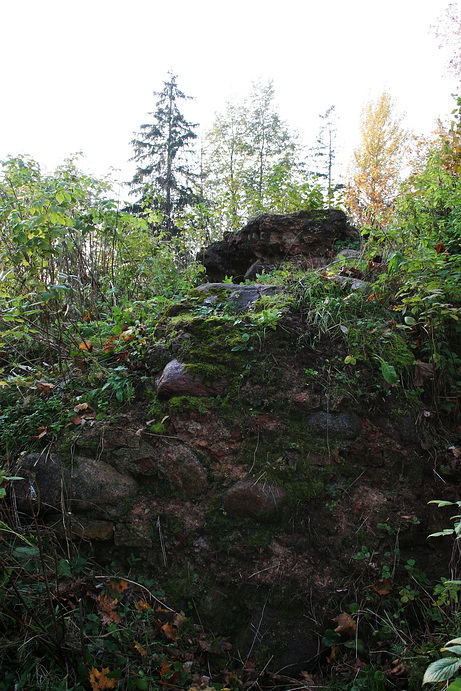
The castle is surrounded by a deep moat, six to seven meters wide, supplemented by two earthen embankments that enhanced its defensive capabilities. The four gates, located on each wall, were designed with varying elevations: the eastern and western gates are at ground level, while the northern and southern gates are elevated about five meters above the courtyard, accessible via drawbridges. This arrangement provided layered defense and controlled access to the inner courtyard.
The main tower (donjon)
The castle’s main tower, or donjon, is a dominant feature measuring approximately 14.2 by 15.4 meters at its base and rising 30 meters high. Its walls are exceptionally thick, ranging from 2.5 to 3 meters, providing substantial protection. The tower projects beyond the outer walls, allowing defenders to monitor and cover the surrounding area effectively. It contains five floors, with the upper levels serving as residential quarters, illustrating the blend of military and domestic functions within the structure.
Additional towers and battlements
Three other towers guard the castle’s gates, reinforcing the perimeter defenses. Along the walls, about 280 arrow slits are positioned within a battlement gallery approximately 11 meters above ground level, enabling defenders to repel attackers while remaining shielded. The castle’s walls also feature decorative brick patterns running horizontally, adding an artistic dimension to its otherwise utilitarian design.
Cultural significance and archaeological findings
Inside the main tower, fragments of frescoes have been discovered, reflecting the influence of the Byzantine Pskov school of art, known for its religious and cultural significance in the region during the medieval period. This artistic heritage adds a unique cultural layer to the castle's historical narrative.
Archaeological research around Medininkai Castle has revealed evidence of a dense wooden settlement or suburb that once surrounded the fortress. This settlement underscores the castle’s role as a center of local administration and habitation, not merely a military installation.
The castle’s design shares notable similarities with neighboring fortresses such as Lida and Kreva castles, indicating common architectural traditions and defensive strategies within the Grand Duchy of Lithuania during the late medieval period.
Modern history and preservation efforts
Medininkai Castle suffered further damage during the Napoleonic Wars when retreating French forces dismantled its wooden structures. In the 20th century, the site endured additional hardship during both World Wars. During World War II, German forces used one of the castle’s towers as a gun arsenal, which was destroyed upon their retreat, causing significant damage to the structure.
From the mid-20th century onwards, archaeological excavations and preservation initiatives began to uncover and stabilize the ruins. Restoration efforts started in the 1960s, focusing on conserving the remaining walls and towers. The main tower underwent reconstruction beginning in the 1990s, with work continuing into the early 21st century, supported by international funding and the European Union.
Today, Medininkai Castle is managed by the Trakai Historical Museum and serves as a cultural and historical site open to visitors. The reconstructed main tower houses exhibitions that narrate the castle’s rich history and its role in Lithuania’s medieval heritage. Although much of the castle remains in ruins, the site stands as a testament to the region’s medieval past and the architectural ingenuity of the Grand Duchy of Lithuania.
Frequently asked questions (FAQ)
- What is the historical significance of Medininkai Castle?
- Medininkai Castle is one of the best-preserved medieval castles in Lithuania, dating back to the late 14th century. It served as a defensive structure and residence for local princes, playing a crucial role in the region's history and defense strategies against invaders.
- When was Medininkai Castle built?
- Construction of Medininkai Castle began in the late 1300s, with significant developments occurring throughout the 15th century. The castle has undergone various renovations over the centuries, reflecting the architectural styles of different periods.
- What are the opening hours for Medininkai Castle?
- Medininkai Castle is typically open to visitors from 10 AM to 6 PM during the summer months and from 10 AM to 4 PM during the winter. It is advisable to check the official website for any seasonal changes or special events that may affect opening hours.
- Can I purchase tickets for Medininkai Castle online?
- Yes, tickets for Medininkai Castle can be purchased online, which is highly recommended during peak tourist seasons. This allows you to skip the lines and ensures you have access to guided tours and special exhibitions.
- Is it possible to access Medininkai Castle with a wheelchair?
- While Medininkai Castle is a historical site, efforts have been made to improve accessibility. However, some areas may still pose challenges due to the castle's medieval structure, so it's best to contact the site ahead of your visit for specific accessibility options.
- When is the best time to visit Medininkai Castle?
- The best time to visit Medininkai Castle is during the spring and summer months, from May to September, when the weather is pleasant and the surrounding landscapes are lush. Additionally, many cultural events and festivals take place during this period, enhancing your experience.
- What nearby attractions can I explore after visiting Medininkai Castle?
- After visiting Medininkai Castle, you can explore the beautiful Medininkai village and nearby natural parks, such as the Pavilniai Regional Park. Additionally, the capital city, Vilnius, is just a short drive away, offering numerous cultural and historical sites.
- What is the ticket price for Medininkai Castle?
- The ticket prices for Medininkai Castle are generally quite affordable, with discounts available for students and seniors. Family tickets and group rates may also be offered, making it an accessible option for all visitors.
Photo gallery

Information
Website
Visit websiteSources & official resources
Verify the information above using these authoritative references.
Loading map...
Visitor reviews
No reviews yet. Been here? Write the first review and help other travelers!
Write the first reviewVisited this castle? Share your experience
Your review helps other travelers and adds first-hand knowledge to our encyclopedia.