Rochlitz Castle
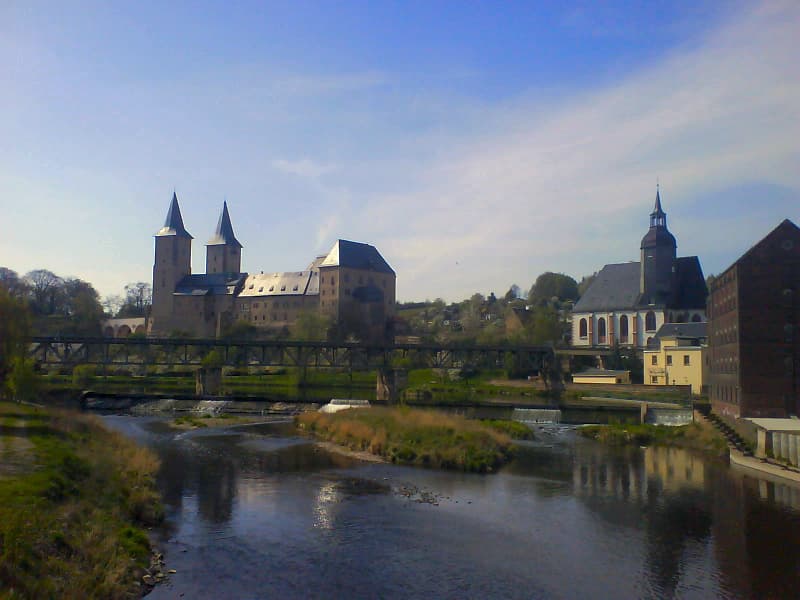
Rochlitz Castle, located in the western part of the town of Rochlitz in Saxony, Germany, stands as a remarkable example of a high medieval hill castle with a rich history spanning over a millennium. The castle is perched on a rocky spur above the Zwickauer Mulde river and the Hellerbach stream, strategically positioned to command the surrounding landscape. Its origins date back to the second half of the 10th century, when an imperial fortress was erected on the site, marking the beginning of its long-standing significance in regional power dynamics.
The castle's early history is closely tied to the Holy Roman Empire, serving as an imperial stronghold during the 11th century under the Salian dynasty. Emperors such as Henry III and Henry IV are documented to have stayed at Rochlitz, underscoring its importance as a royal residence and military base. However, the castle also witnessed conflict, including a destructive fire in 1009 during a family feud, reflecting the turbulent nature of medieval politics.
Transfer to the Wettin family and medieval development
In 1143, King Conrad III granted Rochlitz Castle to the Wettin margraves, who would maintain possession until the end of the monarchy in 1918. The castle became a key seat for the Wettin family, serving multiple roles such as a princely residence, a widow's seat (dower house), and a hunting lodge. It was notably the residence of members of the Saxon princely house on eight separate occasions, highlighting its continued aristocratic significance.
During the late 14th century, the castle underwent extensive Gothic remodeling under Margrave Wilhelm I, the One-Eyed, and his brothers. This transformation reshaped the castle into a margravial schloss, with the construction of key features such as the Fürstenhaus (princely residence) between 1375 and 1380 and the distinctive twin towers known as the "Jupen" around 1390. The transept with its chapel and the south wing were also rebuilt during this period, establishing much of the castle's current architectural character.
Architectural features and later modifications
The castle's architecture is a blend of Romanesque and Gothic elements, with several wings and towers dating to the early 13th century. The Palas (great hall) and two residential towers are notable Romanesque survivals that speak to the castle's medieval origins. The castle chapel was rebuilt around 1480, and nearby St. Peter's Church was constructed between 1470 and 1499, adding to the complex's religious and architectural significance.
In the 15th and 16th centuries, Renaissance influences appeared as the castle expanded and adapted to new functions. The Fürstenhaus was remodeled, and the "Kleine Haus" was built in 1588. A pleasure garden with a pavilion and vineyards was established on the forehill before 1548, reflecting changing tastes and the castle's role as a hunting lodge and leisure residence for the Wettin family.
The lower castle and later uses
The lower castle, including the eastern outer bailey and St. Peter's Church, formed part of the castle complex but suffered destruction by fire in 1645 during the Thirty Years' War. It was demolished in 1717. The 18th century saw the castle repurposed as an administrative center housing the justice department and district court. Significant alterations occurred in the 19th century when the castle was converted into a prison in 1852, necessitating structural changes including the addition of prison cells.
Modern history and preservation
In 1892, a museum was founded within Rochlitz Castle, which has since expanded to occupy nearly the entire complex, preserving and showcasing its layered history. During World War II, the castle served as a storage site for cultural treasures evacuated from other locations. After the war, it was used as a prisoner of war camp by the US Army and later by the Soviet NKVD until 1947.
Following the post-war period, the castle accommodated various civic functions including a museum, archive, and daycare center. Since 1994, the Free State of Saxony and the State Palaces, Castles and Gardens authority have overseen extensive restoration and archaeological work, investing considerable resources to preserve this important heritage site. The northern defensive walkway was reconstructed, and the prison building was demolished to restore the castle's historic character.
Architectural significance and archaeological importance
Rochlitz Castle is a protected archaeological monument, with excavations revealing Slavic and medieval artifacts that illuminate the site's early history as a burgward and imperial fortress. The castle's layered architectural styles—from Romanesque residential towers and great halls to Gothic fortifications and Renaissance pleasure gardens—offer a tangible narrative of evolving medieval and early modern castle design.
Visible cannonball damage on the "Finstere Juppe" tower and the observation tower "Lichten Jupe" opened during Nazi-era restorations are reminders of the castle's military past and the efforts to preserve its historical fabric. Today, Rochlitz Castle stands as a testament to the complex history of Saxony's nobility, medieval warfare, and architectural evolution, making it a significant cultural and tourist attraction in the region.
Frequently asked questions (FAQ)
- How do I get to Rochlitz Castle?
- Rochlitz Castle is located in the town of Rochlitz, Saxony, Germany. It is accessible by car and public transport, with local bus connections from nearby cities such as Leipzig and Chemnitz.
- What are the opening hours of Rochlitz Castle museum?
- The museum inside Rochlitz Castle is generally open daily from 10:00 to 17:00, but it is advisable to check the official website for seasonal variations and special closures.
- Is Rochlitz Castle wheelchair accessible?
- Due to its medieval architecture and hilltop location, Rochlitz Castle has limited wheelchair accessibility. Visitors are advised to contact the museum in advance for specific accessibility information and assistance.
- What architectural styles are visible at Rochlitz Castle?
- Rochlitz Castle features a mix of Romanesque and Gothic architectural styles, with later Renaissance modifications. Notable elements include Romanesque residential towers, Gothic fortifications, and Renaissance pleasure gardens.
- Can I visit St. Peter's Church near Rochlitz Castle?
- Yes, St. Peter's Church is part of the castle complex and can be visited. It was built between 1470 and 1499 and offers insight into the religious history connected to the castle.
- When was Rochlitz Castle built?
- The castle's origins date back to the late 10th century, with significant construction phases in the 12th century and major Gothic remodeling in the late 14th century.
Photo gallery

Information
Sources & official resources
Verify the information above using these authoritative references.
Loading map...
Visitor reviews
No reviews yet. Been here? Write the first review and help other travelers!
Write the first reviewVisited this castle? Share your experience
Your review helps other travelers and adds first-hand knowledge to our encyclopedia.