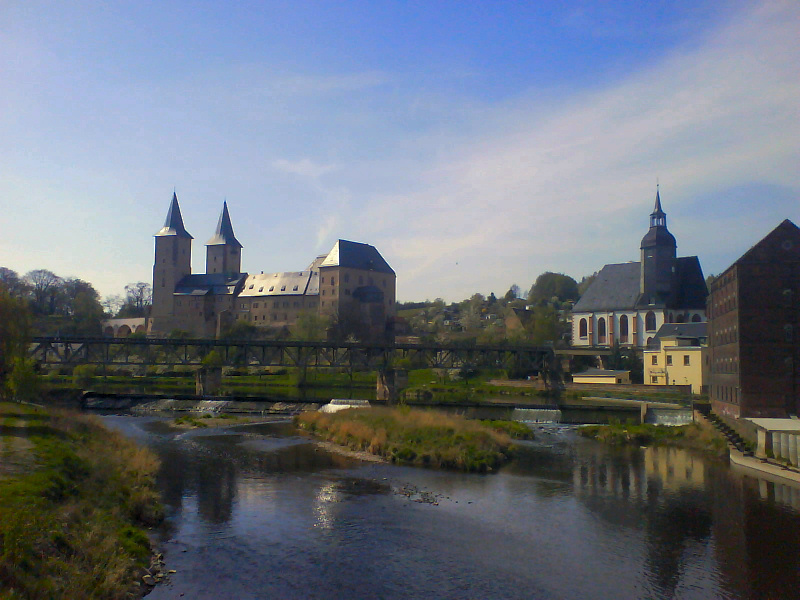
Rochsburg Castle
Rochsburg Castle is a prominent hill castle located on a rocky spur in Lunzenau, Saxony, Germany, surrounded on three sides by the Zwickau Mulde river. Founded likely in the late 12th century, it stands as an important example of Renaissance architecture in Saxony, with significant elements dating from the Late Gothic and Renaissance periods. The castle has a rich history intertwined with the noble families of Saxony and the Wettin dynasty, serving as a feudal seat and later a schloss that reflects architectural and political changes over centuries.
Historical origins and early ownership
The earliest indirect mention of the castle appears in the 1190s with a figure named Gunteros de Rochsberg, though the castle's exact founding date remains uncertain. The first clear record from 1296 names it "castrum Burggravii Rochsberg" as the residence of Burgrave Dietrich II of Altenburg. Throughout the Middle Ages, the castle changed hands among influential Saxon noble families, including the Leisnigs, Lords of Gera, and Schönfelds, reflecting the region's shifting political landscape.
Architectural evolution and major construction phases
Medieval foundations and defensive features
The castle's core includes a quadrangular inner bailey with a central bergfried or keep, originally built around 1200. This tower features thick rubble stone walls resting on gneiss bedrock, with upper sections incorporating red Rochlitz porphyry tuff and brick in monastery-style patterns. The bergfried was raised to 42 meters in the early 17th century, topped by a Baroque pointed roof. Access was initially via a high door about 10 meters above the courtyard, with a staircase added only in the 19th century.
Late Gothic and Renaissance transformations
In 1470, the castle was pledged to Hugold IV of Schleinitz, who commissioned major renovations over 12 years, transforming the medieval fortress into a Renaissance-style schloss. This work was led by the renowned architect Arnold von Westphalia. Despite legal disputes leading to the castle's return to ducal control in 1488, these renovations set the foundation for its current appearance.
Following fires in 1503 and destruction during the Schmalkaldic War in 1547, the castle was sold in 1548 to the Schönburg family. They undertook extensive rebuilding, enhancing the castle's Renaissance features including dormers, windows, and wooden ceilings, many of which survive today. The Schönburgs also added a two-story Renaissance pleasure pavilion in 1574, notable as the last surviving example of its type in Saxony.
Defensive structures and layout
The castle is naturally protected by the river on three sides and accessed via a drawbridge over a neck ditch. The complex includes an outer bailey with a triangular ground plan used historically for economic purposes, housing stables, granaries, and servant quarters. Defensive features include two zwingers—outer defensive enclosures—with the northern zwinger featuring a late 16th-century timber-framed gallery and the southern zwinger containing a defensive wall and ruins of a horse mill.
The gatehouse retains original metal fittings marked by historical combat, emphasizing the castle’s military heritage. The castle well, located in the inner courtyard, is 53 meters deep and housed in an 18th-century wooden wellhouse with a restored wheel mechanism.
Architectural and artistic highlights
Chapel of St. Anne
The castle chapel, dedicated to St. Anne and located in the south wing, is a significant architectural feature. It contains a red porphyry sacrament house predating the Reformation, a large Gothic three-light window with tracery, and a ribbed vault likely crafted by Caspar Krafft in 1523. The Late Renaissance sandstone altar, carved in 1576 by Andreas Lorenz, depicts Passion scenes with Protestant symbolism and includes heraldic decorations of the Schönburg and von Ende families. The chapel also houses a family crypt with wooden double coffins of notable Schönburg members from the 18th and 19th centuries.
Renaissance pleasure pavilion (Lusthaus)
Constructed in 1574, this two-story round pavilion is 15 meters high and topped with a distinctive curved "welsche Haube" roof. The interior walls preserve fragments of 16th-century paintings by Heinrich Göding. Originally, the ground floor featured a grotto room, and the upper floor served as a garden hall surrounded by a gallery, accessed by an external quarter-circle staircase. Renovations in the 17th and 19th centuries added a wooden ceiling with ship-keel-shaped beams and heraldic stones. After periods of disrepair, the pavilion was stabilized and restored in the early 21st century.
Later history and modern uses
The castle remained in the possession of the House of Schönburg until 1945, when it was expropriated by the state of Saxony following World War II. Financial difficulties in the early 20th century led to partial public access starting in 1911, with rooms opened as a museum and a youth hostel established, initially for Roman Catholic youth and later under other administrations until its closure in 1998.
Since the post-war period, the castle has been managed by regional cultural authorities and has undergone ongoing restoration to preserve its historical and architectural significance. The museum displays furnishings from the 16th to 19th centuries, offering visitors insight into the castle’s rich heritage. Since 2015, the site also includes a bean-to-bar chocolate manufactory, adding a contemporary cultural attraction.
Unique features and preservation
The castle’s construction prominently features local red Rochlitz porphyry tuff used in window and door surrounds, contrasting with thick rubble stone walls and brick elements added in later periods. A remarkable feature is the fully functional single-hand turret clock from 1640, which retains its original clock and striking mechanisms along with two historic bells dated 1474 and 1620, both inscribed. The clock operates by stone weights and has been supplemented with an electric motor after restoration.
The castle’s strategic location, architectural evolution from medieval fortress to Renaissance schloss, and well-preserved artistic elements make Rochsburg Castle a key cultural monument in Saxony. Its blend of military, residential, and ceremonial architecture offers a comprehensive glimpse into the region’s history and noble heritage.
Frequently asked questions (FAQ)
- What is the historical significance of Rochsburg Castle?
- Rochsburg Castle, located in Lunzenau, Germany, dates back to the 12th century and served as a key fortification in the region. It has witnessed numerous historical events and has been a symbol of local heritage, showcasing the evolution of medieval architecture and feudal life.
- When was Rochsburg Castle built?
- Rochsburg Castle was constructed in the early 12th century, with its first documented mention occurring in 1209. Over the centuries, it has undergone various renovations, reflecting the architectural styles of different periods.
- What are the opening hours of Rochsburg Castle?
- Rochsburg Castle is typically open to visitors from 10 AM to 6 PM, but hours may vary depending on the season. It is advisable to check the official website for any updates or changes in the schedule before planning your visit.
- Can I take a guided tour of Rochsburg Castle?
- Yes, guided tours are available at Rochsburg Castle, providing insights into its rich history and architectural features. These tours are led by knowledgeable guides who can answer questions and enhance your understanding of the castle's significance.
- Is Rochsburg Castle accessible for visitors with mobility challenges?
- Rochsburg Castle strives to be accessible to all visitors, including those with mobility challenges. While some areas may have limited access due to the castle's historical structure, efforts have been made to accommodate various needs, and staff are available to assist.
- What is the best time to visit Rochsburg Castle?
- The best time to visit Rochsburg Castle is during the late spring and early fall, when the weather is pleasant, and the surrounding landscapes are particularly beautiful. During these seasons, you can also enjoy various cultural events and activities hosted at the castle.
- Are there any nearby attractions to Rochsburg Castle?
- Yes, in addition to Rochsburg Castle, visitors can explore the nearby town of Lunzenau, which offers charming streets and local shops. Additionally, the scenic Mulde River and various hiking trails in the area provide opportunities for outdoor activities.
- What are the ticket prices for Rochsburg Castle?
- Ticket prices for Rochsburg Castle are generally affordable, with discounts available for children, students, and seniors. It's a good idea to check the official website for the latest pricing information and any special promotions or group rates.
Information
Website
Visit websiteSources & official resources
Verify the information above using these authoritative references.
Loading map...
Visitor reviews
No reviews yet. Been here? Write the first review and help other travelers!
Write the first reviewVisited this castle? Share your experience
Your review helps other travelers and adds first-hand knowledge to our encyclopedia.