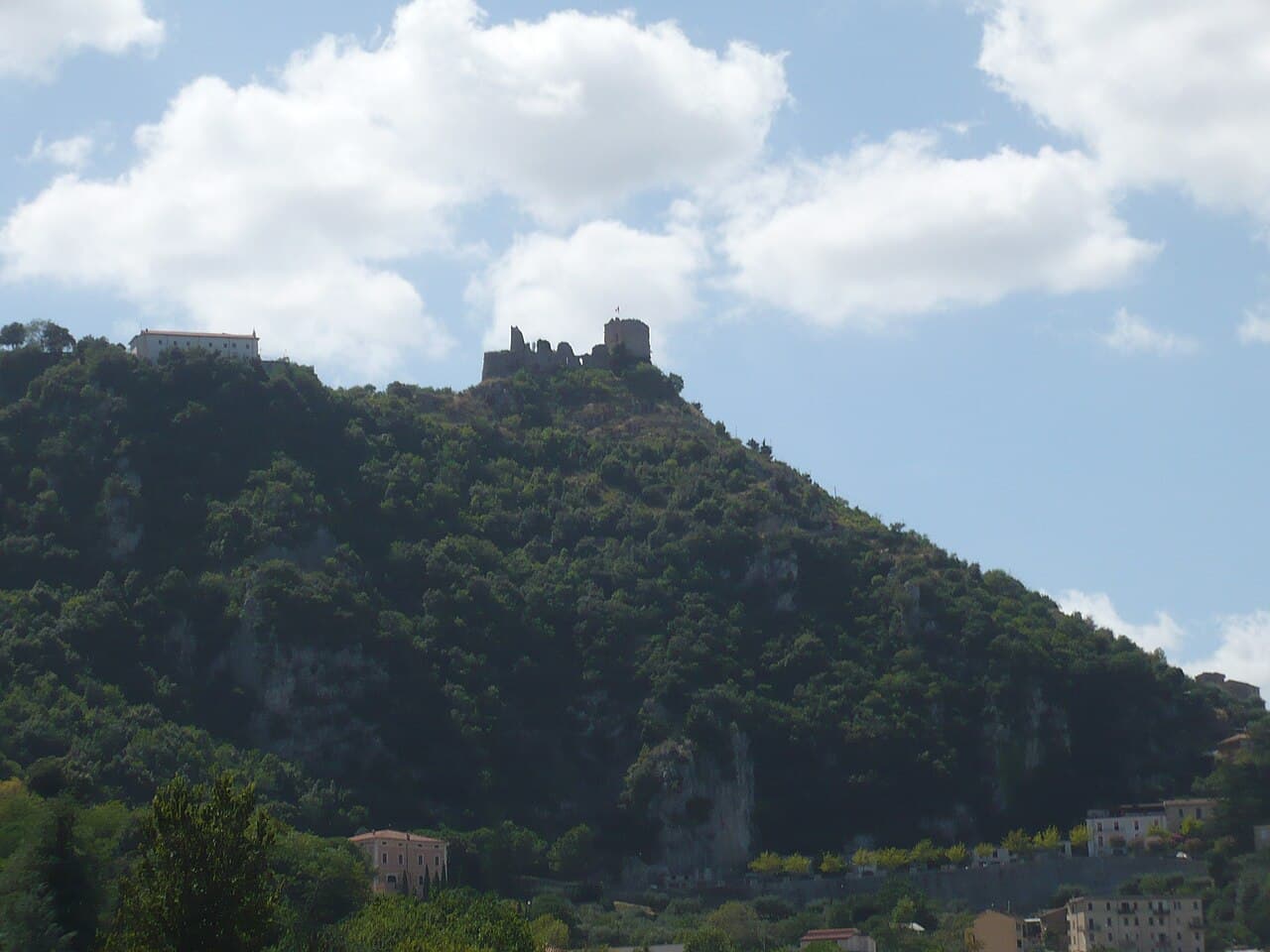
Roccaguglielma
Roccaguglielma castle stands as a significant medieval fortress perched atop Monte Cecubo in the municipality of Esperia, Italy. Its origins date back to the early 12th century, specifically around 1103, when it was founded by the Norman lord Guglielmo of Blosseville. This fortress was strategically constructed to control a vital mountain pass connecting the towns of Pontecorvo and Aquino to the coastal city of Gaeta. The castle’s location allowed the Normans to exert influence in the region while circumventing the powerful monastery of Montecassino, which was a dominant force nearby but outside Norman control.
Historical significance and medieval alliances
The foundation of Roccaguglielma was not only military but also communal, as the Norman lord established the settlement at the base of the fortress, fortifying both castle and town with defensive walls. This created a fortified complex designed for both defense and administration. During the medieval period, the castle became part of a unique alliance known as the "Five Castles of Foris", which included Campello, Pico, Rivomatrice, and San Giovanni Incarico. This small autonomous domain existed for about a decade, surrounded by lands under the control of Montecassino monastery.
Over the centuries, the castle passed through the hands of several prominent noble families, including the Spinelli, della Rovere, and Farnese. The Spinelli family, particularly active in the 14th century, undertook significant construction and reinforcement of the castle’s defenses, adapting it to the evolving military architecture of the time.
Military conflicts and natural disasters
The late 15th and early 16th centuries were turbulent for Roccaguglielma, as the castle and its lands suffered damage during the Italian Wars. Notably, military campaigns led by Gonzalo Fernández de Córdoba, known as the "Great Captain," inflicted extensive destruction. Despite this, the region experienced a period of prosperity from the 16th through 17th centuries.
However, in 1636, the fiefdom reverted to direct royal control. Less than twenty years later, a devastating earthquake in 1654 caused further damage to the castle and surrounding areas. The continuing instability in the region was marked by widespread brigandage during the Napoleonic era and the period of Italian unification, with notable bandits such as Fra Diavolo and Luigi Alonzi (Chiavone) opposing ruling authorities.
Architectural features and fortifications
Roccaguglielma fortress occupies a commanding position approximately 500 meters above sea level on a rocky ridge, overlooking the modern town of Esperia. The castle complex was divided into distinct functional zones: the outer defensive perimeter and the inner residential district, each protected by its own walls and gates.
The outer curtain wall was reinforced by twelve towers and featured three primary gates: Caporave, Santo Spirito (Holy Spirit), and San Bonifacio. Inside this perimeter, a second wall enclosed the residential area, which had three additional gates named Portella, Santa Croce (Holy Cross), and Morrone. The construction utilized local stone and medieval masonry techniques focused on both defense and territorial control.
During the 14th century, renovations led by the Spinelli family enhanced the castle’s fortifications, reflecting advancements in military architecture. These modifications included strengthening walls and towers to better withstand sieges and artillery attacks, which were becoming more prevalent in that era.
Defensive layout and strategic design
The castle’s location on a rocky ridge provided natural defensive advantages, with steep slopes limiting access and visibility for potential attackers. The layered walls and multiple gates created a complex defense system that forced invaders to overcome successive barriers. The presence of numerous towers allowed defenders to monitor the surrounding landscape and mount effective counterattacks.
Religious heritage and later history
Near the castle ruins stands a small church dedicated to the Holy Virgin, maintained by the Trinitarian Fathers. This church occupies the site of the fortress’s original chapel, symbolizing a continuous religious presence on the hill from medieval times to the present. The church serves as a cultural and spiritual link to the castle’s history, reflecting the intertwined nature of faith and feudal power in the region.
In the modern era, administrative reforms during the Napoleonic period altered the local governance structure. Under King Joachim Murat, Roccaguglielma was administratively separated from neighboring villages such as Baja Esperia and Monticelli, which formed the municipality of San Pietro in Curolis. Following Italian unification in 1867, Roccaguglielma and San Pietro combined to form the current town of Esperia.
Current condition and preservation
Today, the remains of Roccaguglielma castle lie mostly in ruins, with many sections of the defensive walls and towers partially preserved. The ruins clearly outline the original layout of the fortress, offering valuable insight into medieval military architecture and Norman influence in southern Italy. The site is under state ownership, ensuring protection and facilitating conservation efforts.
The castle ruins, combined with the adjacent Trinitarian church, create a compelling historical and cultural landmark. Visitors can explore the remnants to understand the strategic importance of the fortress and its role in the region’s complex medieval history. The site also serves as a reminder of the resilience of local communities through centuries of warfare, natural disasters, and political change.
Frequently asked questions (FAQ)
- How do I get to Roccaguglielma castle?
- Roccaguglielma castle is located in Esperia, Lazio, Italy. Visitors can reach the site by car or local transport to Esperia, then follow local signs or paths to Monte Cecubo where the castle ruins are situated.
- What is the historical significance of Roccaguglielma castle?
- Roccaguglielma castle was founded in the early 12th century by Norman lord Guglielmo of Blosseville. It played a strategic role controlling a mountain pass and was part of the "Five Castles of Foris" alliance, reflecting its medieval military importance.
- Can I visit the ruins of Roccaguglielma castle?
- Yes, the castle ruins are accessible to the public as they are under state ownership. Visitors can explore the remains and learn about the castle's medieval architecture and history.
- What architectural features does Roccaguglielma castle have?
- The castle features a double wall system with an outer curtain wall reinforced by twelve towers and three main gates, plus an inner residential area with its own walls and gates, showcasing medieval defensive design.
- When was Roccaguglielma castle most active?
- The castle was most active during the 12th to 17th centuries, particularly under Norman and later noble family control, with significant events during the Italian Wars and Napoleonic era.
Photo gallery

Photo by Carlo.iossa•Public domain
Information
Current owner
State
Loading map...
Visitor reviews
No reviews yet. Been here? Write the first review and help other travelers!
Write the first reviewVisited this castle? Share your experience
Your review helps other travelers and adds first-hand knowledge to our encyclopedia.


