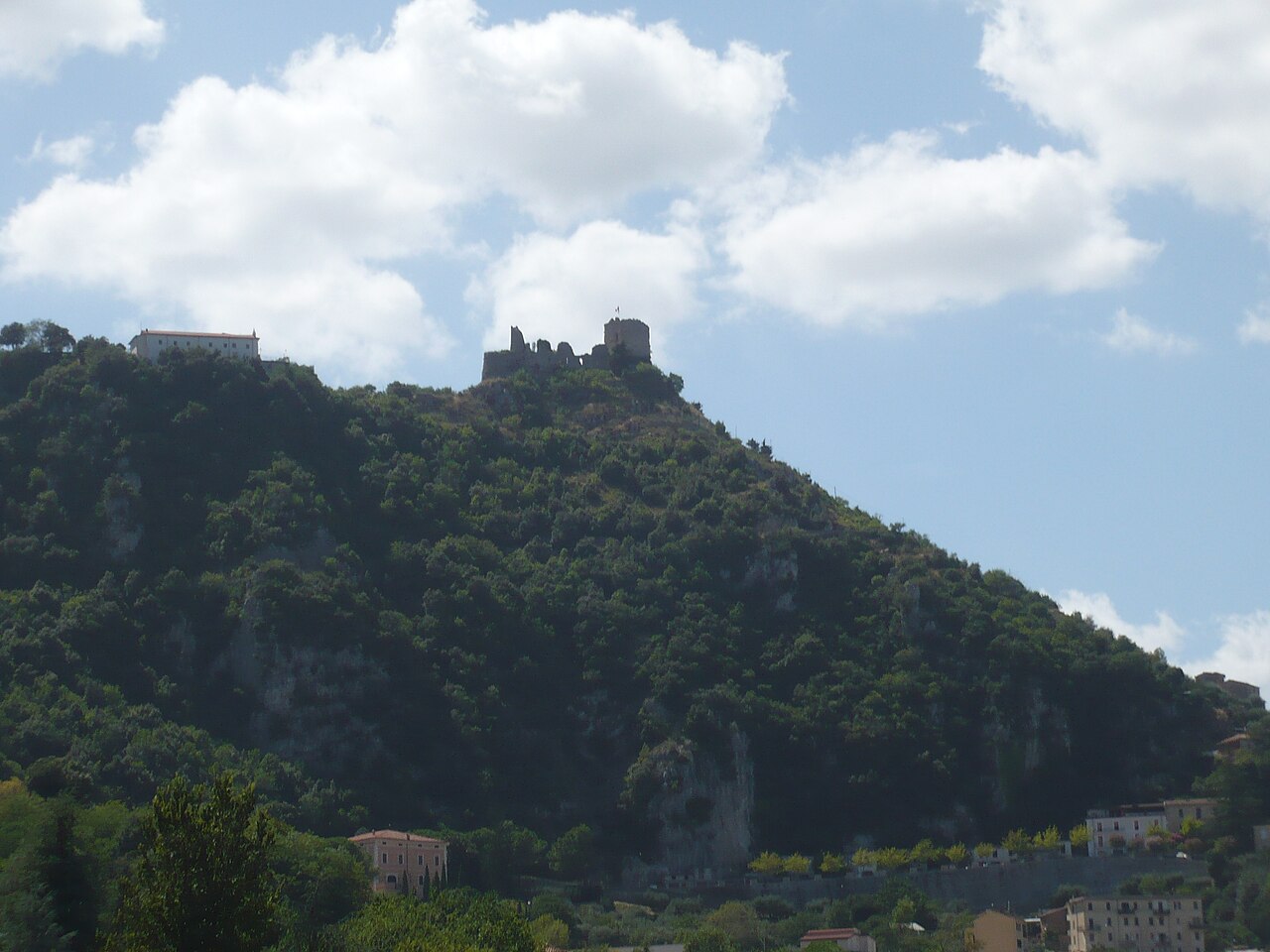
Rocca Janula
Rocca Janula stands as a remarkable example of a historic hill castle in the municipality of Cassino, Italy. Strategically perched at 187 meters above sea level, this fortress has played a pivotal role in the defense of the Terra di San Benedetto territory for centuries. Its proximity to the renowned Montecassino Abbey, situated higher on the hill at 516 meters, underscores the castle's importance in safeguarding one of Italy's most significant religious and cultural sites.
The origins of Rocca Janula trace back to the mid-10th century, when it was established by the Benedictine civilization under the direction of Abbot Aligerno. Although initially constructed without direct imperial or princely authorization, the fortress was later officially sanctioned in 967 by Pandolfo I of Capua, who recognized the necessity of fortifications to protect Benedictine lands. The castle's name is believed to derive either from the Roman god Janus, who was thought to have a place of worship on the hill, or from the Latin term "janua," meaning "door," referencing a gate in the northern walls of ancient Casinum facing the hill.
Architectural evolution and military significance
The original structure of Rocca Janula likely consisted of a square tower within a small fortified enclosure, separate from the main town walls. This design was typical for military fortifications of the period, focusing on defense and control of key routes. The fortress's location allowed it to oversee and protect the vital regional road connecting Marsica with the major cities of Rome, Naples, and the Tyrrhenian coast. Its defensive capacity was notable, as it could shelter up to 2,000 people during emergencies, highlighting its role not only as a military bastion but also as a refuge for the local population.
In 1004, the fortress sustained damage from an earthquake, leading to significant rebuilding efforts in the following centuries. During the early 12th century, the castle became a focal point of local power struggles. Residents of nearby San Germano seized the fortress amid conflicts involving the duchy of Gaeta. The Benedictines, under Abbot Gerardo, reclaimed Rocca Janula and initiated substantial expansions. These included the construction of a distinctive pentagonal tower, two residential towers, an enlarged network of defensive walls, and a small church within the fortress complex.
Subsequent abbots, such as Roffredo and Atenolfo, continued to enhance the fortress throughout the 12th and 13th centuries, reinforcing its military and residential functions. The castle's strategic importance attracted the attention of Emperor Frederick II, who twice ordered its demolition but ultimately rebuilt it, incorporating Swabian architectural elements. Frederick II entrusted the fortress to his vassals and allied with Abbot Landolfo, using Rocca Janula as a stronghold against Pope Gregory IX.
The rocca during the swabian and angevin periods
During the mid-13th century, the fortress played a significant role in the conflict between Manfred of Sicily and Charles I of Anjou. It housed a garrison of approximately 2,000 Saracen soldiers and 1,000 horses under Manfred's command, demonstrating its military capacity and strategic value in regional power struggles.
In the 15th century, Abbot Pyrro undertook efforts to reclaim and restore Rocca Janula after it had been assigned to Antonio Carafa by Queen Joanna II of Anjou. Pyrro paid a substantial sum to regain control and subsequently restored the fortress walls and built two new towers facing the city. These towers bear Pyrro's family coat of arms and an inscription dating the completion of these works to 1418. The fortress briefly returned to the control of San Germano's inhabitants in 1522.
Decline, damage, and restoration
As the temporal power of Montecassino declined, so too did the military importance of Rocca Janula. By the 18th century, the fortress had become royal property under Charles III of Bourbon. A commemorative plaque dedicating the fortress to the Madonna was placed on Pyrro's tower in 1870, symbolizing peace and the site's cultural significance.
The fortress suffered severe damage during World War II, with much of the structure reduced to ruins. Today, only fragments of the walls, the pentagonal tower, and some internal buildings remain intact. Early 21st-century restoration efforts have stabilized these remnants, allowing public access and cultural activities to flourish. Nearby, the Monument to Peace by Umberto Mastroianni stands as a poignant reminder of the costs of war.
Architectural features and surviving elements
The surviving layout of Rocca Janula reflects its origins as a military fortress with a square tower initially enclosed within a small fortified area. The prominent pentagonal tower, dating from the early 12th century, remains a key feature, illustrating the evolution of defensive architecture designed to improve protection and visibility.
The two residential towers and the small church constructed during Abbot Gerardo's expansions indicate the castle's dual role as a defensive stronghold and a place of residence and worship. The 15th-century additions by Abbot Pyrro, including the city-facing towers with his family's coat of arms and dated inscription, further emphasize the castle's ongoing strategic and symbolic importance.
Today, Rocca Janula offers visitors a glimpse into medieval military architecture, Benedictine monastic influence, and the layered history of the Cassino region. Its elevated position provides commanding views over the surrounding landscape, including the Montecassino Abbey and key transit routes, underscoring its historical role in regional defense.
Visiting rocaa janula and cultural significance
Following the extensive restoration completed in 2015, Rocca Janula has become a vibrant cultural site hosting exhibitions, events, and educational programs that celebrate its rich history and architectural heritage. Visitors can explore the remains of the fortress, including the pentagonal tower and the defensive walls, while absorbing the historical context of this remarkable hill castle.
The nearby Monument to Peace enhances the visitor experience by providing a reflective space dedicated to the memory of wartime sacrifices and the pursuit of peace. Rocca Janula remains a testament to the enduring legacy of medieval fortifications and the Benedictine order's influence in shaping the cultural landscape of Italy.
Frequently asked questions (FAQ)
- How do I get to Rocca Janula?
- Rocca Janula is located in Cassino, Lazio, Italy. Visitors can reach the site by car or local transport from Cassino town center, which is well connected by regional train and bus services.
- What is the historical significance of Rocca Janula?
- Rocca Janula served as a key military fortress protecting the Terra di San Benedetto and Montecassino Abbey. It played important roles during medieval conflicts and was expanded by notable abbots and rulers.
- Can I visit the pentagonal tower?
- Yes, the pentagonal tower is one of the most prominent surviving features of Rocca Janula and is accessible to visitors as part of the restored fortress complex.
- When was Rocca Janula built?
- The fortress was originally constructed in the mid-10th century, with major expansions in the 12th and 15th centuries.
- Is Rocca Janula suitable for family visits?
- Yes, the site is suitable for families interested in history and medieval architecture. It offers educational and cultural activities that engage visitors of all ages.
Information
Website
Visit websiteSources & official resources
Verify the information above using these authoritative references.
Loading map...
Visitor reviews
No reviews yet. Been here? Write the first review and help other travelers!
Write the first reviewVisited this castle? Share your experience
Your review helps other travelers and adds first-hand knowledge to our encyclopedia.