Rocca Malatestiana
The Rocca Malatestiana stands as a monumental example of medieval military architecture in the Romagna region of Italy. Perched strategically on a hilltop, this hill castle has served as a defensive stronghold, noble residence, and cultural landmark for over a millennium. Its origins trace back to at least the late 9th century, with early documentation referencing a fortification known as "chastrum sancti arcangeli" on Mons Iovis, near the ancient Roman Via Aemilia. This location underscored the fortress's long-standing role in controlling vital communication and trade routes across northern Italy.
Early history and strategic significance
The Rocca Malatestiana's earliest mentions appear in the "Codice Bavaro," highlighting its presence as a fortified site during the early medieval period. Throughout the Middle Ages, the fortress changed hands among various local noble families, including the Balacchi counts in the 13th century, who likely hailed from Santarcangelo or nearby Rimini. By 1164, records confirm the existence of a castle at this site, reinforcing its importance in regional defense and administration.
In 1295, the castle came under the control of the Malatesta family, a prominent dynasty that would shape Romagna's political landscape for centuries. The Malatestas maintained dominion over the fortress, with some interruptions, until 1500. Notably, between 1353 and 1376, the Papal States exerted direct control after Cardinal Albornoz's military campaigns reasserted papal authority in the region. Despite this, the Malatestas often retained administrative roles, exemplifying the fortress's intertwined military and political functions.
Architectural evolution and military adaptations
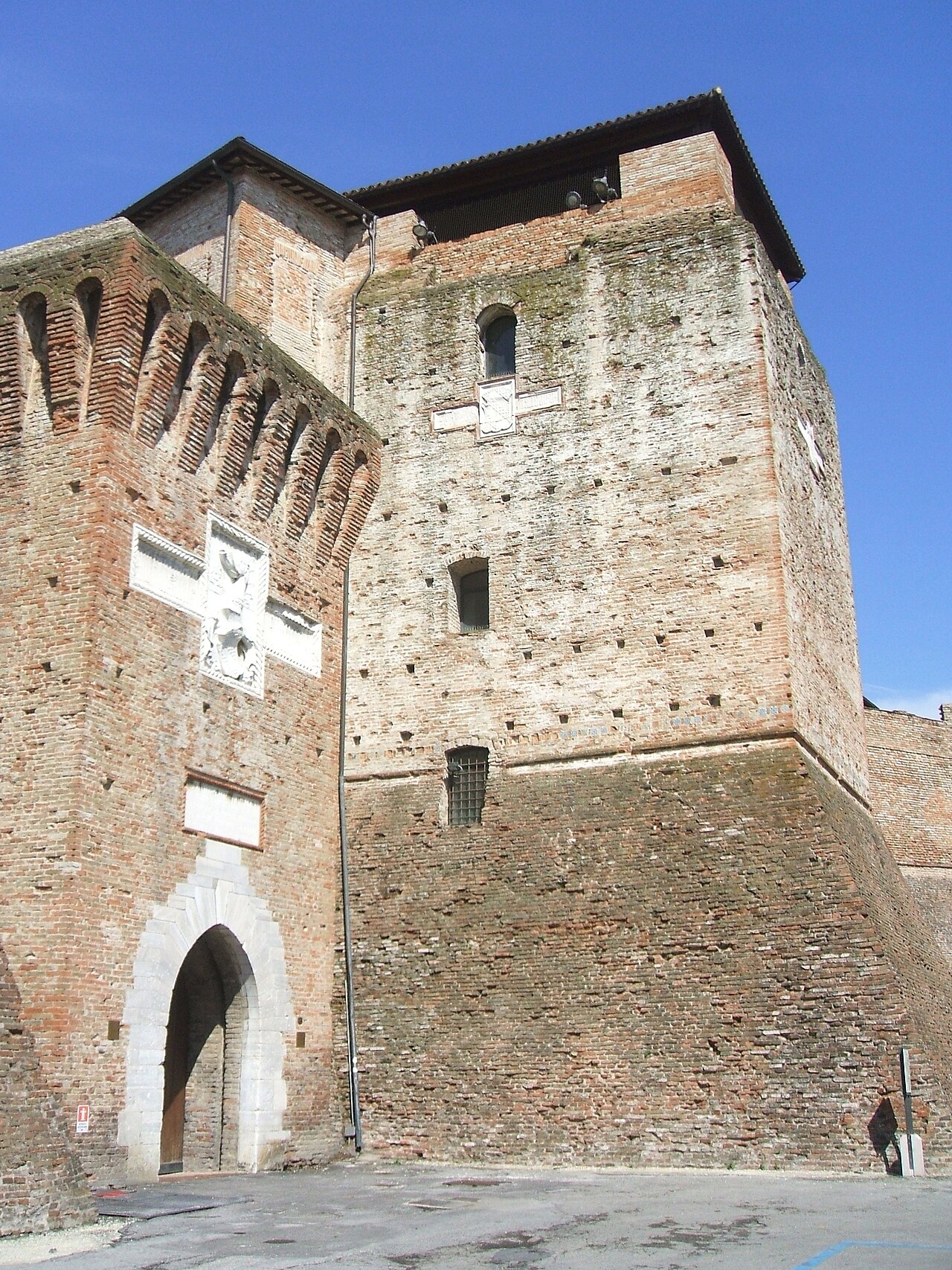
The fortress's architecture reflects continuous adaptation to evolving military technologies and political circumstances. In 1386, Carlo Malatesta commissioned a new tower on the remains of earlier structures, enhancing the fortress's defensive capabilities. This tower served as both a military bastion and a symbol of Malatesta power.
Subsequent renovations under Sigismondo Pandolfo Malatesta in 1447 significantly altered the tower's profile. The upper sections were truncated, and the removed stone was repurposed to strengthen other parts of the fortress, particularly to accommodate emerging artillery technologies. This remodeling illustrates the transition from traditional medieval fortifications to designs responsive to gunpowder weaponry.
Despite these efforts, the fortress endured sieges and damage during the turbulent 15th century. In 1462, the renowned condottiero Federico da Montefeltro captured the castle, and in 1498, Cesare Borgia inflicted substantial damage during his campaigns to consolidate power in Romagna. These events underscore the fortress's strategic value and the fierce contests for control in the region.
Later ownership and cultural significance
Following the Malatesta era, the fortress experienced a series of ownership changes. Pope Pius II confiscated the castle from Sigismondo Malatesta, granting it as fiefs first to the Zampeschi family and later to the Pallavicini. Over subsequent centuries, the Rocca Malatestiana passed through various aristocratic hands, including the Baldini counts and the Massani family, who adapted the site for agricultural use in the late 19th century.
In the 20th century, ownership transferred to notable figures such as Countess Eugenia Rasponi Murat and later Princess Marina Colonna di Paliano, reflecting the fortress's enduring cultural and historical importance. Today, the Rocca Malatestiana remains a prominent landmark that connects the modern town of Santarcangelo di Romagna with its rich medieval past.
Architectural features and current remains
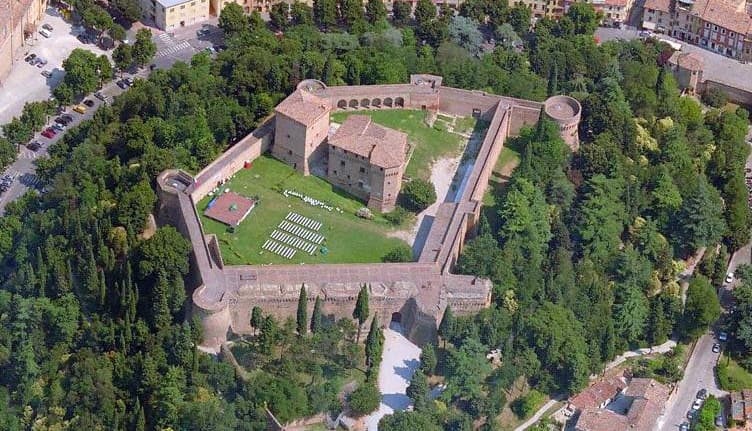
The fortress crowns a hill overlooking Santarcangelo di Romagna, showcasing typical medieval construction materials such as stone and masonry. The central feature is the tower erected by Carlo Malatesta in 1386, built atop earlier ruins. This tower functioned as a defensive stronghold and a symbol of Malatesta authority.
Sigismondo Pandolfo Malatesta’s 1447 renovations truncated the tower’s height, with the removed stone reused to reinforce other defensive elements, adapting the fortress to the era’s artillery threats. While only fragments of the original medieval walls survive, these remnants display the rugged masonry characteristic of the period and hint at the fortress’s once comprehensive defensive perimeter.
The fortress layout integrates closely with the adjacent historical town and the ancient Via Aemilia, emphasizing its strategic placement at a historical crossroads. Although no significant archaeological artifacts such as tools or religious items have been reported, the surviving architectural elements provide vital insights into the fortress's military and administrative roles over centuries.
The rocca malatestiana in historical context
The Rocca Malatestiana exemplifies the dynamic history of Romagna during the Middle Ages and Renaissance. Its construction and modifications mirror broader regional trends, including the rise of powerful noble families like the Malatestas, the assertion of papal authority, and the adaptation to evolving military technologies such as artillery.
The fortress’s endurance through sieges, political upheavals, and changing ownership reflects the strategic importance of hilltop fortifications in controlling territory and trade routes. Its preservation today offers a tangible link to Italy’s medieval heritage and the complex interplay of local and external powers that shaped the region.
Visiting the rocca malatestiana
Visitors to Santarcangelo di Romagna can explore the Rocca Malatestiana’s remains, appreciating its commanding position and architectural features. While the fortress is primarily in a partially preserved state, its historical significance and scenic location make it an essential destination for enthusiasts of medieval history and military architecture.
The site’s proximity to the ancient Via Aemilia and the town center allows for a rich cultural experience, combining historical exploration with the charm of the Romagna region. Interpretive signage and guided tours help contextualize the fortress’s role across centuries, enhancing visitor understanding of its multifaceted past.
Frequently asked questions (FAQ)
- How do I get to Rocca Malatestiana?
- Rocca Malatestiana is located in Santarcangelo di Romagna, Italy. You can reach it by car or public transportation, with local buses connecting to nearby cities. There is parking available for visitors who choose to drive.
- What is the historical significance of Rocca Malatestiana?
- Rocca Malatestiana dates back to the 13th century and is a prime example of medieval military architecture in Italy. It served as a fortress and residence for the Malatesta family, influential rulers in the region. The castle is not only a symbol of the town's history but also reflects the political power struggles of the time.
- When was Rocca Malatestiana built?
- Construction of Rocca Malatestiana began in the early 13th century, with significant expansions and renovations occurring over the following centuries. The castle has undergone various modifications, especially in the 15th century when it was adapted for more comfortable living. Today, it stands as a well-preserved monument to its storied past.
- Can I take guided tours of Rocca Malatestiana?
- Yes, guided tours are available at Rocca Malatestiana, providing visitors with in-depth knowledge of the castle's history and architecture. These tours are typically conducted by knowledgeable local guides who share fascinating stories and insights. It's advisable to check the schedule and book in advance, especially during peak tourist seasons.
- Why is Rocca Malatestiana a popular destination?
- Rocca Malatestiana is popular due to its stunning architecture, rich history, and picturesque location. Visitors are drawn to its impressive towers and panoramic views of the surrounding landscape. Additionally, the castle often hosts cultural events and exhibitions, enhancing its appeal as a tourist destination.
- Is it possible to visit Rocca Malatestiana year-round?
- Yes, Rocca Malatestiana is open to visitors year-round, although hours may vary by season. It's recommended to check the official website for the most current opening hours and any seasonal events that might affect accessibility. Visiting during the spring and fall can offer a more pleasant experience due to milder weather.
- What are the ticket prices for Rocca Malatestiana?
- Ticket prices for Rocca Malatestiana are generally affordable, with discounts available for children, students, and seniors. Special rates may apply for guided tours or group visits. It's best to check their official website or contact the castle for the latest pricing information.
- What are the opening hours for Rocca Malatestiana?
- Rocca Malatestiana typically opens in the morning and closes in the late afternoon, with extended hours during the summer months. However, specific hours can vary based on the season and local events. Visitors should consult the castle's official website for the most accurate and updated information.
- Are there any nearby attractions to visit?
- Yes, Santarcangelo di Romagna is home to several nearby attractions, including charming streets, local shops, and other historical sites. The town also features beautiful parks and natural areas for outdoor activities. After visiting Rocca Malatestiana, you can explore the local cuisine at nearby restaurants for a complete experience.
Photo gallery

Information
Website
Visit websiteSources & official resources
Verify the information above using these authoritative references.
Loading map...
Visitor reviews
No reviews yet. Been here? Write the first review and help other travelers!
Write the first reviewVisited this castle? Share your experience
Your review helps other travelers and adds first-hand knowledge to our encyclopedia.