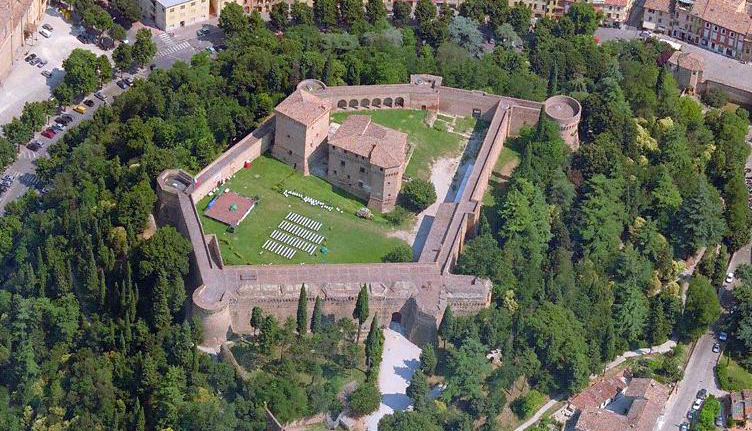
Castello Malatestiano
The Castello Malatestiano in Longiano, Italy, stands as a remarkable example of a medieval fortress that has evolved through centuries into a vibrant cultural landmark. Situated on a strategic hilltop, this hill castle not only commanded the surrounding landscape but also witnessed the shifting tides of political power and architectural styles from the early medieval period through the Renaissance and into modern times.
Originally constructed in the 13th century by the influential Malatesta family, who ruled the Emilia-Romagna region, the castle was built atop the remnants of an ancient Roman castrum, underscoring the site's longstanding military significance. This foundation highlights the continuity of strategic use from Roman times through the Middle Ages, reflecting the castle's role in regional defense and governance.
During the Middle Ages, the Castello Malatestiano functioned as both a fortified residence and a military stronghold. Its design included an almost square plan fortified by five bastions and a prominent tower, characteristic of medieval defensive architecture. A water-filled moat originally encircled the castle, with access controlled by a single eastern entrance defended by a square tower housing the drawbridge mechanism. This combination of features ensured a formidable defense against potential attackers.
Medieval origins and malatesta rule
The earliest documentation of the castle dates back to 1059, indicating its significance during the communal period when local families and city-states vied for control. From 1290 to 1463, the Malatesta family fortified the castle further by adding bastions and expanding its structures, including a civic tower and a keep dating to the 12th century. These enhancements not only strengthened the castle's military capabilities but also emphasized its administrative importance in the region.
The castle's elevated position provided commanding views over the surrounding plain and the Adriatic Sea, making it a critical point for monitoring and controlling access routes. The Malatesta's fortifications reflected the turbulent political climate of the time, where defensive readiness was essential.
Transition under papal and venetian influence
Following the Malatesta rule, the castle came under the authority of the Papal States in 1463. This transition marked a shift in the castle's strategic role within the broader political landscape of Italy. Between 1503 and 1506, the fortress experienced a brief Venetian military occupation, during which a distinctive basin was constructed in the courtyard, exemplifying Venetian architectural influence and military presence.
Renaissance transformation and noble residence
In 1519, Pope Leo X granted the castle as a fief to Count Guido II Rangoni of Modena. Under his ownership, the fortress underwent significant transformation from a military stronghold to a noble residence. Defensive features were diminished or removed, making way for elegant architectural elements such as loggias and frescoed interiors. This period marked a clear shift toward residential comfort and aesthetic refinement, aligning with Renaissance ideals.
Architectural adaptations
The addition of the loggia introduced openness and light, contrasting with the castle's earlier fortress-like solidity. Frescoes commissioned during this time adorned interior halls, including the Sala dell’Arengo and the Sala degli Affreschi, which became focal points for artistic expression and social gatherings. These halls also served civic functions, reinforcing the castle's role in local governance.
19th-century refurbishments and civic use
Throughout the 19th century, the castle continued to evolve, with refurbishments focusing on interior spaces and decorative schemes. The frescoes by artists Giovanni Canepa and Girolamo Bellani in the Sala degli Affreschi highlight the castle's ongoing cultural significance and its connection to the history of Longiano. During this time, the castle also served as the municipal seat until 1989, reinforcing its central role in community life.
Modern restoration and cultural revitalization
A comprehensive restoration completed in 2003 revitalized the Castello Malatestiano, preserving its architectural heritage while adapting it for contemporary use. The castle now houses the Fondazione Tito Balestra, dedicated to modern and contemporary art. This transformation from fortress to cultural hub illustrates the adaptive reuse of historic structures to serve present-day educational and artistic purposes.
The castle's inner courtyard, once the site of the Church of Madonna di Loreto, now serves as a venue for exhibitions, concerts, and festivals, including an annual event honoring Saint Lawrence, reflecting the site's enduring religious and communal significance.
Architectural features and layout
The Castello Malatestiano showcases a complex architectural fabric combining medieval masonry with Renaissance and 19th-century modifications. Its nearly square plan includes five bastions and two prominent towers, including the 12th-century civic tower and a keep, which underscore its defensive origins.
The original moat, once filled with water to deter invaders, was filled in the 18th century, and the drawbridge was replaced by a fixed stone bridge, marking the castle's transition from military fortress to a more peaceful residence and administrative center.
Inside, the castle features the Sala dell’Arengo, historically used for public assemblies, and the Sala degli Affreschi, named for its decorative frescoes. These spaces reflect the castle's multifaceted role as a military, administrative, and cultural site across centuries.
Subterranean areas beneath the complex hint at the depth of the castle's construction, though their specific functions remain partially unexplored, adding an element of mystery to the site.
Cultural significance and visitor experience
Today, the Castello Malatestiano stands as a testament to the layered history of the Emilia-Romagna region. Its preservation and adaptive reuse as a cultural center provide visitors with insights into medieval military architecture, Renaissance residential design, and modern artistic endeavors.
The castle's panoramic terrace offers sweeping views of the surrounding landscape and the Adriatic Sea, enhancing its appeal as a tourist destination. Visitors can explore the well-preserved bastions, towers, and halls, gaining a comprehensive understanding of the site's evolution.
Annual festivals, exhibitions, and educational programs hosted within the castle foster community engagement and celebrate the rich heritage of Longiano and the Malatesta legacy.
Frequently asked questions (FAQ)
- What is the historical significance of Castello Malatestiano?
- Castello Malatestiano, located in Longiano, Italy, is a prime example of medieval architecture and played a crucial role in the political and military history of the region. Built in the 15th century, it served as a stronghold for the Malatesta family, who were influential leaders in Romagna. Today, it stands as a testament to the rich cultural heritage of Italy.
- When was Castello Malatestiano built?
- The construction of Castello Malatestiano began in the early 15th century, around 1400, under the direction of the Malatesta family. The castle underwent various modifications and expansions over the years, reflecting the architectural styles of different periods. It has been preserved and restored, allowing visitors to appreciate its historical grandeur.
- What are the opening hours for Castello Malatestiano?
- Castello Malatestiano is typically open to visitors from Tuesday to Sunday, with specific hours varying by season. It is advisable to check the castle's official website for the most current opening hours and any special events. Plan your visit accordingly to ensure you have ample time to explore this historic site.
- Can I purchase tickets in advance?
- Yes, visitors can purchase tickets for Castello Malatestiano in advance through the official website or at the castle's entrance. Buying tickets ahead of time can help you avoid long waiting times, especially during peak tourist seasons. Group rates and guided tour options may also be available for a more enriching experience.
- Is Castello Malatestiano accessible for visitors with disabilities?
- Castello Malatestiano strives to be accessible for all visitors, but due to its historical structure, some areas may pose challenges for those with mobility issues. There are efforts in place to improve accessibility, including ramps and adapted facilities. It is recommended to contact the castle staff in advance to inquire about specific accommodations.
- What is the best time to visit Castello Malatestiano?
- The best time to visit Castello Malatestiano is during the spring and early fall when the weather is mild and pleasant. These seasons often see fewer crowds, allowing for a more enjoyable experience while exploring the castle grounds and surrounding areas. Additionally, local festivals in these months can enhance your visit.
- Are there nearby attractions to visit after exploring the castle?
- Yes, after visiting Castello Malatestiano, you can explore the charming town of Longiano, which features beautiful architecture and local shops. Nearby attractions include the picturesque hills of Romagna and other historical sites such as the Fortress of San Leo and the city of Cesena. These sites offer a rich cultural experience in addition to your castle visit.
- How do I get to Castello Malatestiano?
- Castello Malatestiano is easily accessible by car, with parking available nearby for visitors. If you prefer public transportation, you can take a train to the nearest station and then use local buses or taxis to reach the castle. Detailed directions can be found on the castle's official website to assist with your travel plans.
Information
Website
Visit websiteSources & official resources
Verify the information above using these authoritative references.
Loading map...
Visitor reviews
No reviews yet. Been here? Write the first review and help other travelers!
Write the first reviewVisited this castle? Share your experience
Your review helps other travelers and adds first-hand knowledge to our encyclopedia.