Castel Sismondo
Castel Sismondo, located in Rimini, Emilia-Romagna, Italy, stands as a remarkable example of Renaissance military architecture and noble residence. Commissioned by Sigismondo Pandolfo Malatesta in 1437, this hill castle was designed to serve both as a fortress and a symbol of Malatesta power. Its construction spanned over fifteen years, reflecting the complex political and cultural milieu of 15th-century Italy. The castle’s foundation date, 20 May 1437, was deliberately chosen based on astrological readings, underscoring the era’s intertwining of science, superstition, and politics.
The initial design and construction incorporated pre-existing fortifications and family residences from the 13th and 14th centuries, demonstrating a continuity of defensive and residential functions on the site. Notably, the involvement of prominent figures such as Filippo Brunelleschi in 1438, who inspected and advised on the design, and architects Cristoforo Foschi and Matteo Nuti further enriched the castle’s architectural significance. The castle was officially inaugurated in 1446, although finishing touches continued until 1454, and the original grand vision was never fully realized.
Historical context and Malatesta legacy
The castle was built during the late medieval period transitioning into the Renaissance, a time marked by evolving military technologies and shifting political landscapes. Sigismondo Malatesta, lord of Rimini and Fano, sought to consolidate his authority through this imposing structure. His death within the castle walls in 1468 symbolized the end of an era for the Malatesta dynasty’s dominance.
Following the decline of the Malatesta family in the late 15th century, Castel Sismondo’s role shifted from noble residence to a purely military fortress. This transition prompted significant architectural modifications to adapt to the advent of firearms. By 1526, the castle’s defenses had been modernized with polygonal bastions, a design innovation documented in plans by the renowned military architect Antonio da Sangallo the Younger.
Architectural evolution and military adaptations
Between 1624 and 1626, further enhancements were made to improve the castle’s artillery capabilities. Walls were raised, cannon embrasures were added, and a ravelin facing the countryside was demolished. During this period, the castle was renamed Castel Urbano in honor of Pope Urban VIII, reflecting the influence of papal authority on the region.
The 19th century saw the castle repurposed for institutional use, including serving as a barracks for the Carabinieri from 1821 and later as a prison from 1857 until 1967. These changes led to the removal of several defensive features, filling of the moat, and construction of a salt warehouse, significantly altering the castle’s original military layout.
Restoration and cultural significance
The 20th century marked a renewed focus on preservation and cultural utilization. Under the guidance of Carla Tomasini Pietramellara, extensive restoration efforts revealed archaeological remains from Roman and early medieval periods integrated within the castle’s exhibition spaces. Since 2019, ongoing restorations have concentrated on the eastern moat and the western courtyard known as the "corte a mare." Today, Castel Sismondo forms part of the Fellini Museum complex, serving as a vibrant cultural landmark.
Architectural features and defensive elements
Fortified complex and moats
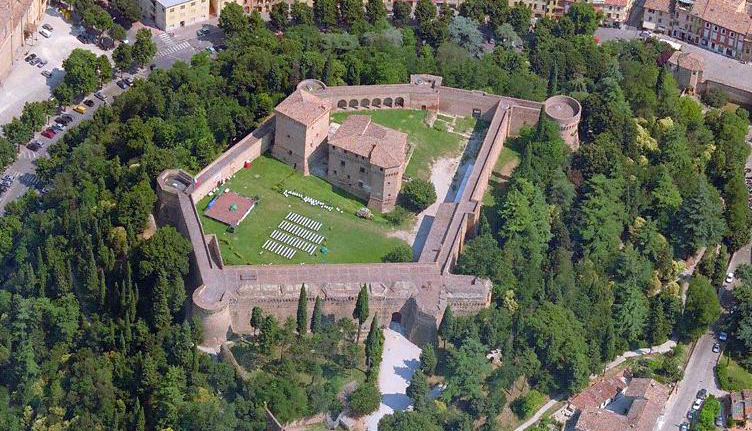
The castle is a vast fortified complex resembling a citadel, enclosed by high, irregular outer walls originally surrounded by a large dry moat through which the "fustigata" stream flowed. Ingenious hydraulic systems allowed the moat to be flooded despite its elevation above the nearby Marecchia River, enhancing the castle’s defensive capabilities by creating a formidable barrier to attackers.
Courtyards and bastions
Inside the walls, two large open courtyards existed: the "corte a mare" facing the city and the "corte del soccorso", a trapezoidal parade ground still preserved. The "corte a mare" was once surrounded by imposing polygonal bastions forming a "false braga"—a defensive projection designed for flanking fire. Access was through a gate tower with two doors and drawbridges. Although this courtyard is now destroyed and filled in, its historical presence is well documented. The "corte del soccorso" lies between the city walls and the castle’s central buildings and was formerly defended by a now-demolished ravelin near marshy terrain.
Central keep and towers
At the fortress’s heart stands the central keep, the "rocca di mezzo", comprising the mastio (main tower) and the Isotta wing. These two structures are connected by a covered passage on an intermediate floor. The castle’s six towers, each approximately 80 feet tall with square foundations, face the city and were designed to house bronze cannons, highlighting the fortress’s artillery focus. The bunkers and bastions behind these towers feature thick, sloped walls called scarps, reinforced with brick and earthen embankments up to eight meters thick, providing robust resistance against artillery fire.
Isotta wing and mastio details
The Isotta wing is a three-story rectangular building with walls up to three meters thick. Originally, it housed reception rooms and a chapel on the ground floor, private apartments above, and staircases leading to a rooftop terrace. This wing incorporates a preexisting corner tower resting on Roman foundations visible in the floor plan. The mastio features a scarped base protecting the courtyard entrance and contains vaulted halls serving as kitchens, cellars, and wells. It also integrates remnants of older Malatesta residences. Upper floors included living quarters for the castellan and lord, storage rooms, an armory, and administrative spaces.
Gate and decorative elements
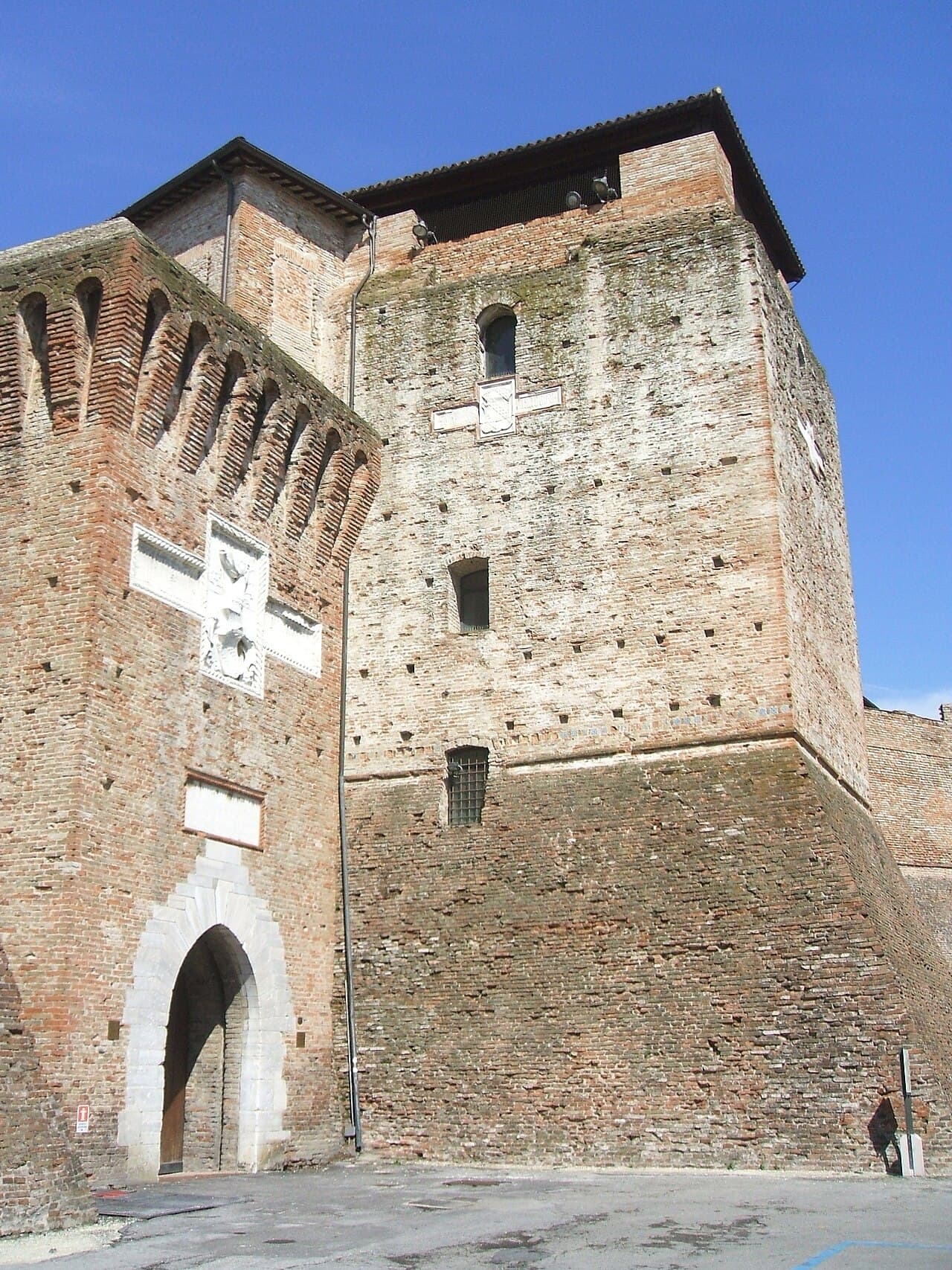
The city entrance through the castle is marked by a Gothic pointed arch made of marble blocks. Above the portal, a Latin inscription dedicates the castle to Sigismondo Malatesta with the date 1446. Heraldic emblems such as a checkered shield, an elephant crest, and a four-petaled rose—symbols of the Malatesta family—flank the gate. Similar Renaissance architectural details and inscriptions adorn the Isotta wing and the fourth tower.
The castle’s exterior was once richly decorated with multicolored plaster in red, white, and green, reflecting Malatesta heraldry. Historical documents and 15th-century frescoes by Piero della Francesca confirm this vivid color scheme. Traces of red paint remain on the gate tower corbels. Decorative bands of glazed maiolica tiles featuring the Malatesta four-petaled rose run along bastion walls and above towers, while carved family coats of arms crown the tower tops.
Underground passages and defensive traps
Below the surface, the castle contains underground passages wide enough for horses, facilitating rapid movement within and outside the fortress. Historical records mention defensive traps such as pits lined with sharpened iron spikes hidden beneath wooden panels, allegedly used by Sigismondo’s successor, Pandolfo IV, to deter intruders.
Architectural significance and military innovation
Castel Sismondo’s architectural and defensive features anticipate later innovations in military fortification design, such as the star-shaped fortresses theorized by Francesco di Giorgio Martini. The outward-projecting towers, polygonal bastions, and thick scarps illustrate mid-15th-century responses to evolving artillery threats. The castle blends Gothic and early Renaissance styles, combining aesthetic refinement with practical military engineering.
Today, Castel Sismondo remains a well-preserved Renaissance hill castle embodying centuries of Italian history, military architecture, and cultural heritage. Its integration into the Fellini Museum complex ensures ongoing public engagement with this iconic landmark, making it a must-visit destination for those interested in medieval and Renaissance fortifications, Malatesta history, and Italian art and culture.
Frequently asked questions (FAQ)
- What is Castel Sismondo?
- Castel Sismondo is a historic fortress located in Rimini, Italy, built by the Malatesta family in the 15th century. It is known for its impressive architecture and strategic significance during its time as a defensive stronghold. Today, it serves as a cultural venue and a symbol of Rimini's rich history.
- When was Castel Sismondo built?
- Construction of Castel Sismondo began in 1437 and was completed in 1446. The castle was designed by the renowned architect and military engineer, Francesco di Giorgio Martini, reflecting the military architecture of the Renaissance period. Its establishment marked a significant period in the Malatesta family's rule over Rimini.
- What are the opening hours for Castel Sismondo?
- Castel Sismondo is typically open to visitors from Tuesday to Sunday, with varying hours depending on the season. During peak tourist seasons, the castle may extend its hours to accommodate more visitors. It is advisable to check the official website for the most current opening times before planning your visit.
- Can I purchase tickets in advance for Castel Sismondo?
- Yes, tickets for Castel Sismondo can be purchased in advance through the official website or at local ticket offices. Buying tickets ahead of time is recommended, especially during the busy tourist season, to ensure you have a spot and avoid long lines. Group discounts may also be available.
- Is Castel Sismondo accessible for visitors with disabilities?
- Castel Sismondo strives to be accessible to all visitors, including those with disabilities. The castle features ramps and designated pathways to facilitate movement within the premises. However, it is advisable to contact the staff in advance to inquire about specific accessibility arrangements.
- What is the best time to visit Castel Sismondo?
- The best time to visit Castel Sismondo is during the spring and early autumn months when the weather is mild and pleasant. These seasons are less crowded than the peak summer months, allowing for a more enjoyable experience. Additionally, various cultural events and exhibitions are often held during these times.
- Are there any nearby attractions to visit after Castel Sismondo?
- Yes, there are several nearby attractions worth exploring after visiting Castel Sismondo. Just a short walk away, you can find the Arch of Augustus, the Roman Amphitheater, and the beautiful beaches of Rimini. These sites offer rich historical context and leisure activities, making for a full day of exploration.
- Why is Castel Sismondo significant in history?
- Castel Sismondo is significant as it represents the political and military power of the Malatesta family during the Renaissance. The castle served not only as a fortress but also as a symbol of the family's influence in the region. Its architectural design reflects the advancements in military technology and aesthetics of the period.
Photo gallery

Information
Sources & official resources
Verify the information above using these authoritative references.
Loading map...
Visitor reviews
No reviews yet. Been here? Write the first review and help other travelers!
Write the first reviewVisited this castle? Share your experience
Your review helps other travelers and adds first-hand knowledge to our encyclopedia.