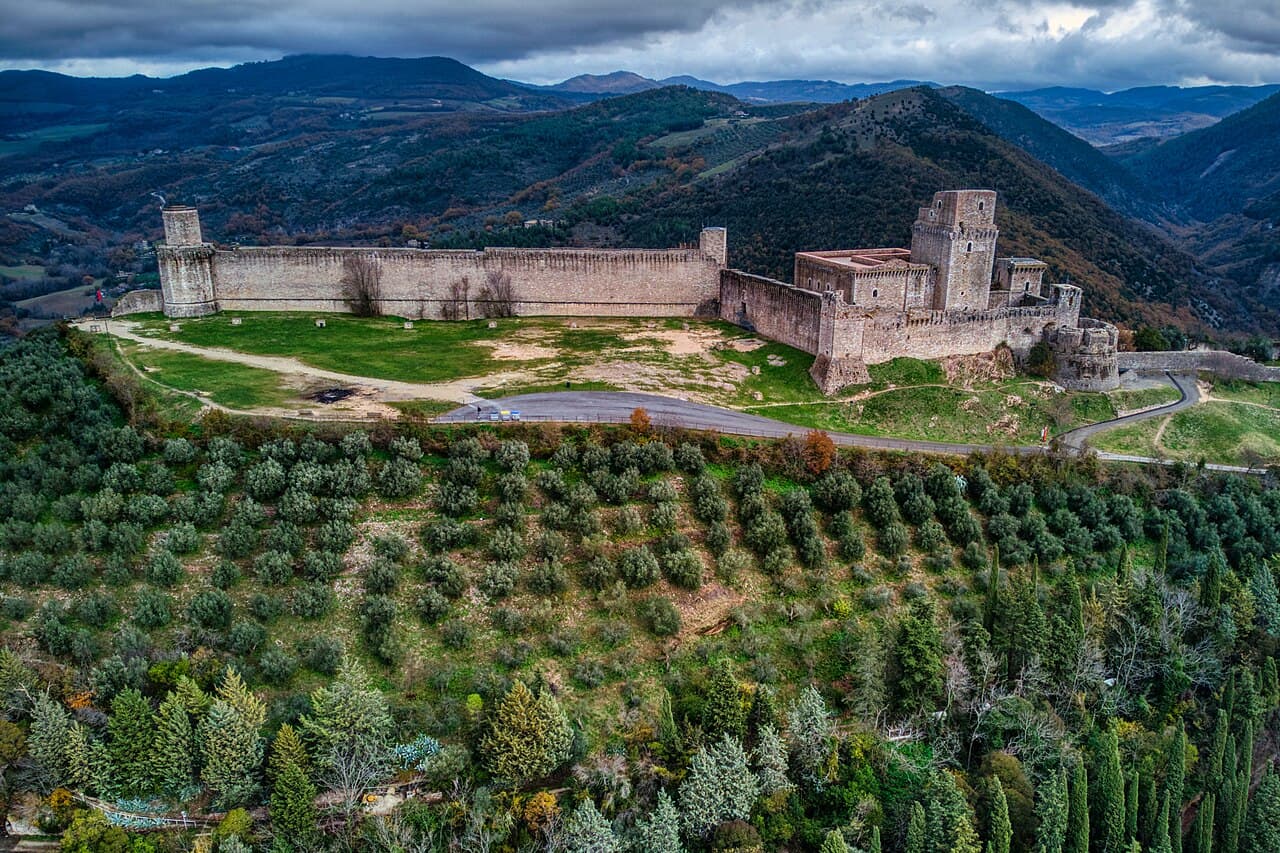
Rocca Maggiore
Rocca Maggiore is a commanding hill castle that has dominated the skyline of Assisi and the surrounding Tescio valley for over eight centuries. This fortress stands as a monumental example of medieval military architecture in the region of Umbria, Italy. Its strategic location atop a rocky spur provided a formidable defensive position controlling the approaches to the city and the valley below.
The origins of Rocca Maggiore date back to the 12th century, with the earliest documented mention in 1173 when it was occupied by Christian of Mainz, an archbishop and imperial diplomat acting on behalf of Emperor Frederick I Barbarossa. The fortress briefly hosted the emperor himself, underscoring its importance within the Holy Roman Empire's network of fortifications.
Historical significance and early history
During the early High Medieval period, the fortress served not only as a military stronghold but also as a residence for notable figures. Most famously, it was the childhood home of Frederick II, future King of Sicily and Holy Roman Emperor. Under the guardianship of the Duchess of Urslingen, Frederick II spent his formative years at Rocca Maggiore. His baptism at the nearby Cathedral of San Rufino and his family's ties to Assisi highlight the fortress's political and dynastic significance.
In 1198, the political landscape shifted as Assisi aligned with the Guelph faction supporting the papacy under Pope Innocent III. This allegiance led to the expulsion of imperial forces and the young Frederick II, resulting in damage to the fortress during the upheaval. The fortress's fortunes were closely tied to the turbulent conflicts between imperial and papal powers that characterized medieval Italy.
Architectural evolution and fortifications
The fortress underwent significant transformations from the 14th to the 16th centuries, reflecting advances in military architecture and the changing needs of its occupants. In 1316, the Porta Perlici was constructed, providing a fortified gateway to the complex. The fortress walls, built from distinctive pink limestone quarried from Mount Subasio, remain largely intact, showcasing the durability and craftsmanship of medieval builders.
Cardinal Egidio Albornoz, acting under Pope Innocent VI during the Avignon Papacy, orchestrated a major rebuilding of the fortress in 1356. This reconstruction reinforced the defensive capabilities of Rocca Maggiore and linked it physically to the smaller Rocca Minore, also known as the Keep of St. Anthony, built in 1360 to guard the mountain side.
Further enhancements were made in 1458 by Jacopo Piccinino, captain of Perugia and lord of Assisi, who added a polygonal tower on the northwest side. This tower was later completed by Pope Pius II and connected to the fortress walls by a fortified corridor, improving the fortress's defensive coverage.
In 1478, under the direction of Pope Sixtus V, the square structure supporting the central keep, or mastio, was reinforced. The entrance was fortified further in 1535 with a round bastion commissioned by Pope Paul III, reflecting the evolving military architecture of the Renaissance period.
Layout and structural features
The fortress is characterized by its trapezoidal walls enclosing a large courtyard. The central keep is divided into four rooms accessible via a spiral staircase, allowing defenders to move efficiently between levels. Towers at each corner provide overlapping fields of fire, a common medieval defensive strategy.
The connection to Rocca Minore by 14th-century walls created a comprehensive defensive system guarding both the city and the mountainous approaches. The smaller fortress served as an outpost to monitor and repel attacks from the mountain side.
Cultural importance and modern recognition
Beyond its military role, Rocca Maggiore has gained cultural significance in recent decades. In 1972, the fortress served as a filming location for the movie "Brother Sun, Sister Moon," highlighting its evocative medieval atmosphere.
The site is also recognized as a "Living Monument" due to its role as a habitat for protected species such as common swifts and bats, emphasizing the intersection of cultural heritage and natural conservation.
In 1980, the Italian Post honored Rocca Maggiore by featuring it on a postage stamp as part of the "Castles of Italy" series, further cementing its status as a symbol of Italian historical architecture.
Visiting rocaa maggiore today
Visitors to Assisi can reach Rocca Maggiore on foot via the Porta Perlici, a medieval gate constructed in 1316. The fortress offers panoramic views of Assisi and the surrounding valley, making it a popular destination for history enthusiasts and tourists alike.
The well-preserved walls and towers provide insight into medieval defensive strategies and architectural techniques. Visitors can explore the courtyard, the keep, and the polygonal tower, gaining a tangible sense of the fortress's historical importance.
While the fortress lacks decorative inscriptions or mosaics, its austere and robust design speaks to its primary function as a military stronghold. The site stands as a testament to the region's turbulent history and the enduring legacy of medieval fortifications in Italy.
Frequently asked questions (FAQ)
- How do I get to Rocca Maggiore?
- Rocca Maggiore is located in Assisi, Italy, and can be easily reached by foot from the town center. Visitors can follow the well-marked paths that lead up the hillside, offering scenic views along the way. Public transportation options are available, though walking provides the best experience of the beautiful surroundings.
- What is the historical significance of Rocca Maggiore?
- Rocca Maggiore was built in the 14th century and served as a strategic fortress to protect the city of Assisi. It played a crucial role during various conflicts, particularly in the struggle between the Guelphs and Ghibellines. Today, it stands as a testament to the medieval architecture and history of the region.
- When was Rocca Maggiore built?
- Construction of Rocca Maggiore began in the early 14th century, specifically around the year 1365. The fortress was completed shortly thereafter and has since undergone various restorations to preserve its historical integrity. This timeline reflects the turbulent period in which Assisi was a significant player in regional politics.
- Can I enter Rocca Maggiore with my dog?
- Yes, pets are generally allowed at Rocca Maggiore, but they must be kept on a leash at all times. It’s recommended to check specific regulations upon arrival, as some areas may have restrictions. Bringing your dog can enhance your visit as you explore the beautiful grounds together.
- Why is Rocca Maggiore a popular tourist attraction?
- Rocca Maggiore is popular due to its impressive architecture, panoramic views of the Umbrian countryside, and rich history. Visitors are drawn to its well-preserved structures and the opportunity to learn about the medieval era. Additionally, the scenic surroundings make it a perfect spot for photography and leisurely exploration.
- Is it possible to host events at Rocca Maggiore?
- Yes, Rocca Maggiore can be rented for special events such as weddings, corporate gatherings, and cultural activities. The unique setting offers a memorable backdrop that combines history with breathtaking views. It’s advisable to contact the management in advance to discuss availability and arrangements.
- What are the opening hours of Rocca Maggiore?
- Rocca Maggiore is typically open to visitors from 9:00 AM to 6:00 PM, but hours may vary by season. It’s best to check the official website or contact the visitor center for the most current information before planning your visit. Extended hours may be available during peak tourist seasons.
- What is the ticket price for Rocca Maggiore?
- The entrance fee for Rocca Maggiore is generally modest, with discounts available for children, students, and seniors. Tickets can usually be purchased on-site or in advance online. Prices may vary depending on special events or exhibitions, so it’s wise to verify before your visit.
- What nearby attractions should I visit while in Assisi?
- While in Assisi, don't miss the Basilica of San Francesco, a UNESCO World Heritage site known for its stunning frescoes. Other nearby attractions include the Eremo delle Carceri, a serene retreat in the forests, and the beautiful Piazza del Comune. Each site offers a unique glimpse into the rich history and culture of this charming town.
Photo gallery

Information
Website
Visit websiteSources & official resources
Verify the information above using these authoritative references.
Loading map...
Visitor reviews
No reviews yet. Been here? Write the first review and help other travelers!
Write the first reviewVisited this castle? Share your experience
Your review helps other travelers and adds first-hand knowledge to our encyclopedia.



