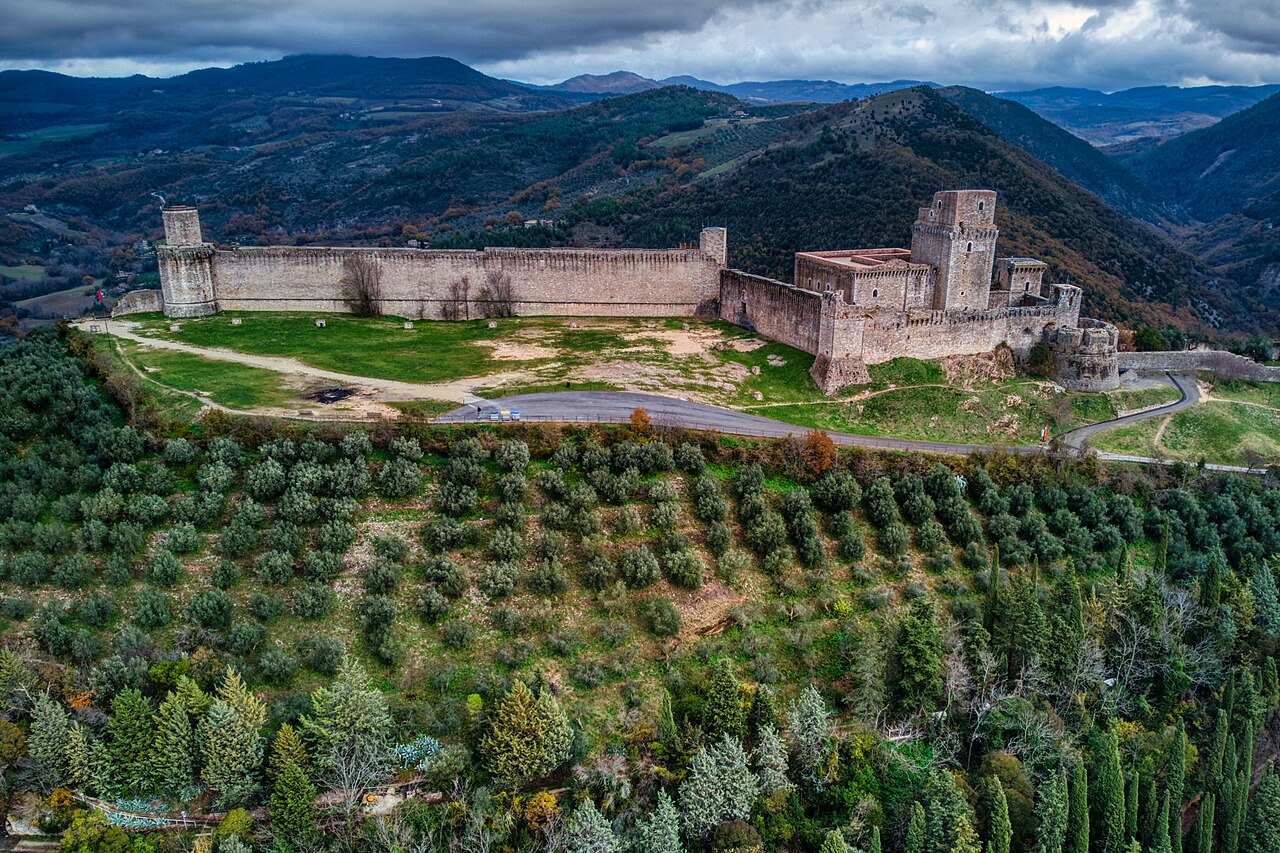
Castello di Rosciano
The Castello di Rosciano stands as a significant historical site nestled in the municipality of Torgiano, Italy. This hill castle is uniquely positioned atop an ancient settlement that dates back to the Etruscan and Roman civilizations, reflecting a deep and layered history spanning millennia. The castle's site was known by various names over time, including Russanum, Rescanum, Recsano, and Rusciano, each name marking different phases of its extensive past.
Early history and medieval origins
The origins of Castello di Rosciano are closely intertwined with the ancient settlements that preceded it. The location was originally inhabited during the Etruscan period, followed by Roman occupation, indicating its strategic and cultural importance in the region. The castle itself was constructed during the early medieval period, with the first documented mention appearing on February 18, 1038. On this date, Emperor Conrad II confirmed the ownership of several properties, including the church of Sant’Angelo in Rusciano, which was part of the territory governed by Assisi.
Destruction and fortification in the early medieval era
In the year 548, the castle suffered significant destruction at the hands of Totila, the Ostrogothic king during the Gothic Wars. Despite this early devastation, the site was rebuilt and fortified extensively during the Middle Ages. By this time, the castle was renowned for its strong defensive capabilities, often described as impregnable. Though detailed architectural records are scarce, the fortifications likely included thick defensive walls and other typical medieval military features designed to withstand sieges.
Political and religious significance in the high and late medieval periods
During the 13th century, Castello di Rosciano played a pivotal role in both regional ecclesiastical and political affairs. In 1266, the relics of Saint Crispolto were transferred from the Passaggio Abbey of Bettona to Rosciano, underscoring the castle’s importance as a religious center. This period also saw heightened tensions with the nearby city of Perugia, which constructed the castle of Torgiano in 1274 to assert military control over the territory of Bettona. These rivalries culminated in violent clashes between the inhabitants of Rosciano and Torgiano, notably in September 1277.
Shifts in ownership and military conflict
The castle's ownership changed hands multiple times in the late medieval era. Emperor Frederick II granted it to the Scifi counts of Sassorosso, and subsequently, it came under the influence of noble families such as the Tancredi, Signorelli, Graziani, Baglioni, and Ansidei. In 1378, Pope Urban VI confirmed Perugia’s jurisdiction over Rosciano for twenty years, although the local lord Tello resisted this authority. The resistance ended in 1383 when Tello surrendered to Guglielmo di Carlo Fiumi, the gonfaloniere of Assisi. However, the following year, despite a papal grant from Pope Boniface IX restoring the castle to Tello, Perugian forces captured and destroyed it down to its foundations in 1384.
Religious heritage and the church of sant’angelo
Alongside its military history, the site maintained a strong religious presence. The church of Sant’Angelo in Rosciano served as a Camaldolese priory from the 13th century until 1521, operating under the direct authority of the Sansepolcro Abbey. This connection emphasizes the enduring spiritual significance of the area, even as the castle’s military role diminished. While specific architectural details of the church are not extensively documented, its function as a religious institution highlights the dual nature of the site as both a fortress and a center of faith.
Architectural features and current remains
The original Castello di Rosciano was constructed with typical medieval military architecture, including strong defensive walls and likely towers and other fortifications that rendered it nearly impregnable during its peak. Unfortunately, detailed descriptions or plans of the castle’s layout are not preserved. The complete destruction by Perugian forces in 1384 left only the foundational remains visible today.
These archaeological remains provide valuable insight into the castle’s footprint and the historical layers beneath it, including the earlier Etruscan and Roman settlements. No standing walls or towers survive, but the base foundations mark the location of what was once a formidable fortress.
Nearby, the church of Sant’Angelo remains a testament to the site's religious heritage, continuing to symbolize the historical importance of Castello di Rosciano beyond its military function.
Cultural and historical significance
Today, the Castello di Rosciano is recognized for its archaeological and historical value, representing a site where ancient civilizations and medieval fortifications intersect. Its layered history from Etruscan origins through medieval conflicts to its eventual ruin offers a compelling narrative of the region’s turbulent past.
As a hill castle with a rich religious and military legacy, it attracts scholars and visitors interested in medieval architecture, Italian history, and archaeological heritage. The castle’s story reflects broader themes of power struggles, religious influence, and the evolution of fortification techniques in central Italy.
Visiting and preservation
While the castle itself exists today only as ruins, the site remains accessible for historical exploration and archaeological study. The preservation of the foundational remains alongside the church of Sant’Angelo offers visitors a tangible connection to the past. Efforts to maintain the site focus on protecting its archaeological integrity and promoting awareness of its significance within the Umbria region.
Frequently asked questions (FAQ)
- When was Castello di Rosciano originally built?
- Castello di Rosciano was constructed during the early medieval period, with the first official record dating back to 1038.
- What caused the destruction of Castello di Rosciano?
- The castle was destroyed in 1384 by Perugian forces who captured and demolished it down to its foundations.
- What is the significance of the church of Sant’Angelo near the castle?
- The church of Sant’Angelo served as a Camaldolese priory from the 13th century until 1521, highlighting the site's religious importance.
- Can visitors see any remains of the castle today?
- Today, only the foundational remains of Castello di Rosciano survive, marking the footprint of the former fortress.
- What historical events involved Castello di Rosciano in the 13th century?
- In the 13th century, the castle was involved in regional conflicts and religious events, including the transfer of Saint Crispolto's relics and clashes with nearby Torgiano.
Information
Website
Visit websiteSources & official resources
Verify the information above using these authoritative references.
Loading map...
Visitor reviews
No reviews yet. Been here? Write the first review and help other travelers!
Write the first reviewVisited this castle? Share your experience
Your review helps other travelers and adds first-hand knowledge to our encyclopedia.