Castello di Monterone
Castello di Monterone stands as a remarkable example of a historic hill castle nestled on a strategic ridge overlooking the valley connecting Perugia and Assisi in central Italy. This fortress embodies a deep historical layering, with archaeological evidence tracing human activity at the site back to the 3rd century BCE. Its commanding position along an ancient route made it a vital defensive and religious hub throughout the medieval period and beyond.
The castle’s origins are firmly rooted in the 13th century, a time marked by political strife between regional powers, notably Perugia and Assisi. Early records cite local lords such as Gerardo di Ugolino di Alberico and Gerardo di Ghislerio, who played significant roles in the castle’s early history and its alignment with Perugian interests. Local tradition intriguingly suggests that the young Francis of Assisi may have been detained within its walls following the 1202 Battle of Collestrada, highlighting the castle’s involvement in regional conflicts.
Archaeological significance and early history
The site of Castello di Monterone reveals a rich archaeological tapestry. Excavations have uncovered funerary urns typical of the Etruscan city of Chiusi and bronze mirrors decorated with mythological scenes, underscoring the area's importance from antiquity. These artifacts indicate continuous occupation and cultural significance long before the castle’s medieval construction, illustrating the site's role in connecting ancient civilizations to later historic developments.
Medieval role and templar connections
During the mid-13th century, the castle likely functioned as a hospice for pilgrims, possibly managed by the Knights Templar associated with the nearby San Bevignate monastery. Historical texts and local lore mention underground passages linking the castle to San Bevignate, reflecting a network of religious and defensive sites. The suppression of the Templar order in 1312 led to the castle's abandonment, mirroring the fate of many Templar properties.
Military significance and later history
From the 14th to 16th centuries, Castello di Monterone served as a critical watchtower guarding access routes to Perugia. Its strategic importance made it a target during regional conflicts, suffering damage from notable condottieri such as Braccio da Montone in 1416 and Malatesta Baglioni in 1582. The castle’s military role diminished over time, transitioning into a suburban villa by the late 18th century under the ownership of the Counts Ansidei.
19th-century restoration and cultural revival
The 19th century marked a significant period of restoration and cultural enrichment under the Piceller family. Giuseppe Piceller contributed to Perugia’s cultural life, while Bernardino Piceller was recognized for his work in historical and sacred art. Alessandro Piceller spearheaded an ambitious restoration, introducing romantic architectural elements uncommon in the region. Architects Filippo Lardoni and Alessandro Arienti oversaw the renovations, which included the addition of a chapel consecrated in 1849 by Vincenzo Gioacchino Pecci, later Pope Leo XIII.
Architectural features and decorations
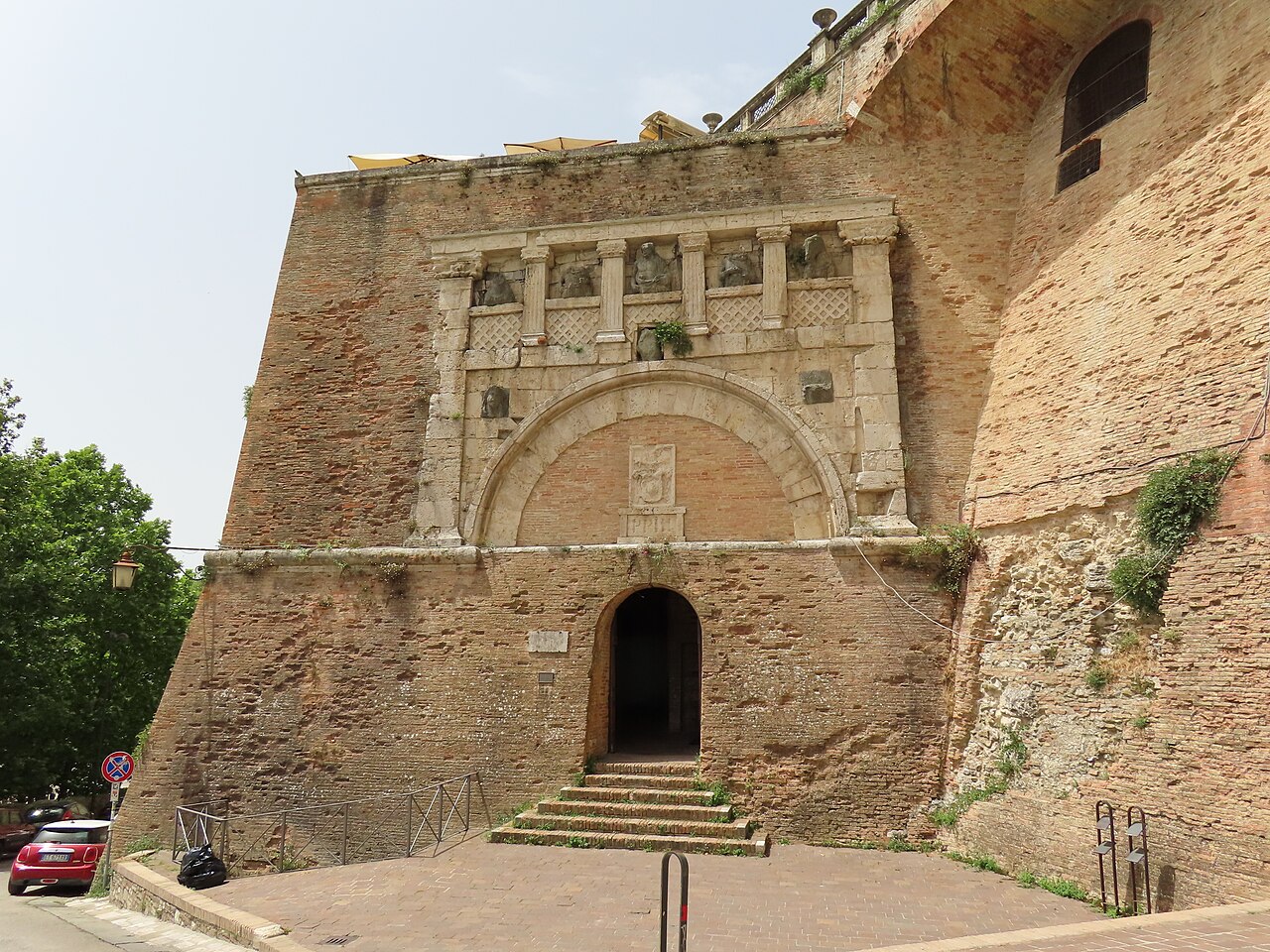
The castle’s architecture showcases a blend of materials, including local sandstone, pietra serena, and brick, arranged in alternating bands of pink and white stone. This eclectic mix was enhanced during the 19th-century restoration, giving the castle a distinctive appearance. The courtyard is enclosed by round columns with marble capitals collected during archaeological excavations, alongside Etruscan urns and bas-reliefs that connect the site’s ancient past with its medieval heritage.
Interior decorations include frescoes by Matteo Tassi, depicting the valor of condottieri, and a detached fresco attributed to Cristoforo di Jacopo da Foligno portraying the Madonna of Loreto with Saints Peter and Paul. A notable epigraphic fragment in uncial Latin script from the early 1400s commemorates the condottiero Fortebraccio, emphasizing the castle’s military and political legacy.
Damage, restoration, and modern status
Castello di Monterone suffered severe damage during World War II from bombings and military occupation, leading to a period of disuse. Post-war restoration efforts led by Professor Antonini Giuliano and later Professor Orlando Scalco, supported by a prominent Umbrian family, have restored much of the castle’s historical character. Today, it stands as a well-preserved monument reflecting centuries of layered history, from ancient times through medieval and modern transformations.
Underground tunnels and local legends
Oral traditions speak of subterranean tunnels linking the castle with the Church of San Bevignate, suggesting a network used for discreet movement and protection. While physical evidence of these passages remains elusive, their mention highlights the castle’s integration into a broader medieval defensive and religious landscape.
Cultural and heritage significance
Castello di Monterone is not only a symbol of military and religious history but also a testament to the cultural revival efforts of the 19th century and the enduring legacy of the Piceller family. Its rich archaeological finds, architectural diversity, and artistic treasures make it a significant heritage site within the Umbria region, attracting scholars and visitors interested in medieval fortifications and Italian history.
Frequently asked questions (FAQ)
- How do I get to Castello di Monterone?
- Castello di Monterone is located just a few kilometers from the center of Perugia, Italy. You can reach it by car, and there is parking available nearby, or you can take a local bus that stops close to the castle.
- What is the historical significance of Castello di Monterone?
- Castello di Monterone dates back to the 13th century and played a vital role in the defense of Perugia. It has witnessed numerous historical events and serves as a reminder of the medieval architecture and feudal system of the time.
- When was Castello di Monterone built?
- The construction of Castello di Monterone began in the early 1200s and was completed in the 14th century. It was primarily built for defensive purposes and has since undergone various renovations while retaining much of its original charm.
- Can I visit Castello di Monterone?
- Yes, Castello di Monterone is open to visitors, and guided tours are available. It’s advisable to check the castle's official website for specific visiting hours and any special events that may be taking place.
- Why is Castello di Monterone popular among tourists?
- Castello di Monterone is popular not only for its rich history but also for its stunning views of the Umbrian countryside. Visitors are drawn to its beautiful architecture and the opportunity to explore the well-preserved castle grounds.
- Is it possible to host events at Castello di Monterone?
- Yes, Castello di Monterone offers event spaces that can be rented for weddings, corporate events, and private functions. Its picturesque setting makes it a sought-after location for memorable gatherings.
- What are the opening hours for Castello di Monterone?
- The opening hours for Castello di Monterone vary by season, typically welcoming visitors from 9 AM to 6 PM. It's recommended to verify the hours on their official website before your visit.
- What are the ticket prices for visiting Castello di Monterone?
- Ticket prices for Castello di Monterone are generally reasonable, with discounts available for students and seniors. Children under a certain age may enter for free, but it's best to check the official website for the most current pricing information.
- What are some nearby attractions to Castello di Monterone?
- Nearby attractions include the historic center of Perugia, the beautiful Etruscan Arch, and the renowned Palazzo dei Priori. Visitors can enjoy exploring these sites which are easily accessible from the castle.
Information
Website
Visit websiteSources & official resources
Verify the information above using these authoritative references.
Loading map...
Visitor reviews
No reviews yet. Been here? Write the first review and help other travelers!
Write the first reviewVisited this castle? Share your experience
Your review helps other travelers and adds first-hand knowledge to our encyclopedia.