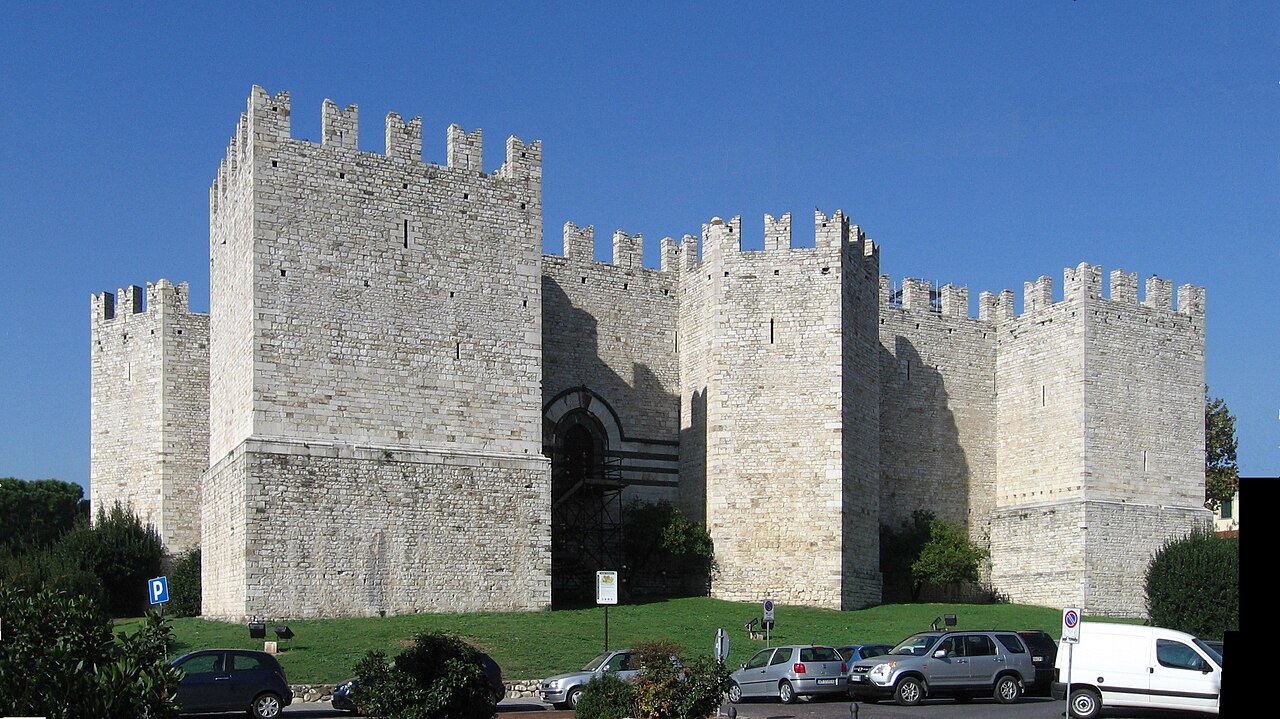
Rocca di Cerbaia
The Rocca di Cerbaia stands as a significant medieval fortress nestled in the municipality of Cantagallo, in the heart of Tuscany, Italy. Constructed in the early 12th century by the feudal Alberti family, this castle was strategically positioned to guard the crucial regional route known as the strada di Lombardia, which historically connected central Italy with Lombardy. Its location atop a hill provided commanding views of the surrounding landscape, essential for both defense and control of trade and military movements.
By 1164, the fortress was officially granted to the Alberti counts by Emperor Frederick Barbarossa, cementing its role as both a noble residence and a military stronghold. This imperial recognition underscored the fortress's importance in the feudal power structures of medieval Italy. Throughout the 13th century, the Rocca di Cerbaia became a focal point in the turbulent struggles between the Alberti lords and the rising civic power of the nearby town of Prato. These conflicts mirrored broader tensions between feudal authorities and the emergent communal governments that characterized much of medieval Italian political life.
Historical significance and notable figures
The fortress is steeped in personal and cultural history. It was here that Adelaide degli Alberti met her husband Ezzelino II da Romano, a notable figure of the period. Their daughter, Cunizza da Romano, who is immortalized by Dante Alighieri in his Paradiso, spent her later years at Cerbaia. Cunizza made her will in 1278 at the fortress and is believed to have been buried in a cemetery adjacent to the castle grounds, linking the site to the literary and historical heritage of medieval Italy.
In 1361, the last Alberti count, Niccolò Aghinolfo, sold the fortress to the city of Florence. Recognizing its strategic importance, Florence undertook significant fortifications and maintained a military garrison there well into the 15th century. This period marked a transition from feudal lordship to civic control, reflecting the expanding influence of Florence in the region. Subsequently, the fortress evolved into a noble residence, passing into the hands of the Novellucci family in the 17th century and later the Eldmann family in the 19th century.
At the end of the 20th century, the local municipality acquired the fortress, initiating restoration and preservation efforts to safeguard its cultural and historical legacy for future generations.
Dante alighieri and cultural legends
The Rocca di Cerbaia is also intertwined with the life and works of Dante Alighieri. The poet references the fortress in both his Inferno and Purgatorio, particularly highlighting the violent deeds of some members of the Alberti family. A Florentine legend from the 15th century recounts an episode from 1285 when Dante, caught in a severe snowstorm, sought shelter at the Rocca but was refused by the Alberti counts. Forced to find refuge in a humble shepherd’s hut at the base of the fortress, this hut remains in ruins today, serving as a poignant reminder of the castle's storied past.
Architectural features and layout
The Rocca di Cerbaia is primarily constructed from local sandstone, laid in regular horizontal courses in a technique known as filaretto. This method gives the fortress a distinctive sturdy and orderly appearance, characteristic of medieval military architecture in the region. The fortress's design includes two concentric defensive walls that encircle the central keep, or mastio, creating layered defense mechanisms.
Outer circuit and religious structures
The outer, larger circuit encompasses the remains of a small medieval oratory with characteristic apses, indicating the presence of religious practices within the fortress walls. This oratory would have served the spiritual needs of the inhabitants and garrison, reflecting the integration of faith and daily life in medieval fortifications.
Inner defenses and essential facilities
The inner ring of walls encloses several service rooms and a covered cistern with a barrel-vaulted ceiling. This cistern was a vital feature designed to store water, ensuring the fortress could withstand prolonged sieges. The presence of such infrastructure highlights the strategic planning behind the fortress's construction, balancing defense with sustainability.
The central keep or mastio
At the heart of the complex stands the massive pentagonal tower, which served as the main watchtower or keep. Although much of this central structure has collapsed, architectural studies suggest that the keep was reconstructed in the latter half of the 13th century. Its design drew inspiration from the Emperor’s Castle in Prato, featuring similar stylistic elements such as narrow arrow slits and windows optimized for defense and surveillance.
Surrounding features and access
Below the fortress lies the Ponte di Cerbaia, a historic bridge that likely served as a vital access point across the surrounding terrain. This connection would have been crucial for trade, military movements, and communication, linking the fortress to the wider region.
Together, these architectural and historical elements illustrate the Rocca di Cerbaia’s evolution from a feudal military bastion to a noble residence. Its surviving features provide valuable insights into medieval military architecture, feudal politics, and the cultural history of Tuscany.
Preservation and current status
Today, the Rocca di Cerbaia stands as a partially preserved medieval fortress, with ongoing restoration efforts led by the local municipality. These initiatives aim to protect the site’s historical fabric while making it accessible to visitors interested in exploring Tuscany’s rich medieval heritage. The fortress remains an important cultural landmark, attracting historians, architects, and tourists alike.
Visiting information and tourism
Visitors to the Rocca di Cerbaia can explore its rugged ruins and appreciate the strategic design that once made it a formidable stronghold. The site offers a unique glimpse into medieval life and architecture, set against the scenic backdrop of the Tuscan hills. While some areas are in ruins, the fortress’s layout and remaining structures convey the complexity and significance of this historic site.
Frequently asked questions (FAQ)
- How do I get to Rocca di Cerbaia?
- Rocca di Cerbaia is located in Cantagallo, Tuscany. Visitors can reach it by car or local transport from nearby cities such as Prato or Florence. The site is accessible via local roads leading to the hilltop.
- What is the historical significance of Rocca di Cerbaia?
- Rocca di Cerbaia played a crucial role in medieval Tuscany as a defensive fortress and noble residence. It was built by the Alberti family in the 12th century and later controlled by Florence, reflecting the region's feudal and civic power struggles.
- Can I visit the interior of the fortress?
- While much of Rocca di Cerbaia is in ruins, visitors can explore the outer walls, remains of the oratory, cistern, and the base of the central keep. Some areas may be restricted for safety reasons, so guided tours are recommended.
- When is the best time to visit Rocca di Cerbaia?
- The best time to visit is during the spring and autumn months when the weather is mild and the Tuscan landscape is particularly beautiful. Summer can be hot, and winter may be less accessible due to weather conditions.
- Are there any notable legends associated with Rocca di Cerbaia?
- Yes, a famous Florentine legend tells of Dante Alighieri being refused shelter at the fortress during a snowstorm in 1285. He found refuge in a shepherd’s hut at the base of the castle, which remains a historical point of interest.
Information
Sources & official resources
Verify the information above using these authoritative references.
Loading map...
Visitor reviews
No reviews yet. Been here? Write the first review and help other travelers!
Write the first reviewVisited this castle? Share your experience
Your review helps other travelers and adds first-hand knowledge to our encyclopedia.