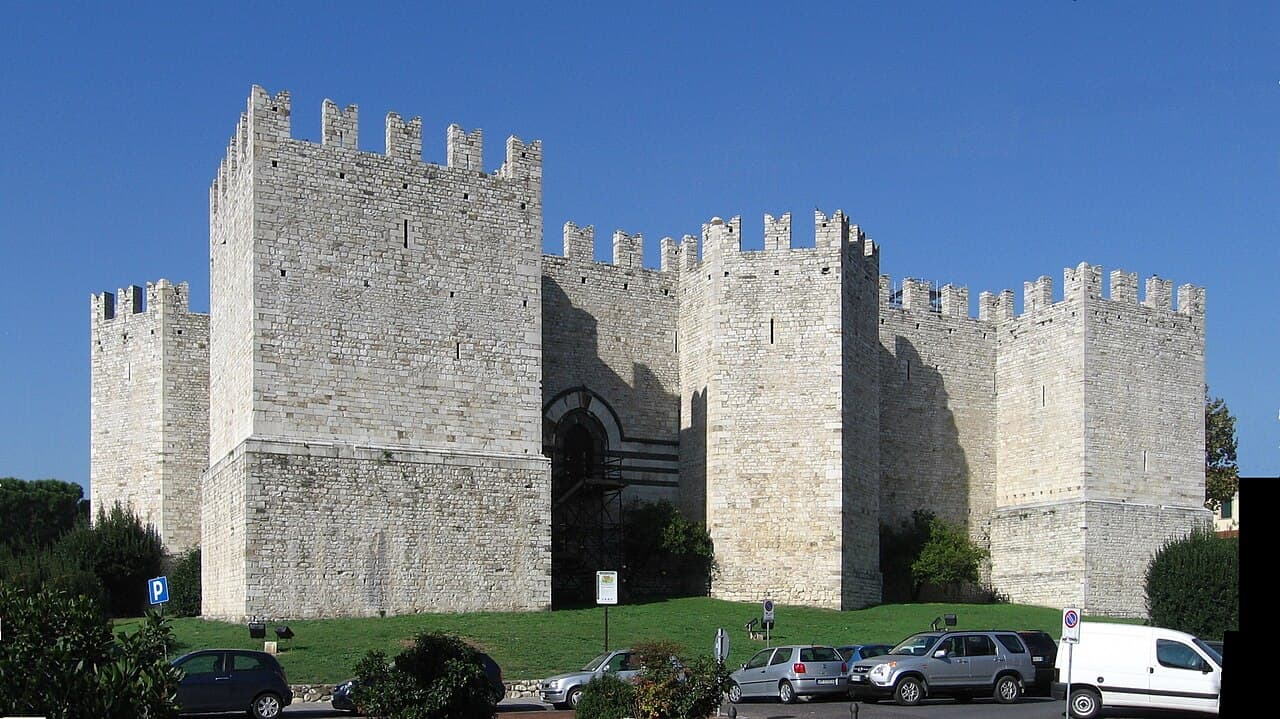
Castello dell'Imperatore
Castello dell'Imperatore stands as a remarkable example of High Medieval military architecture in the heart of Prato, Tuscany. Constructed in the 13th century under the directive of the Holy Roman Emperor Frederick II of Swabia, this imposing hill castle was designed to assert imperial authority in northern Tuscany and to serve as a strategic garrison. The castle's commanding position atop a hill allowed for extensive surveillance over the surrounding landscape and the city below.
The castle was built on the site of an earlier fortification, remnants of which remain visible today in the form of two towers integrated into the current structure. These earlier fortifications trace back to a palatium mentioned in documents from 1035, central to the early settlement of Castrum Prati. This original fortress belonged to the Alberti family until its near destruction in 1107 during a siege by forces loyal to the powerful noblewoman Matilda of Canossa. The surviving towers from the subsequent Palazzolo fortress were incorporated into the design of the new imperial castle.
Historical context and construction
Between approximately 1240 and 1247, Emperor Frederick II commissioned the construction of the castle to establish a permanent and visible symbol of imperial power in the region. The project was overseen by the architect Riccardo da Lentini, who implemented a design featuring crenellated stone walls and eight defensive towers. The castle was originally connected to Prato’s second set of city walls from the 12th century and was partially surrounded by a moat, enhancing its defensive capabilities.
Work on the castle's interior ceased abruptly around 1250 following Frederick II's death, leaving several parts unfinished. Despite this, the external fortifications were largely completed, providing a formidable stronghold. The castle's design includes a camminamento di ronda, a battlement walkway accessible via spiral staircases within the corner towers, allowing defenders to patrol the perimeter and maintain vigilance.
Evolution through the centuries
In the 14th century, after Prato fell under the control of Florence, the castle's military role evolved. It was linked to the city’s third defensive walls by the Corridore del Cassero, a covered passageway enabling secure troop movements between the castle and the urban defenses during sieges or conflicts. Although much of this corridor was demolished in the 20th century due to urban development, two segments remain as a testament to its historical function.
Over time, residential buildings were constructed within the castle's enclosure. These were removed in the 1930s during restoration efforts under the Italian fascist regime, which aimed to return the castle to its original external appearance. The construction of the nearby Viale Piave also led to the partial demolition of the Cassero corridor, further altering the castle’s immediate surroundings.
Architectural features and remains
The castle is characterized by its tall crenellated walls and eight towers, some of which incorporate the remains of earlier medieval structures. Originally, these towers were approximately twice as high as they stand today, indicating significant reduction over the centuries. The moat and defensive walls emphasize the castle’s role as a fortress designed for both defense and control.
The camminamento di ronda remains a key architectural feature, offering visitors panoramic views over Prato and the surrounding Tuscan countryside. The spiral staircases embedded in the towers highlight the castle’s thoughtful defensive design, enabling rapid movement of guards along the battlements.
Nearby medieval structures
Behind the castle lie the ruins of a 12th-century hospital and the church of San Giovanni Gerosolimitano, associated with the Knights of Malta. These buildings are notable for their rare Romanesque terracotta decorations shaped in anthropomorphic forms, which are significant examples of medieval art in Tuscany. Although no longer in use, these ruins contribute to the historical richness of the castle complex.
Modern history and restoration
During World War II, the castle was used by fascist forces as a prison for local citizens arrested during strikes. Later in 1944, following occupation by partisan forces, the castle was the site of the Eccidio del Castello dell'Imperatore, a grim episode in which fascists and suspected collaborators were executed within its grounds.
Restoration efforts in the 1970s focused on preserving the castle’s external walls and the nearby medieval ruins, allowing the site to be opened to the public. Today, Castello dell'Imperatore serves as a cultural venue hosting exhibitions and events, while its well-preserved fortifications offer insight into medieval military architecture and the historical legacy of Frederick II’s reign.
The castle remains a prominent landmark in Prato, attracting visitors interested in medieval history, military architecture, and Tuscan heritage. Its combination of historical significance, architectural grandeur, and panoramic views makes it a key site for understanding the region’s medieval past.
Frequently asked questions (FAQ)
- How do I get to Castello dell'Imperatore?
- Castello dell'Imperatore is located in Prato, Italy, and can be easily reached by public transportation. You can take a train to Prato Centrale station, followed by a short walk to the castle. There is also parking available nearby for those traveling by car.
- What is the historical significance of Castello dell'Imperatore?
- Castello dell'Imperatore was built in the 13th century and served as a fortress for the Emperor Frederick II. It played a crucial role in the defense of the city and is an excellent example of medieval military architecture. The castle's history reflects the power struggles of the time and its influence on the region.
- When was Castello dell'Imperatore constructed?
- Construction of Castello dell'Imperatore began in 1235 under the orders of Frederick II and was completed in the following years. The castle was designed as a strategic stronghold and showcases the architectural innovations of the period. Its historical context adds to the richness of the visitor experience.
- Can I take guided tours of the castle?
- Yes, guided tours are available at Castello dell'Imperatore, offering visitors insights into its history and architecture. These tours are typically led by knowledgeable guides who can provide a deeper understanding of the castle's significance. It is recommended to check the official website for tour schedules and availability.
- Why is Castello dell'Imperatore a popular tourist attraction?
- Castello dell'Imperatore attracts visitors due to its stunning architecture and rich historical background. The castle offers panoramic views of the surrounding area and hosts various cultural events throughout the year. Its unique blend of history and beauty makes it a must-visit destination in Prato.
- Is it possible to visit Castello dell'Imperatore year-round?
- Yes, Castello dell'Imperatore is open to visitors throughout the year, although opening hours may vary by season. It is advisable to check the official website for the latest information on visiting hours and special events. Planning your visit in advance ensures you can make the most of your experience.
- What are the ticket prices for Castello dell'Imperatore?
- Ticket prices for Castello dell'Imperatore are generally affordable, with discounts available for students and seniors. Children under a certain age may enter for free. For the latest pricing information and any special offers, it is best to visit the official website before your visit.
- When is the best time to visit Castello dell'Imperatore?
- The best time to visit Castello dell'Imperatore is during the spring and early autumn when the weather is pleasant for exploring the grounds. These seasons also see fewer crowds compared to the summer months. If you prefer a quieter visit, aim for weekdays or visit outside of peak tourist season.
- Are there any nearby attractions to visit while at Castello dell'Imperatore?
- Yes, nearby attractions include the Prato Cathedral and the Textile Museum, both of which highlight the rich cultural heritage of the region. Visitors can enjoy a day exploring the historical center of Prato, which features charming streets and local eateries. Combining these attractions makes for a fulfilling day trip.
Photo gallery

Information
Website
Visit websiteSources & official resources
Verify the information above using these authoritative references.
Loading map...
Visitor reviews
No reviews yet. Been here? Write the first review and help other travelers!
Write the first reviewVisited this castle? Share your experience
Your review helps other travelers and adds first-hand knowledge to our encyclopedia.


