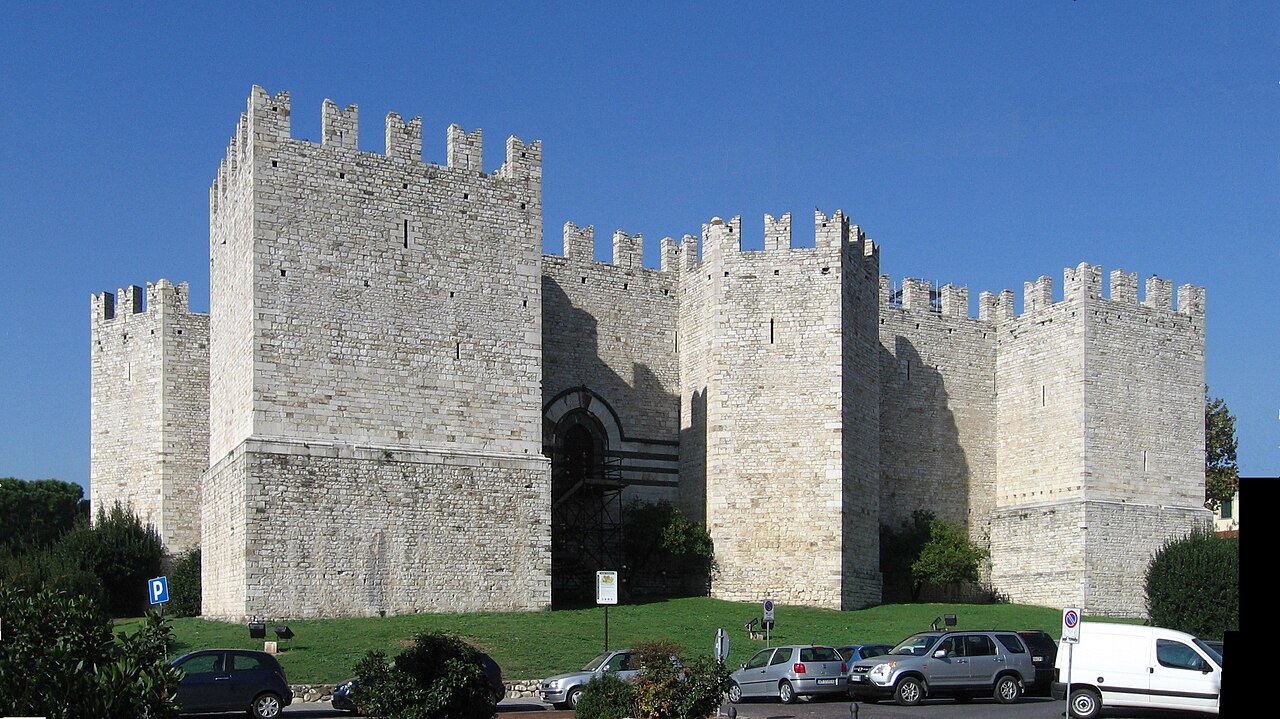
Castello di Montemurlo
The Castello di Montemurlo stands as a remarkable example of medieval military architecture that evolved into a refined residential complex over the centuries. Located in the municipality of Montemurlo, in the heart of Tuscany, Italy, this hill castle occupies a strategic position on elevated terrain, commanding sweeping views of the surrounding landscape. Its origins date back to the 10th century, when it was constructed by medieval builders primarily as a defensive fortress to control the vital routes and protect the region from incursions.
Historical significance and early ownership
Initially, the castle was under the dominion of the noble Guidi family, a prominent lineage in medieval Tuscany. The castle was part of a defensive network comprising four key fortifications that secured the Via delle Rocche, an important medieval route connecting Montemurlo with the Val di Bisenzio valley. This network was crucial for military and economic control, enabling the Guidi family to monitor movement and defend their territories effectively.
The castle's strategic importance is underscored by its role in regional conflicts and power struggles typical of medieval Tuscany. Its commanding position on a hilltop allowed defenders to observe approaching forces from a distance, providing both early warning and a strong defensive advantage.
Transition under the medici and architectural transformation
The Battle of Montemurlo in 1537 marked a turning point in the castle's history. Following the battle, control of the fief passed to the powerful Medici family, the ruling dynasty of Florence. Under Medici stewardship, the castle's military function diminished as the region stabilized politically.
During the mid-16th century, the fortress underwent a significant transformation from a military stronghold into an elegant residence. This change reflected broader Renaissance trends where fortifications were adapted for comfort and status rather than purely defensive purposes. A notable contribution during this period was made by the renowned artist and architect Giorgio Vasari, who designed a drawbridge for the castle. Although this drawbridge was later removed, it symbolized the blend of military architecture and Renaissance aesthetics.
19th-century restoration and present-day appearance
The castle experienced a comprehensive restoration in the 19th century, which largely shaped its current appearance. The renovations emphasized residential and aesthetic qualities, moving further away from its original defensive role. The restoration preserved key medieval features while integrating elements that enhanced the castle’s function as a noble residence.
Today, the Castello di Montemurlo consists of two main buildings connected to each other, one of which is organized around an internal courtyard providing a central open space. The complex is enclosed within multiple curtain walls, which served as defensive barriers. In front of these walls, well-maintained gardens create a landscaped approach, enhancing the castle’s visual appeal.
Architectural features and defensive elements
The castle’s exterior walls are constructed from robust stone masonry, characteristic of medieval fortifications designed to withstand sieges and attacks. Along the upper edges, the walls feature crenellations (also known as merlature), which are the notched battlements that provided cover for defenders while allowing them to observe and repel attackers.
The original entrance was marked by the drawbridge designed by Giorgio Vasari in the 16th century, a significant architectural and defensive feature of the castle. This drawbridge was replaced by a broad double staircase during the 19th-century restoration, reflecting the shift from military defense to ceremonial and residential use.
Internal layout and courtyard
The internal courtyard, a typical feature of many Tuscan castles and palaces, served as a multifunctional space for gatherings, ceremonies, and daily activities. Surrounding buildings provided living quarters, administrative rooms, and service areas, arranged to balance defense with domestic comfort.
Gardens and landscape setting
The gardens extending in front of the castle walls are an important aspect of the site’s transformation from fortress to residence. These landscaped areas not only enhance the aesthetic appeal but also reflect the changing function of the castle as a noble estate rather than a military bastion.
Cultural heritage and tourism
Today, Castello di Montemurlo is recognized for its historical and architectural significance within Tuscany. It offers visitors insight into the evolution of medieval fortifications into Renaissance residences and the shifting political landscape of the region. The castle’s preservation allows for exploration of its robust defensive structures alongside elegant residential adaptations.
Visitors can appreciate the blend of military and residential architecture, the strategic hilltop location, and the landscaped gardens that together tell the story of centuries of Tuscan history. The castle remains a testament to the region’s rich cultural heritage and the legacy of families like the Guidi and Medici.
Frequently asked questions (FAQ)
- How do I get to Castello di Montemurlo?
- Castello di Montemurlo is located in the municipality of Montemurlo in Tuscany, Italy. It is accessible by car via local roads from nearby cities such as Prato and Florence. Public transportation options include regional buses, but checking local schedules is recommended.
- What is the historical significance of Castello di Montemurlo?
- The castle played a key role in medieval Tuscany as part of a defensive network protecting important routes. It later became a Medici residence after the Battle of Montemurlo in 1537, marking its transition from military fortress to noble estate.
- Can I visit the interior of the castle?
- Access to the interior of Castello di Montemurlo may be limited as it is privately owned. Visitors can explore the exterior, gardens, and surrounding grounds. Special tours or events might offer opportunities to see inside, so checking ahead is advisable.
- When was the castle built?
- Castello di Montemurlo was originally constructed in the 10th century during the early medieval period as a defensive fortress.
- What architectural styles are present at Castello di Montemurlo?
- The castle features a mix of architectural styles, including medieval defensive elements and Renaissance modifications, particularly from the 16th-century Medici renovations and later 19th-century restorations.
- Why was the drawbridge replaced with a staircase?
- The original drawbridge designed by Giorgio Vasari was replaced during the 19th-century restoration to reflect the castle’s shift from a military fortress to a residential and ceremonial residence, emphasizing accessibility and aesthetics.
Information
Current owner
Private owner
Loading map...
Visitor reviews
No reviews yet. Been here? Write the first review and help other travelers!
Write the first reviewVisited this castle? Share your experience
Your review helps other travelers and adds first-hand knowledge to our encyclopedia.